On the divergent reactivity of allenylstannanes generated from the O-directed free radical hydrostannation reaction of (±)-trans-3-(2-phenylcyclopropyl)prop-2-yn-1-ol. EPR evidence for the reversible addition of Ph3Sn radicals to vinyl triphenyltins†‡
K. Lawrence E. Hale , Alistair J. Fielding , Karl J. Hale
{"title":"On the divergent reactivity of allenylstannanes generated from the O-directed free radical hydrostannation reaction of (±)-trans-3-(2-phenylcyclopropyl)prop-2-yn-1-ol. EPR evidence for the reversible addition of Ph3Sn radicals to vinyl triphenyltins†‡","authors":"K. Lawrence E. Hale , Alistair J. Fielding , Karl J. Hale","doi":"10.1039/d4ob01847h","DOIUrl":null,"url":null,"abstract":"<div><div>(±)-<em>trans</em>-3-(2-Phenylcyclopropyl)prop-2-yn-1-ol () undergoes O-directed rt free radical hydrostannation with 2 equiv. of Bu<sub>3</sub>SnH or Ph<sub>3</sub>SnH in PhMe to produce the α-cyclopropyl-β-stannylvinyl radicals and , which rapidly ring-open to give the benzylic stannylhomoallenyl radicals and . These, in turn, react with the excess stannane that is present to provide and as primary reaction products. The triphenylstannylallene also undergoes a competitive Ph<sub>3</sub>Sn˙ addition to its central allene carbon. This affords the allylically-stabilised radical , which itself reacts with the stannane to produce (<em>Z</em>)-6-phenyl-2,3-bis(triphenylstannyl)hex-3-en-1-ol (). EPR studies of the reaction of with Ph<sub>3</sub>SnH (1 equiv.) and cat. Et<sub>3</sub>B/O<sub>2</sub> in PhMe at 250 K have failed to identify the radicals and in the reaction mixtures. Rather, a sharp dd is always observed whose multiplicity is consistent with it being the tris-Ph<sub>3</sub>Sn-stabilised free radical . The latter is suggested to arise from a reversible O-directed Ph<sub>3</sub>Sn˙ addition to . The radical has <sup>1</sup>H<sup>β</sup> values of 1.32 mT (13.2 G) and 0.57 mT (5.7 G) and a <em>g</em> of 2.0020.</div></div>","PeriodicalId":96,"journal":{"name":"Organic & Biomolecular Chemistry","volume":"23 17","pages":"Pages 4116-4130"},"PeriodicalIF":2.7000,"publicationDate":"2025-03-24","publicationTypes":"Journal Article","fieldsOfStudy":null,"isOpenAccess":false,"openAccessPdf":"","citationCount":"0","resultStr":null,"platform":"Semanticscholar","paperid":null,"PeriodicalName":"Organic & Biomolecular Chemistry","FirstCategoryId":"92","ListUrlMain":"https://www.sciencedirect.com/org/science/article/pii/S1477052025002642","RegionNum":3,"RegionCategory":"化学","ArticlePicture":[],"TitleCN":null,"AbstractTextCN":null,"PMCID":null,"EPubDate":"","PubModel":"","JCR":"Q1","JCRName":"CHEMISTRY, ORGANIC","Score":null,"Total":0}
引用次数: 0
Abstract
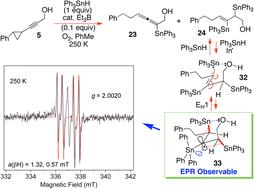
(±)-trans-3-(2-Phenylcyclopropyl)prop-2-yn-1-ol () undergoes O-directed rt free radical hydrostannation with 2 equiv. of Bu3SnH or Ph3SnH in PhMe to produce the α-cyclopropyl-β-stannylvinyl radicals and , which rapidly ring-open to give the benzylic stannylhomoallenyl radicals and . These, in turn, react with the excess stannane that is present to provide and as primary reaction products. The triphenylstannylallene also undergoes a competitive Ph3Sn˙ addition to its central allene carbon. This affords the allylically-stabilised radical , which itself reacts with the stannane to produce (Z)-6-phenyl-2,3-bis(triphenylstannyl)hex-3-en-1-ol (). EPR studies of the reaction of with Ph3SnH (1 equiv.) and cat. Et3B/O2 in PhMe at 250 K have failed to identify the radicals and in the reaction mixtures. Rather, a sharp dd is always observed whose multiplicity is consistent with it being the tris-Ph3Sn-stabilised free radical . The latter is suggested to arise from a reversible O-directed Ph3Sn˙ addition to . The radical has 1Hβ values of 1.32 mT (13.2 G) and 0.57 mT (5.7 G) and a g of 2.0020.
期刊介绍:
Organic & Biomolecular Chemistry is an international journal using integrated research in chemistry-organic chemistry. Founded in 2003 by the Royal Society of Chemistry, the journal is published in Semimonthly issues and has been indexed by SCIE, a leading international database. The journal focuses on the key research and cutting-edge progress in the field of chemistry-organic chemistry, publishes and reports the research results in this field in a timely manner, and is committed to becoming a window and platform for rapid academic exchanges among peers in this field. The journal's impact factor in 2023 is 2.9, and its CiteScore is 5.5.



 京公网安备 11010802042870号
京ICP备2023020795号-1
京公网安备 11010802042870号
京ICP备2023020795号-1

 分享
分享
 求助内容:
求助内容: 应助结果提醒方式:
 扫码关注我们
