Do Duc Anh, Lara Vugrek, Nguyen Trong The, Nourhane Hafza, Truong Nhat My, Le Thi Kieu Linh, Do Huy Loc, Jonas Schmidt-Chanasit, Nguyen Linh Toan, Peter G Kremsner, Le Huu Song, Thirumalaisamy P Velavan
{"title":"Characterization of dengue patients in Vietnam: Clinical, virological, and IL-10 profiles during 2021- 2022 outbreaks.","authors":"Do Duc Anh, Lara Vugrek, Nguyen Trong The, Nourhane Hafza, Truong Nhat My, Le Thi Kieu Linh, Do Huy Loc, Jonas Schmidt-Chanasit, Nguyen Linh Toan, Peter G Kremsner, Le Huu Song, Thirumalaisamy P Velavan","doi":"10.1371/journal.pntd.0012954","DOIUrl":null,"url":null,"abstract":"<p><strong>Background: </strong>The pathogenesis of dengue is attributed to a complex interaction between the dengue virus (DENV) and the host immune system. The aim of this study is to investigate the clinical, virological, and Interleukin-10 (IL-10) profiles of dengue patients in Vietnam from two consecutive outbreaks in 2021 and 2022.</p><p><strong>Methods: </strong>A total of n=306 dengue patients were examined, who were clinically stratified according to dengue without warning signs (DF; n=178), dengue with warning signs (DWS; n=115) and severe dengue (SD; n=13). Patients were screened for dengue, Zika and chikungunya viruses. DENV were subjected to serotype specific real-time RT-PCR. Interleukin-10 (IL-10) levels were measured by ELISA, and IL-10 promoter variants (-1082G/A; -819C/T; -592C/A) were genotyped by direct Sanger sequencing to determine a possible association with susceptibility to dengue and disease severity.</p><p><strong>Results: </strong>No chikungunya or Zika viruses were detected. Patients were infected by one of the three different DENV serotypes (DENV-1, -2, -4). Plasma IL-10 levels were significantly elevated in patients (DF vs. DWS, p=0.004; DF vs. SD, p=0.001; DWS vs. SD, p=0.015). While the IL-10 allele -819C contributed to an increased risk of dengue (OR = 1.5, 95% CI = 1.1-2.0, p=0.04), genotype -1082GA showed a protective role against the disease (OR = 0.45, 95% CI = 0.27-0.72, p=0.009), and allele -1082G showed a protective role against DWS (OR = 0.44, 95% CI = 0.22-0.81, p=0.049). Also, the IL-10 GTA (-1082G/-819T/-592A) haplotype was observed to confer protection (OR = 0.31, 95% CI = 0.14-0.67, p< 0.003).</p><p><strong>Conclusion: </strong>While DENV-1 and DENV-2 were the predominant serotypes in circulation, plasma IL-10 levels and IL-10 promoter variants were also significantly associated with dengue and its severity.</p>","PeriodicalId":49000,"journal":{"name":"PLoS Neglected Tropical Diseases","volume":"19 3","pages":"e0012954"},"PeriodicalIF":3.4000,"publicationDate":"2025-03-28","publicationTypes":"Journal Article","fieldsOfStudy":null,"isOpenAccess":false,"openAccessPdf":"https://www.ncbi.nlm.nih.gov/pmc/articles/PMC11977983/pdf/","citationCount":"0","resultStr":null,"platform":"Semanticscholar","paperid":null,"PeriodicalName":"PLoS Neglected Tropical Diseases","FirstCategoryId":"3","ListUrlMain":"https://doi.org/10.1371/journal.pntd.0012954","RegionNum":2,"RegionCategory":"医学","ArticlePicture":[],"TitleCN":null,"AbstractTextCN":null,"PMCID":null,"EPubDate":"2025/3/1 0:00:00","PubModel":"eCollection","JCR":"Q1","JCRName":"PARASITOLOGY","Score":null,"Total":0}
引用次数: 0
Abstract
Background: The pathogenesis of dengue is attributed to a complex interaction between the dengue virus (DENV) and the host immune system. The aim of this study is to investigate the clinical, virological, and Interleukin-10 (IL-10) profiles of dengue patients in Vietnam from two consecutive outbreaks in 2021 and 2022.
Methods: A total of n=306 dengue patients were examined, who were clinically stratified according to dengue without warning signs (DF; n=178), dengue with warning signs (DWS; n=115) and severe dengue (SD; n=13). Patients were screened for dengue, Zika and chikungunya viruses. DENV were subjected to serotype specific real-time RT-PCR. Interleukin-10 (IL-10) levels were measured by ELISA, and IL-10 promoter variants (-1082G/A; -819C/T; -592C/A) were genotyped by direct Sanger sequencing to determine a possible association with susceptibility to dengue and disease severity.
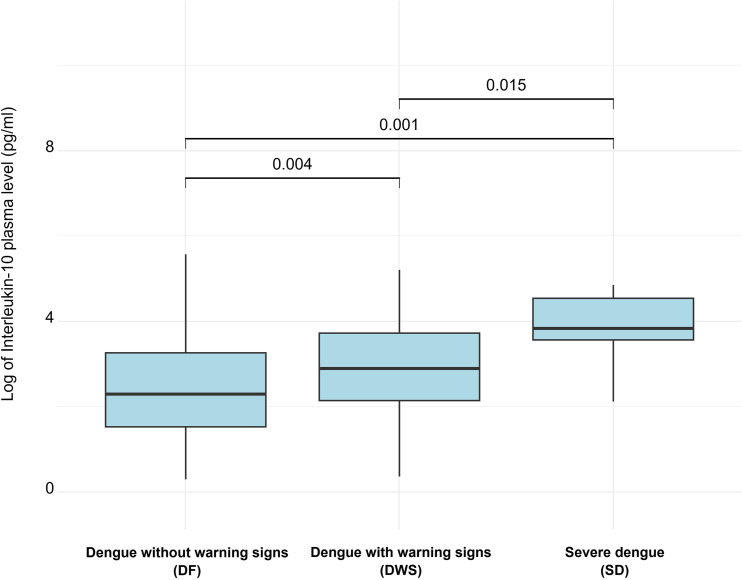
Results: No chikungunya or Zika viruses were detected. Patients were infected by one of the three different DENV serotypes (DENV-1, -2, -4). Plasma IL-10 levels were significantly elevated in patients (DF vs. DWS, p=0.004; DF vs. SD, p=0.001; DWS vs. SD, p=0.015). While the IL-10 allele -819C contributed to an increased risk of dengue (OR = 1.5, 95% CI = 1.1-2.0, p=0.04), genotype -1082GA showed a protective role against the disease (OR = 0.45, 95% CI = 0.27-0.72, p=0.009), and allele -1082G showed a protective role against DWS (OR = 0.44, 95% CI = 0.22-0.81, p=0.049). Also, the IL-10 GTA (-1082G/-819T/-592A) haplotype was observed to confer protection (OR = 0.31, 95% CI = 0.14-0.67, p< 0.003).
Conclusion: While DENV-1 and DENV-2 were the predominant serotypes in circulation, plasma IL-10 levels and IL-10 promoter variants were also significantly associated with dengue and its severity.
期刊介绍:
PLOS Neglected Tropical Diseases publishes research devoted to the pathology, epidemiology, prevention, treatment and control of the neglected tropical diseases (NTDs), as well as relevant public policy.
The NTDs are defined as a group of poverty-promoting chronic infectious diseases, which primarily occur in rural areas and poor urban areas of low-income and middle-income countries. Their impact on child health and development, pregnancy, and worker productivity, as well as their stigmatizing features limit economic stability.
All aspects of these diseases are considered, including:
Pathogenesis
Clinical features
Pharmacology and treatment
Diagnosis
Epidemiology
Vector biology
Vaccinology and prevention
Demographic, ecological and social determinants
Public health and policy aspects (including cost-effectiveness analyses).




 京公网安备 11010802042870号
京ICP备2023020795号-1
京公网安备 11010802042870号
京ICP备2023020795号-1

 分享
分享
 求助内容:
求助内容: 应助结果提醒方式:
 扫码关注我们
