Yannick Niamsi-Emalio, Hugues C Nana-Djeunga, Claudio Fronterrè, Himal Shrestha, Georges B Nko'Ayissi, Théophile M Mpaba Minkat, Joseph Kamgno, María-Gloria Basáñez
{"title":"Model-Based Geostatistical Mapping of the Prevalence of Onchocerca volvulus in Cameroon between 1971 and 2020.","authors":"Yannick Niamsi-Emalio, Hugues C Nana-Djeunga, Claudio Fronterrè, Himal Shrestha, Georges B Nko'Ayissi, Théophile M Mpaba Minkat, Joseph Kamgno, María-Gloria Basáñez","doi":"10.1371/journal.pntd.0012250","DOIUrl":null,"url":null,"abstract":"<p><strong>Background: </strong>After the closure of the African Programme for Onchocerciasis Control (APOC) in 2015, the Ministry of Public Health of Cameroon has continued implementing annual community-directed treatment with ivermectin (CDTI) in endemic areas. The World Health Organization has proposed that 12 countries be verified for elimination (interruption) of transmission by 2030. Using Rapid Epidemiological Mapping of Onchocerciasis, a baseline geostatistical map of nodule (onchocercoma) prevalence had been generated for APOC countries, indicating high initial endemicity in most regions of Cameroon. After more than two decades of CDTI, infection prevalence remains high in some areas. This study aimed at mapping the spatio-temporal evolution of Onchocerca volvulus prevalence from 1971 to 2020 to: i) identify such areas; ii) indicate where alternative and complementary interventions are most needed to accelerate elimination, and iii) improve the projections of transmission models.</p><p><strong>Methodology: </strong>A total of 1,404 georeferenced (village-level) prevalence surveys were obtained from published articles; the Expanded Special Project for Elimination of Neglected Tropical Diseases portal for Cameroon; independent researchers and grey literature. These data were used together with bioclimatic layers to generate model-based geostatistical (MBG) maps of microfilarial prevalence for 1971-2000; 2001-2010 and 2011-2020.</p><p><strong>Principal findings: </strong>Time-period was negatively and statistically significantly associated with prevalence. In 1971-2000 and 2001-2010, prevalence levels were high in most regions and ≥60% in some areas. Mean predicted prevalence declined in 2011-2020, reaching <20% in most areas, but data for this period were sparse, leading to substantial uncertainty. Hotspots were identified in South West, Littoral and Centre regions.</p><p><strong>Conclusions/significance: </strong>Our results are broadly consistent with recent MBG studies and can be used to intensify onchocerciasis control and elimination efforts in areas with persisting transmission, providing spatio-temporal prevalence trends to which transmission models can be fitted to improve projections of onchocerciasis elimination by 2030 and beyond.</p>","PeriodicalId":49000,"journal":{"name":"PLoS Neglected Tropical Diseases","volume":"19 3","pages":"e0012250"},"PeriodicalIF":3.4000,"publicationDate":"2025-03-28","publicationTypes":"Journal Article","fieldsOfStudy":null,"isOpenAccess":false,"openAccessPdf":"https://www.ncbi.nlm.nih.gov/pmc/articles/PMC11978065/pdf/","citationCount":"0","resultStr":null,"platform":"Semanticscholar","paperid":null,"PeriodicalName":"PLoS Neglected Tropical Diseases","FirstCategoryId":"3","ListUrlMain":"https://doi.org/10.1371/journal.pntd.0012250","RegionNum":2,"RegionCategory":"医学","ArticlePicture":[],"TitleCN":null,"AbstractTextCN":null,"PMCID":null,"EPubDate":"2025/3/1 0:00:00","PubModel":"eCollection","JCR":"Q1","JCRName":"PARASITOLOGY","Score":null,"Total":0}
引用次数: 0
Abstract
Background: After the closure of the African Programme for Onchocerciasis Control (APOC) in 2015, the Ministry of Public Health of Cameroon has continued implementing annual community-directed treatment with ivermectin (CDTI) in endemic areas. The World Health Organization has proposed that 12 countries be verified for elimination (interruption) of transmission by 2030. Using Rapid Epidemiological Mapping of Onchocerciasis, a baseline geostatistical map of nodule (onchocercoma) prevalence had been generated for APOC countries, indicating high initial endemicity in most regions of Cameroon. After more than two decades of CDTI, infection prevalence remains high in some areas. This study aimed at mapping the spatio-temporal evolution of Onchocerca volvulus prevalence from 1971 to 2020 to: i) identify such areas; ii) indicate where alternative and complementary interventions are most needed to accelerate elimination, and iii) improve the projections of transmission models.
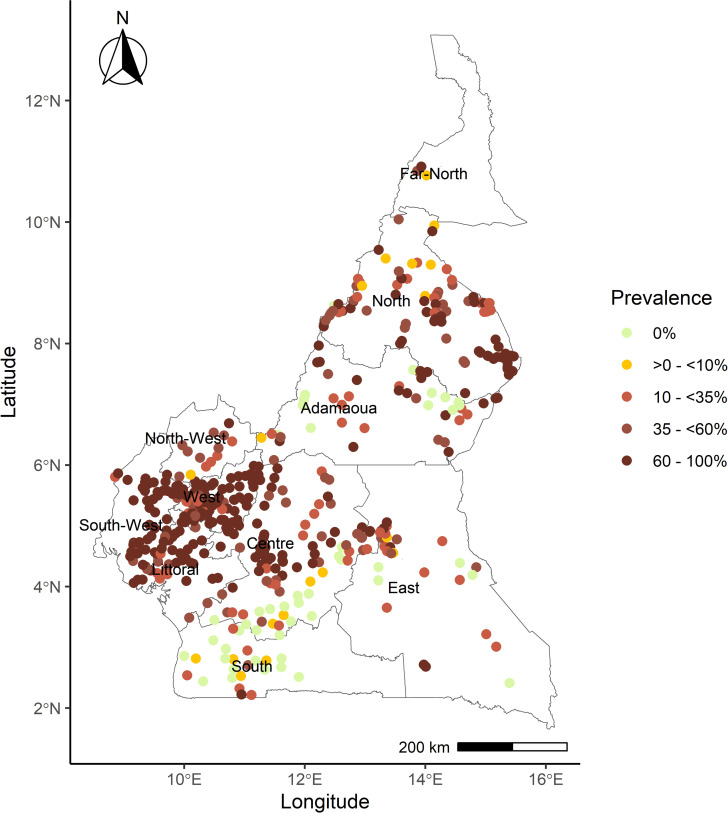
Methodology: A total of 1,404 georeferenced (village-level) prevalence surveys were obtained from published articles; the Expanded Special Project for Elimination of Neglected Tropical Diseases portal for Cameroon; independent researchers and grey literature. These data were used together with bioclimatic layers to generate model-based geostatistical (MBG) maps of microfilarial prevalence for 1971-2000; 2001-2010 and 2011-2020.
Principal findings: Time-period was negatively and statistically significantly associated with prevalence. In 1971-2000 and 2001-2010, prevalence levels were high in most regions and ≥60% in some areas. Mean predicted prevalence declined in 2011-2020, reaching <20% in most areas, but data for this period were sparse, leading to substantial uncertainty. Hotspots were identified in South West, Littoral and Centre regions.
Conclusions/significance: Our results are broadly consistent with recent MBG studies and can be used to intensify onchocerciasis control and elimination efforts in areas with persisting transmission, providing spatio-temporal prevalence trends to which transmission models can be fitted to improve projections of onchocerciasis elimination by 2030 and beyond.
期刊介绍:
PLOS Neglected Tropical Diseases publishes research devoted to the pathology, epidemiology, prevention, treatment and control of the neglected tropical diseases (NTDs), as well as relevant public policy.
The NTDs are defined as a group of poverty-promoting chronic infectious diseases, which primarily occur in rural areas and poor urban areas of low-income and middle-income countries. Their impact on child health and development, pregnancy, and worker productivity, as well as their stigmatizing features limit economic stability.
All aspects of these diseases are considered, including:
Pathogenesis
Clinical features
Pharmacology and treatment
Diagnosis
Epidemiology
Vector biology
Vaccinology and prevention
Demographic, ecological and social determinants
Public health and policy aspects (including cost-effectiveness analyses).





 京公网安备 11010802042870号
京ICP备2023020795号-1
京公网安备 11010802042870号
京ICP备2023020795号-1

 分享
分享
 求助内容:
求助内容: 应助结果提醒方式:
 扫码关注我们
