Rodrigo Torrão Victor, Syed Hamza Safeer, John F. R. Marroquin, Marcio Costa, Jorlandio F. Felix, Victor Carozo, Luiz C. Sampaio, Flavio Garcia
{"title":"Disentangling edge and bulk spin-to-charge interconversion in MoS2 monolayer flakes","authors":"Rodrigo Torrão Victor, Syed Hamza Safeer, John F. R. Marroquin, Marcio Costa, Jorlandio F. Felix, Victor Carozo, Luiz C. Sampaio, Flavio Garcia","doi":"10.1038/s41467-025-58119-4","DOIUrl":null,"url":null,"abstract":"<p>Semiconductor transition metal dichalcogenides are an archetype for spintronic devices due to their spin-to-charge interconversion mechanisms. However, the exact microscopic origin of this interconversion is not yet determined. In our study, we investigated light-induced spin pumping in YIG/MoS<sub>2</sub> heterostructures. Our findings revealed that the MoS<sub>2</sub> monolayer microsized flakes contribute to spin current injection through two distinct mechanisms: metallic edge states and semiconductor area states. The competition between these mechanisms, influenced by the flake size, leads to different behaviors of spin-pumping. Our calculations of the local density of states, by means of density functional theory, of a flake show that light-driven spin current injection can be controlled based on the intensity of light with a suitable wavelength. We demonstrate that a lightdriven spin current injection can enhance up to very high values, attenuate, or even switch on/off the spin-to-charge interconversion. These results hold promise for developing low energy-consuming opto-spintronic device applications.</p>","PeriodicalId":19066,"journal":{"name":"Nature Communications","volume":"4 1","pages":""},"PeriodicalIF":15.7000,"publicationDate":"2025-03-30","publicationTypes":"Journal Article","fieldsOfStudy":null,"isOpenAccess":false,"openAccessPdf":"","citationCount":"0","resultStr":null,"platform":"Semanticscholar","paperid":null,"PeriodicalName":"Nature Communications","FirstCategoryId":"103","ListUrlMain":"https://doi.org/10.1038/s41467-025-58119-4","RegionNum":1,"RegionCategory":"综合性期刊","ArticlePicture":[],"TitleCN":null,"AbstractTextCN":null,"PMCID":null,"EPubDate":"","PubModel":"","JCR":"Q1","JCRName":"MULTIDISCIPLINARY SCIENCES","Score":null,"Total":0}
引用次数: 0
Abstract
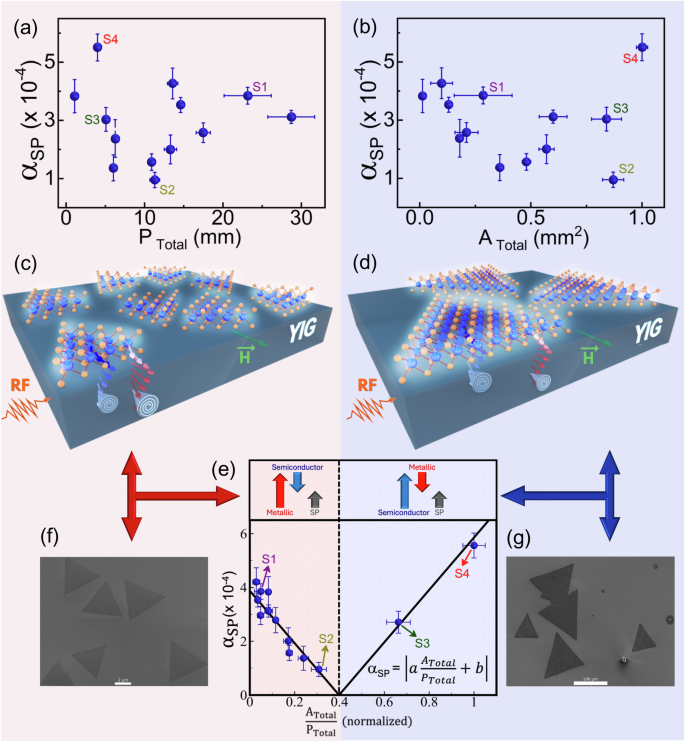
Semiconductor transition metal dichalcogenides are an archetype for spintronic devices due to their spin-to-charge interconversion mechanisms. However, the exact microscopic origin of this interconversion is not yet determined. In our study, we investigated light-induced spin pumping in YIG/MoS2 heterostructures. Our findings revealed that the MoS2 monolayer microsized flakes contribute to spin current injection through two distinct mechanisms: metallic edge states and semiconductor area states. The competition between these mechanisms, influenced by the flake size, leads to different behaviors of spin-pumping. Our calculations of the local density of states, by means of density functional theory, of a flake show that light-driven spin current injection can be controlled based on the intensity of light with a suitable wavelength. We demonstrate that a lightdriven spin current injection can enhance up to very high values, attenuate, or even switch on/off the spin-to-charge interconversion. These results hold promise for developing low energy-consuming opto-spintronic device applications.
期刊介绍:
Nature Communications, an open-access journal, publishes high-quality research spanning all areas of the natural sciences. Papers featured in the journal showcase significant advances relevant to specialists in each respective field. With a 2-year impact factor of 16.6 (2022) and a median time of 8 days from submission to the first editorial decision, Nature Communications is committed to rapid dissemination of research findings. As a multidisciplinary journal, it welcomes contributions from biological, health, physical, chemical, Earth, social, mathematical, applied, and engineering sciences, aiming to highlight important breakthroughs within each domain.



 京公网安备 11010802042870号
京ICP备2023020795号-1
京公网安备 11010802042870号
京ICP备2023020795号-1

 分享
分享
 求助内容:
求助内容: 应助结果提醒方式:
 扫码关注我们
