Jan Philipp Dobert, Jan-Hannes Schäfer, Thomas Dal Maso, Priyadarshini Ravindran, Dustin J. E. Huard, Eileen Socher, Lisa A. Schildmeyer, Raquel L. Lieberman, Wim Versées, Arne Moeller, Friederike Zunke, Philipp Arnold
{"title":"Cryo-TEM structure of β-glucocerebrosidase in complex with its transporter LIMP-2","authors":"Jan Philipp Dobert, Jan-Hannes Schäfer, Thomas Dal Maso, Priyadarshini Ravindran, Dustin J. E. Huard, Eileen Socher, Lisa A. Schildmeyer, Raquel L. Lieberman, Wim Versées, Arne Moeller, Friederike Zunke, Philipp Arnold","doi":"10.1038/s41467-025-58340-1","DOIUrl":null,"url":null,"abstract":"<p>Targeting proteins to their final cellular destination requires transport mechanisms and nearly all lysosomal enzymes reach the lysosome via the mannose-6-phosphate receptor pathway. One of the few known exceptions is the enzyme β-glucocerebrosidase (GCase) that requires the lysosomal integral membrane protein type-2 (LIMP-2) as a proprietary lysosomal transporter. Genetic variations in the GCase encoding gene GBA1 cause Gaucher’s disease (GD) and present the highest genetic risk factor to develop Parkinson’s disease (PD). Activators targeting GCase emerge as a promising therapeutic approach to treat GD and PD, with pre-clinical and clinical trials ongoing. In this study, we resolve the complex of GCase and LIMP-2 using cryo-electron microscopy with the aid of an engineered LIMP-2 shuttle and two GCase-targeted pro-macrobodies. We identify helix 5 and helix 7 of LIMP-2 to interact with a binding pocket in GCase, forming a mostly hydrophobic interaction interface supported by one essential salt bridge. Understanding the interplay of GCase and LIMP-2 on a structural level is crucial to identify potential activation sites and conceptualizing novel therapeutic approaches targeting GCase. Here, we unveil the protein structure of a mannose-6-phosphate-independent lysosomal transport complex and provide fundamental knowledge for translational clinical research to overcome GD and PD.</p>","PeriodicalId":19066,"journal":{"name":"Nature Communications","volume":"37 1","pages":""},"PeriodicalIF":15.7000,"publicationDate":"2025-03-30","publicationTypes":"Journal Article","fieldsOfStudy":null,"isOpenAccess":false,"openAccessPdf":"","citationCount":"0","resultStr":null,"platform":"Semanticscholar","paperid":null,"PeriodicalName":"Nature Communications","FirstCategoryId":"103","ListUrlMain":"https://doi.org/10.1038/s41467-025-58340-1","RegionNum":1,"RegionCategory":"综合性期刊","ArticlePicture":[],"TitleCN":null,"AbstractTextCN":null,"PMCID":null,"EPubDate":"","PubModel":"","JCR":"Q1","JCRName":"MULTIDISCIPLINARY SCIENCES","Score":null,"Total":0}
引用次数: 0
Abstract
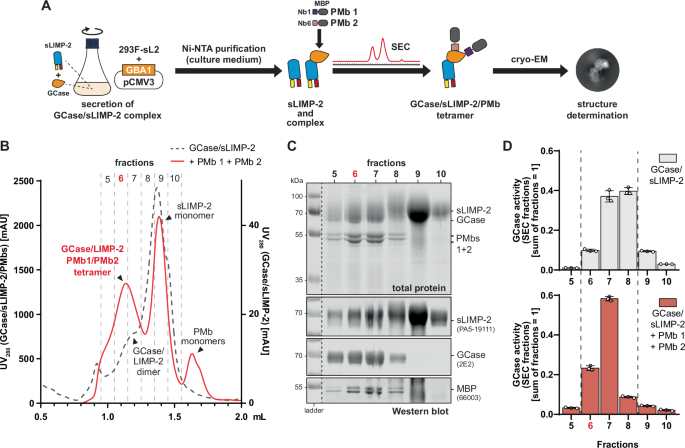
Targeting proteins to their final cellular destination requires transport mechanisms and nearly all lysosomal enzymes reach the lysosome via the mannose-6-phosphate receptor pathway. One of the few known exceptions is the enzyme β-glucocerebrosidase (GCase) that requires the lysosomal integral membrane protein type-2 (LIMP-2) as a proprietary lysosomal transporter. Genetic variations in the GCase encoding gene GBA1 cause Gaucher’s disease (GD) and present the highest genetic risk factor to develop Parkinson’s disease (PD). Activators targeting GCase emerge as a promising therapeutic approach to treat GD and PD, with pre-clinical and clinical trials ongoing. In this study, we resolve the complex of GCase and LIMP-2 using cryo-electron microscopy with the aid of an engineered LIMP-2 shuttle and two GCase-targeted pro-macrobodies. We identify helix 5 and helix 7 of LIMP-2 to interact with a binding pocket in GCase, forming a mostly hydrophobic interaction interface supported by one essential salt bridge. Understanding the interplay of GCase and LIMP-2 on a structural level is crucial to identify potential activation sites and conceptualizing novel therapeutic approaches targeting GCase. Here, we unveil the protein structure of a mannose-6-phosphate-independent lysosomal transport complex and provide fundamental knowledge for translational clinical research to overcome GD and PD.
期刊介绍:
Nature Communications, an open-access journal, publishes high-quality research spanning all areas of the natural sciences. Papers featured in the journal showcase significant advances relevant to specialists in each respective field. With a 2-year impact factor of 16.6 (2022) and a median time of 8 days from submission to the first editorial decision, Nature Communications is committed to rapid dissemination of research findings. As a multidisciplinary journal, it welcomes contributions from biological, health, physical, chemical, Earth, social, mathematical, applied, and engineering sciences, aiming to highlight important breakthroughs within each domain.



 京公网安备 11010802042870号
京ICP备2023020795号-1
京公网安备 11010802042870号
京ICP备2023020795号-1

 分享
分享
 求助内容:
求助内容: 应助结果提醒方式:
 扫码关注我们
