Jun Ma, Keke Mao, Jiayi Li, Guangyao Zhai, Di Wu, Dong Liu, Ran Long, Yujie Xiong
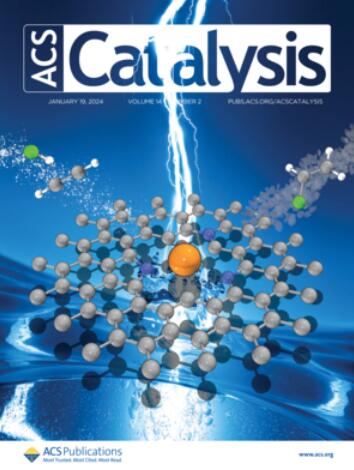
{"title":"Modulating Chloride Adsorption for Efficient Chloride-Mediated Methane Conversion over Tungsten Oxide Photoanode","authors":"Jun Ma, Keke Mao, Jiayi Li, Guangyao Zhai, Di Wu, Dong Liu, Ran Long, Yujie Xiong","doi":"10.1021/acscatal.4c07046","DOIUrl":null,"url":null,"abstract":"Utilizing alkali chlorides as the chloride source in chloride-mediated methane activation represents an efficient approach for CH<sub>4</sub> valorization. Nevertheless, great challenges remain due to the restricted catalytic activity and durability. Here, we present a photoelectrochemical approach for chloride-mediated methane conversion to C<sub>1</sub> products using WO<sub>3</sub> with surface oxygen vacancies (OV). Theoretical calculations indicate that oxygen vacancies play a crucial role in enhancing chloride adsorption to facilitate methane activation. The engineered WO<sub>3</sub>–OV photoanode exhibits enhanced catalytic performance in comparison to the pristine counterparts, attaining a Faradaic efficiency of 94.5% for C<sub>1</sub> products (methyl chloride, methanol, formic acid, and formaldehyde) at 0.9 V vs RHE. This performance corresponds to a total production rate of 139.2 mmol g<sup>–1</sup> h<sup>–1</sup> for the C<sub>1</sub> products. Furthermore, the system is capable of achieving a high CH<sub>4</sub> conversion efficiency of 11.8%. This work emphasizes the pivotal role of photoanode design and surface engineering in facilitating methane conversion.","PeriodicalId":9,"journal":{"name":"ACS Catalysis ","volume":"31 1","pages":"6058-6066"},"PeriodicalIF":13.1000,"publicationDate":"2025-03-30","publicationTypes":"Journal Article","fieldsOfStudy":null,"isOpenAccess":false,"openAccessPdf":"","citationCount":"0","resultStr":null,"platform":"Semanticscholar","paperid":null,"PeriodicalName":"ACS Catalysis ","FirstCategoryId":"92","ListUrlMain":"https://doi.org/10.1021/acscatal.4c07046","RegionNum":1,"RegionCategory":"化学","ArticlePicture":[],"TitleCN":null,"AbstractTextCN":null,"PMCID":null,"EPubDate":"","PubModel":"","JCR":"Q1","JCRName":"CHEMISTRY, PHYSICAL","Score":null,"Total":0}
引用次数: 0
Abstract
Utilizing alkali chlorides as the chloride source in chloride-mediated methane activation represents an efficient approach for CH4 valorization. Nevertheless, great challenges remain due to the restricted catalytic activity and durability. Here, we present a photoelectrochemical approach for chloride-mediated methane conversion to C1 products using WO3 with surface oxygen vacancies (OV). Theoretical calculations indicate that oxygen vacancies play a crucial role in enhancing chloride adsorption to facilitate methane activation. The engineered WO3–OV photoanode exhibits enhanced catalytic performance in comparison to the pristine counterparts, attaining a Faradaic efficiency of 94.5% for C1 products (methyl chloride, methanol, formic acid, and formaldehyde) at 0.9 V vs RHE. This performance corresponds to a total production rate of 139.2 mmol g–1 h–1 for the C1 products. Furthermore, the system is capable of achieving a high CH4 conversion efficiency of 11.8%. This work emphasizes the pivotal role of photoanode design and surface engineering in facilitating methane conversion.
利用碱氯化物作为氯化物源进行氯化物介导的甲烷活化是一种有效的甲烷活化途径。然而,由于催化活性和耐久性的限制,仍然存在很大的挑战。在这里,我们提出了一种利用表面氧空位(OV)的WO3将氯化物介导的甲烷转化为C1产物的光电化学方法。理论计算表明,氧空位在增强氯化物吸附以促进甲烷活化方面起着至关重要的作用。与原始的WO3-OV光阳极相比,工程WO3-OV光阳极表现出更强的催化性能,在0.9 V vs RHE下,对C1产物(氯甲烷、甲醇、甲酸和甲醛)的法拉第效率达到94.5%。这一性能对应于C1产品的总生产速率为139.2 mmol g-1 h-1。此外,该系统能够实现高达11.8%的CH4转化效率。这项工作强调了光阳极设计和表面工程在促进甲烷转化中的关键作用。
期刊介绍:
ACS Catalysis is an esteemed journal that publishes original research in the fields of heterogeneous catalysis, molecular catalysis, and biocatalysis. It offers broad coverage across diverse areas such as life sciences, organometallics and synthesis, photochemistry and electrochemistry, drug discovery and synthesis, materials science, environmental protection, polymer discovery and synthesis, and energy and fuels.
The scope of the journal is to showcase innovative work in various aspects of catalysis. This includes new reactions and novel synthetic approaches utilizing known catalysts, the discovery or modification of new catalysts, elucidation of catalytic mechanisms through cutting-edge investigations, practical enhancements of existing processes, as well as conceptual advances in the field. Contributions to ACS Catalysis can encompass both experimental and theoretical research focused on catalytic molecules, macromolecules, and materials that exhibit catalytic turnover.




 京公网安备 11010802042870号
京ICP备2023020795号-1
京公网安备 11010802042870号
京ICP备2023020795号-1

 分享
分享
 求助内容:
求助内容: 应助结果提醒方式:
 扫码关注我们
