Effect of air frying on in vitro digestion and transport properties of scallop (Patinopecten yessoensis) adductor muscles: Insights from peptidomics analyses
{"title":"Effect of air frying on in vitro digestion and transport properties of scallop (Patinopecten yessoensis) adductor muscles: Insights from peptidomics analyses","authors":"Zi-Ye Wang, Qian Wang, De-Yang Li, Yu-Xin Liu, Lei Qin, Peng-Fei Jiang, Da-Yong Zhou","doi":"10.1016/j.foodchem.2025.144135","DOIUrl":null,"url":null,"abstract":"<div><div>The fresh and air-fried scallop adductor muscles (SAM) were subjected to simulate gastrointestinal digestion. Peptidomics technology using LC-MS/MS determined 1920, 2288, 1870 peptides (tripeptides and above) in digestive products from fresh, 160 °C-, and 200 °C-heated groups, with the 160 °C-heated group having more tripeptides. By contrast, the main parent proteins such as myosin heavy chain, actin and paramyosin in 160 °C-heated group released more peptides. Moreover, the oxidative modification such as S-oxidation, carbonylation and deamidation caused by heat treatment was found in digestive peptides, and the oxidative level was positively correlated with air-fried temperature. The everted-rat-gut sacs experiment exhibited that the protein digestive products from 160 °C-heated group exhibited higher transport levels, manifested by higher transport kinetics parameters of peptides and amino acids transport rates. These findings suggested that the primary factor influencing the transport of SAM protein digestive products was their digestion degree rather than their oxidation degree.</div></div>","PeriodicalId":318,"journal":{"name":"Food Chemistry","volume":"481 ","pages":"Article 144135"},"PeriodicalIF":9.8000,"publicationDate":"2025-03-30","publicationTypes":"Journal Article","fieldsOfStudy":null,"isOpenAccess":false,"openAccessPdf":"","citationCount":"0","resultStr":null,"platform":"Semanticscholar","paperid":null,"PeriodicalName":"Food Chemistry","FirstCategoryId":"97","ListUrlMain":"https://www.sciencedirect.com/science/article/pii/S030881462501386X","RegionNum":1,"RegionCategory":"农林科学","ArticlePicture":[],"TitleCN":null,"AbstractTextCN":null,"PMCID":null,"EPubDate":"","PubModel":"","JCR":"Q1","JCRName":"CHEMISTRY, APPLIED","Score":null,"Total":0}
引用次数: 0
Abstract
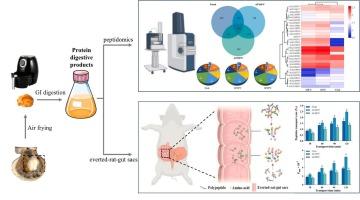
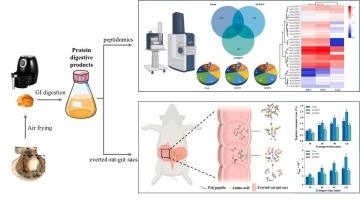
The fresh and air-fried scallop adductor muscles (SAM) were subjected to simulate gastrointestinal digestion. Peptidomics technology using LC-MS/MS determined 1920, 2288, 1870 peptides (tripeptides and above) in digestive products from fresh, 160 °C-, and 200 °C-heated groups, with the 160 °C-heated group having more tripeptides. By contrast, the main parent proteins such as myosin heavy chain, actin and paramyosin in 160 °C-heated group released more peptides. Moreover, the oxidative modification such as S-oxidation, carbonylation and deamidation caused by heat treatment was found in digestive peptides, and the oxidative level was positively correlated with air-fried temperature. The everted-rat-gut sacs experiment exhibited that the protein digestive products from 160 °C-heated group exhibited higher transport levels, manifested by higher transport kinetics parameters of peptides and amino acids transport rates. These findings suggested that the primary factor influencing the transport of SAM protein digestive products was their digestion degree rather than their oxidation degree.
期刊介绍:
Food Chemistry publishes original research papers dealing with the advancement of the chemistry and biochemistry of foods or the analytical methods/ approach used. All papers should focus on the novelty of the research carried out.



 京公网安备 11010802042870号
京ICP备2023020795号-1
京公网安备 11010802042870号
京ICP备2023020795号-1

 分享
分享
 求助内容:
求助内容: 应助结果提醒方式:
 扫码关注我们
