Shi-Qian Bian, Zikai Wang, Jin-Song Gong, Chang Su, Heng Li, Zheng-Hong Xu, Jin-Song Shi
{"title":"Enhancing the Substrate Specificity of Nitrilase toward Aliphatic Nitriles Based on Substrate Channel Design","authors":"Shi-Qian Bian, Zikai Wang, Jin-Song Gong, Chang Su, Heng Li, Zheng-Hong Xu, Jin-Song Shi","doi":"10.1021/acssuschemeng.5c00435","DOIUrl":null,"url":null,"abstract":"Nitrilase has attracted widespread attention due to its efficiency, specificity, and ecofriendliness in the hydrolysis reactions of nitrile compounds. These enzymes can catalyze various substrates, including aliphatic nitriles and aromatic nitriles. However, high substrate specificity is key to efficient catalysis and high-purity product synthesis. This study aims to enhance the preference of nitrilase for aliphatic nitriles through substrate channel engineering to expand its industrial applications. We developed a semirational design workflow that integrates extensive search and deep optimization strategies, relying on computational tools such as substrate channel modeling and molecular docking to systematically identify and optimize key amino acid residues related to substrate binding. Taking 3-chloropropionitrile as an example, the specific activity of the optimal mutant G191A/L194W increased from 2.47 to 58.35 U·mg<sup>–1</sup>, with the substrate conversion rate approaching 100%, while the catalytic activity toward aromatic nitriles significantly decreased. Molecular dynamics simulations revealed the correlation between substrate specificity and channel morphology regulated by W194 and promoted the formation of a specificity-enhanced mutant network. This study provides a structural and mechanistic basis for substrate channel design and enzyme function modification and validates its potential for industrial applications.","PeriodicalId":25,"journal":{"name":"ACS Sustainable Chemistry & Engineering","volume":"2 1","pages":""},"PeriodicalIF":7.3000,"publicationDate":"2025-03-29","publicationTypes":"Journal Article","fieldsOfStudy":null,"isOpenAccess":false,"openAccessPdf":"","citationCount":"0","resultStr":null,"platform":"Semanticscholar","paperid":null,"PeriodicalName":"ACS Sustainable Chemistry & Engineering","FirstCategoryId":"92","ListUrlMain":"https://doi.org/10.1021/acssuschemeng.5c00435","RegionNum":1,"RegionCategory":"化学","ArticlePicture":[],"TitleCN":null,"AbstractTextCN":null,"PMCID":null,"EPubDate":"","PubModel":"","JCR":"Q1","JCRName":"CHEMISTRY, MULTIDISCIPLINARY","Score":null,"Total":0}
引用次数: 0
Abstract
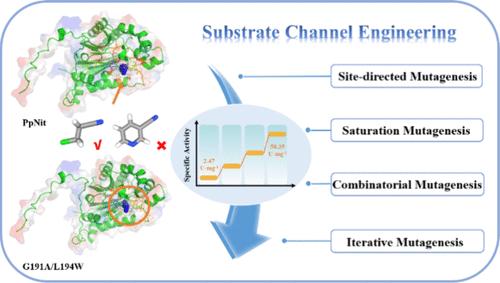
Nitrilase has attracted widespread attention due to its efficiency, specificity, and ecofriendliness in the hydrolysis reactions of nitrile compounds. These enzymes can catalyze various substrates, including aliphatic nitriles and aromatic nitriles. However, high substrate specificity is key to efficient catalysis and high-purity product synthesis. This study aims to enhance the preference of nitrilase for aliphatic nitriles through substrate channel engineering to expand its industrial applications. We developed a semirational design workflow that integrates extensive search and deep optimization strategies, relying on computational tools such as substrate channel modeling and molecular docking to systematically identify and optimize key amino acid residues related to substrate binding. Taking 3-chloropropionitrile as an example, the specific activity of the optimal mutant G191A/L194W increased from 2.47 to 58.35 U·mg–1, with the substrate conversion rate approaching 100%, while the catalytic activity toward aromatic nitriles significantly decreased. Molecular dynamics simulations revealed the correlation between substrate specificity and channel morphology regulated by W194 and promoted the formation of a specificity-enhanced mutant network. This study provides a structural and mechanistic basis for substrate channel design and enzyme function modification and validates its potential for industrial applications.
期刊介绍:
ACS Sustainable Chemistry & Engineering is a prestigious weekly peer-reviewed scientific journal published by the American Chemical Society. Dedicated to advancing the principles of green chemistry and green engineering, it covers a wide array of research topics including green chemistry, green engineering, biomass, alternative energy, and life cycle assessment.
The journal welcomes submissions in various formats, including Letters, Articles, Features, and Perspectives (Reviews), that address the challenges of sustainability in the chemical enterprise and contribute to the advancement of sustainable practices. Join us in shaping the future of sustainable chemistry and engineering.



 京公网安备 11010802042870号
京ICP备2023020795号-1
京公网安备 11010802042870号
京ICP备2023020795号-1

 分享
分享
 求助内容:
求助内容: 应助结果提醒方式:
 扫码关注我们
