Coordination-driven assembly of a ferrocene-functionalized lead iodide framework with enhanced stability and charge transfer for photocatalytic CO2-to-CH3OH conversion†
Jinlin Yin, Yani He, Chen Sun, Yilin Jiang and Honghan Fei
{"title":"Coordination-driven assembly of a ferrocene-functionalized lead iodide framework with enhanced stability and charge transfer for photocatalytic CO2-to-CH3OH conversion†","authors":"Jinlin Yin, Yani He, Chen Sun, Yilin Jiang and Honghan Fei","doi":"10.1039/D4SC08216H","DOIUrl":null,"url":null,"abstract":"<p >Hybrid lead halides are promising photocatalysts due to their high structural tunability and excellent photophysical properties, but their ionic structures suffer from instability in polar environments and suppressed charge transfer between lead halide units and organic components. Herein, we successfully incorporated a ferrocene-based light-harvesting antenna into a lead iodide framework by coordination-driven assembly. The π-conjugated Pb<small><sup>2+</sup></small>-carboxylate linkage affords synergistic interactions between [Pb<small><sub>2</sub></small>I<small><sub>2</sub></small>]<small><sup>2+</sup></small> chains and ferrocene linkers, achieving broad visible absorption up to 612.7 nm and efficient ligand-to-metal charge transfer for spatial charge separation. This ultrastable framework combines strong visible-light absorption of ferrocene centers with excellent charge transport of lead halide units, achieving 6e<small><sup>−</sup></small> CO<small><sub>2</sub></small> photoreduction to CH<small><sub>3</sub></small>OH coupled with ethanol oxidation. Mechanistic studies reveal that ferrocene photoexcitation followed by linker-to-metal charge transfer significantly enhances carrier accumulation, accelerating CH<small><sub>3</sub></small>O* intermediate formation as indicated by <em>in situ</em> spectroscopy and theoretical calculations.</p>","PeriodicalId":9909,"journal":{"name":"Chemical Science","volume":" 19","pages":" 8327-8337"},"PeriodicalIF":7.4000,"publicationDate":"2025-03-31","publicationTypes":"Journal Article","fieldsOfStudy":null,"isOpenAccess":false,"openAccessPdf":"https://pubs.rsc.org/en/content/articlepdf/2025/sc/d4sc08216h?page=search","citationCount":"0","resultStr":null,"platform":"Semanticscholar","paperid":null,"PeriodicalName":"Chemical Science","FirstCategoryId":"92","ListUrlMain":"https://pubs.rsc.org/en/content/articlelanding/2025/sc/d4sc08216h","RegionNum":1,"RegionCategory":"化学","ArticlePicture":[],"TitleCN":null,"AbstractTextCN":null,"PMCID":null,"EPubDate":"","PubModel":"","JCR":"Q1","JCRName":"CHEMISTRY, MULTIDISCIPLINARY","Score":null,"Total":0}
引用次数: 0
Abstract
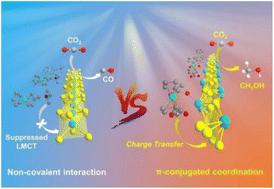
Hybrid lead halides are promising photocatalysts due to their high structural tunability and excellent photophysical properties, but their ionic structures suffer from instability in polar environments and suppressed charge transfer between lead halide units and organic components. Herein, we successfully incorporated a ferrocene-based light-harvesting antenna into a lead iodide framework by coordination-driven assembly. The π-conjugated Pb2+-carboxylate linkage affords synergistic interactions between [Pb2I2]2+ chains and ferrocene linkers, achieving broad visible absorption up to 612.7 nm and efficient ligand-to-metal charge transfer for spatial charge separation. This ultrastable framework combines strong visible-light absorption of ferrocene centers with excellent charge transport of lead halide units, achieving 6e− CO2 photoreduction to CH3OH coupled with ethanol oxidation. Mechanistic studies reveal that ferrocene photoexcitation followed by linker-to-metal charge transfer significantly enhances carrier accumulation, accelerating CH3O* intermediate formation as indicated by in situ spectroscopy and theoretical calculations.
期刊介绍:
Chemical Science is a journal that encompasses various disciplines within the chemical sciences. Its scope includes publishing ground-breaking research with significant implications for its respective field, as well as appealing to a wider audience in related areas. To be considered for publication, articles must showcase innovative and original advances in their field of study and be presented in a manner that is understandable to scientists from diverse backgrounds. However, the journal generally does not publish highly specialized research.




 京公网安备 11010802042870号
京ICP备2023020795号-1
京公网安备 11010802042870号
京ICP备2023020795号-1

 分享
分享
 求助内容:
求助内容: 应助结果提醒方式:
 扫码关注我们
