Isaiah O. Betinol, Aleksandra Demchenko, Jolene P. Reid
{"title":"Evaluating Predictive Accuracy in Asymmetric Catalysis: A Machine Learning Perspective on Local Reaction Space","authors":"Isaiah O. Betinol, Aleksandra Demchenko, Jolene P. Reid","doi":"10.1021/acscatal.5c01051","DOIUrl":null,"url":null,"abstract":"Machine learning (ML) models are increasingly being employed in asymmetric catalysis to predict reaction outcomes and optimize enantioselective processes. Despite the trend of expanding data set sizes to improve model performance, asymmetric catalysis presents unique challenges, including the difficulty of acquiring high-quality experimental data and the often-limited availability of structurally diverse examples. Consequently, rational data set design requires the practitioner to choose whether to collect data that maximizes diversity in the training set or data that maximizes representation around a target prediction. A key challenge in these studies is understanding the role of local reaction space─specifically, how much predictive accuracy is driven by nearest neighbors (structurally and electronically similar data points) and the next-nearest neighbors? This study investigates the predictive power of ML models trained with varying levels of local representation in the reaction space. We provide a framework, a radius-based random forest (RaRF) algorithm, to systematically probe the effects of including diverse reactions dissimilar to a target prediction. We show that when the training set is representative of the target reaction, the gains from increasing data set diversity are modest─typically less than 0.1 kcal/mol in predictive error─and increasing to only 0.5 kcal/mol for extrapolative tests, highlighting the need for targeted data set design. Furthermore, these findings hold even for complex architectures and features. Finally, we demonstrate that a targeted, neighborhood-oriented strategy greatly accelerates the identification of predictive models compared to diversity-driven approaches.","PeriodicalId":9,"journal":{"name":"ACS Catalysis ","volume":"16 1","pages":""},"PeriodicalIF":13.1000,"publicationDate":"2025-03-31","publicationTypes":"Journal Article","fieldsOfStudy":null,"isOpenAccess":false,"openAccessPdf":"","citationCount":"0","resultStr":null,"platform":"Semanticscholar","paperid":null,"PeriodicalName":"ACS Catalysis ","FirstCategoryId":"92","ListUrlMain":"https://doi.org/10.1021/acscatal.5c01051","RegionNum":1,"RegionCategory":"化学","ArticlePicture":[],"TitleCN":null,"AbstractTextCN":null,"PMCID":null,"EPubDate":"","PubModel":"","JCR":"Q1","JCRName":"CHEMISTRY, PHYSICAL","Score":null,"Total":0}
引用次数: 0
Abstract
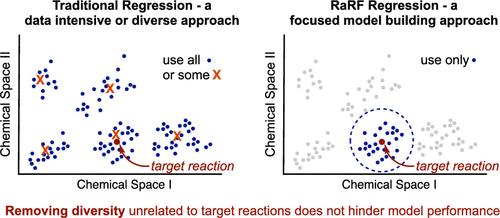
Machine learning (ML) models are increasingly being employed in asymmetric catalysis to predict reaction outcomes and optimize enantioselective processes. Despite the trend of expanding data set sizes to improve model performance, asymmetric catalysis presents unique challenges, including the difficulty of acquiring high-quality experimental data and the often-limited availability of structurally diverse examples. Consequently, rational data set design requires the practitioner to choose whether to collect data that maximizes diversity in the training set or data that maximizes representation around a target prediction. A key challenge in these studies is understanding the role of local reaction space─specifically, how much predictive accuracy is driven by nearest neighbors (structurally and electronically similar data points) and the next-nearest neighbors? This study investigates the predictive power of ML models trained with varying levels of local representation in the reaction space. We provide a framework, a radius-based random forest (RaRF) algorithm, to systematically probe the effects of including diverse reactions dissimilar to a target prediction. We show that when the training set is representative of the target reaction, the gains from increasing data set diversity are modest─typically less than 0.1 kcal/mol in predictive error─and increasing to only 0.5 kcal/mol for extrapolative tests, highlighting the need for targeted data set design. Furthermore, these findings hold even for complex architectures and features. Finally, we demonstrate that a targeted, neighborhood-oriented strategy greatly accelerates the identification of predictive models compared to diversity-driven approaches.
期刊介绍:
ACS Catalysis is an esteemed journal that publishes original research in the fields of heterogeneous catalysis, molecular catalysis, and biocatalysis. It offers broad coverage across diverse areas such as life sciences, organometallics and synthesis, photochemistry and electrochemistry, drug discovery and synthesis, materials science, environmental protection, polymer discovery and synthesis, and energy and fuels.
The scope of the journal is to showcase innovative work in various aspects of catalysis. This includes new reactions and novel synthetic approaches utilizing known catalysts, the discovery or modification of new catalysts, elucidation of catalytic mechanisms through cutting-edge investigations, practical enhancements of existing processes, as well as conceptual advances in the field. Contributions to ACS Catalysis can encompass both experimental and theoretical research focused on catalytic molecules, macromolecules, and materials that exhibit catalytic turnover.



 京公网安备 11010802042870号
京ICP备2023020795号-1
京公网安备 11010802042870号
京ICP备2023020795号-1

 分享
分享
 求助内容:
求助内容: 应助结果提醒方式:
 扫码关注我们
