Wenxuan Zhu, Hua Bai, Lei Han, Feng Pan, Cheng Song
{"title":"Tunable Quantum Anomalous Hall Effect via Crystal Order in Spin-Splitting Antiferromagnets","authors":"Wenxuan Zhu, Hua Bai, Lei Han, Feng Pan, Cheng Song","doi":"10.1021/acs.nanolett.4c06419","DOIUrl":null,"url":null,"abstract":"The quantum anomalous Hall (QAH) effect provides dissipationless channels for spin transport, which is highly expected for low-power quantum computation. Spin-splitting bands are vital for the QAH effect in topological systems, with ferromagnetism indispensable to manipulate the Chern number. Crystal-order-dependent QAH effects in spin-splitting antiferromagnets are proposed here. Since the spin splitting of these antiferromagnets originates from the alternate crystal environment, the Chern number can be modulated by the crystal order, opening an additional dimension for tuning the QAH effect. Our concept is illustrated by two-dimensional (2D) MnBi<sub>2</sub>Te<sub>4</sub> (MBT) with even septuple layers, typical axion insulators with fully magnetic compensation. By interlayer rotation and translation operations, sublattices of MBT with opposite magnetizations are no longer connected by inversion or mirror symmetries, leading to the transition to QAH insulators. Flexible stacking of 2D materials enables a reversible Chern number by crystal design. Our findings would advance QAH effect-based devices toward high controllability, integration density, and operation speed.","PeriodicalId":53,"journal":{"name":"Nano Letters","volume":"76 1","pages":""},"PeriodicalIF":9.1000,"publicationDate":"2025-03-31","publicationTypes":"Journal Article","fieldsOfStudy":null,"isOpenAccess":false,"openAccessPdf":"","citationCount":"0","resultStr":null,"platform":"Semanticscholar","paperid":null,"PeriodicalName":"Nano Letters","FirstCategoryId":"88","ListUrlMain":"https://doi.org/10.1021/acs.nanolett.4c06419","RegionNum":1,"RegionCategory":"材料科学","ArticlePicture":[],"TitleCN":null,"AbstractTextCN":null,"PMCID":null,"EPubDate":"","PubModel":"","JCR":"Q1","JCRName":"CHEMISTRY, MULTIDISCIPLINARY","Score":null,"Total":0}
引用次数: 0
Abstract
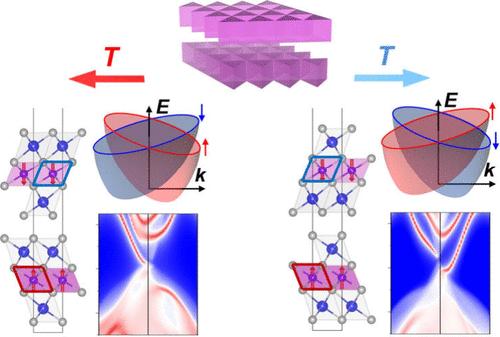
The quantum anomalous Hall (QAH) effect provides dissipationless channels for spin transport, which is highly expected for low-power quantum computation. Spin-splitting bands are vital for the QAH effect in topological systems, with ferromagnetism indispensable to manipulate the Chern number. Crystal-order-dependent QAH effects in spin-splitting antiferromagnets are proposed here. Since the spin splitting of these antiferromagnets originates from the alternate crystal environment, the Chern number can be modulated by the crystal order, opening an additional dimension for tuning the QAH effect. Our concept is illustrated by two-dimensional (2D) MnBi2Te4 (MBT) with even septuple layers, typical axion insulators with fully magnetic compensation. By interlayer rotation and translation operations, sublattices of MBT with opposite magnetizations are no longer connected by inversion or mirror symmetries, leading to the transition to QAH insulators. Flexible stacking of 2D materials enables a reversible Chern number by crystal design. Our findings would advance QAH effect-based devices toward high controllability, integration density, and operation speed.
期刊介绍:
Nano Letters serves as a dynamic platform for promptly disseminating original results in fundamental, applied, and emerging research across all facets of nanoscience and nanotechnology. A pivotal criterion for inclusion within Nano Letters is the convergence of at least two different areas or disciplines, ensuring a rich interdisciplinary scope. The journal is dedicated to fostering exploration in diverse areas, including:
- Experimental and theoretical findings on physical, chemical, and biological phenomena at the nanoscale
- Synthesis, characterization, and processing of organic, inorganic, polymer, and hybrid nanomaterials through physical, chemical, and biological methodologies
- Modeling and simulation of synthetic, assembly, and interaction processes
- Realization of integrated nanostructures and nano-engineered devices exhibiting advanced performance
- Applications of nanoscale materials in living and environmental systems
Nano Letters is committed to advancing and showcasing groundbreaking research that intersects various domains, fostering innovation and collaboration in the ever-evolving field of nanoscience and nanotechnology.




 京公网安备 11010802042870号
京ICP备2023020795号-1
京公网安备 11010802042870号
京ICP备2023020795号-1

 分享
分享
 求助内容:
求助内容: 应助结果提醒方式:
 扫码关注我们
