{"title":"Field Detection of Multiple Infectious Diseases with Naked Eye Using Plasmonic-Enhanced Fluorescent Nanoparticles","authors":"Xuan Tan, Jingkai Yang, Ying Liu, Zexi Tang, HongJun Xiao, Jiahui Lv, Yun He, Ruibin Hu, Ziqi Jin, Shiyu Chen, Ziyi Xu, Li Cheng, Jiaxin Li, Rongrong Zou, Xiaohe Li, Panlin Shao, Jing Yuan, Bo Zhang","doi":"10.1021/acs.analchem.4c07106","DOIUrl":null,"url":null,"abstract":"Accurately diagnosing infectious diseases in a resource-limited setting is a major challenge. Plasmonic materials, via localized surface plasmon resonance (LSPR), have greatly enhanced fluorescence signal and detection sensitivity. However, traditional plasmonic-enhanced fluorescence methods largely rely on near-infrared or visible-light fluorophores with small Stokes shift, limiting naked-eye visibility without filters. In this study, we developed a novel plasmonic silver film (pSilverF) to enhance visible-light fluorescence with large Stokes shift, allowing for improved biomarker detection sensitivity under naked-eye observation. Integrated with bright fluorescent nanoparticles, we designed a multiplexed assay for detecting Hepatitis C Virus (HCV), Hepatitis B Virus (HBV), and Human Immunodeficiency Virus (HIV) antibodies, achieving detection sensitivities down to 0.0032, 0.023, and 0.168 NCU/mL, respectively. In a cohort of 68 clinical samples, our method achieved 100% sensitivity and specificity for HIV and HCV detection and 96% sensitivity and 100% specificity for HBV detection. Notably, the results can be visualized by the naked eye and directly captured by a standard mobile phone camera without any modification for signal analysis using RGB image splitting. This platform demonstrated potential for field detection of multiple infectious diseases with simple settings, providing a useful tool for disease control in communities and areas with limited medical resources.","PeriodicalId":27,"journal":{"name":"Analytical Chemistry","volume":"72 1","pages":""},"PeriodicalIF":6.7000,"publicationDate":"2025-03-30","publicationTypes":"Journal Article","fieldsOfStudy":null,"isOpenAccess":false,"openAccessPdf":"","citationCount":"0","resultStr":null,"platform":"Semanticscholar","paperid":null,"PeriodicalName":"Analytical Chemistry","FirstCategoryId":"92","ListUrlMain":"https://doi.org/10.1021/acs.analchem.4c07106","RegionNum":1,"RegionCategory":"化学","ArticlePicture":[],"TitleCN":null,"AbstractTextCN":null,"PMCID":null,"EPubDate":"","PubModel":"","JCR":"Q1","JCRName":"CHEMISTRY, ANALYTICAL","Score":null,"Total":0}
引用次数: 0
Abstract
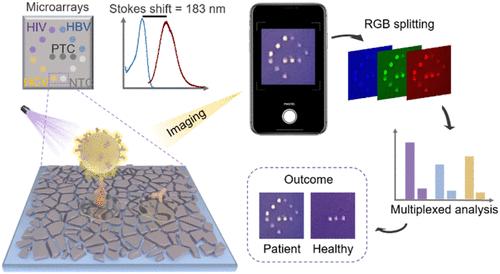
Accurately diagnosing infectious diseases in a resource-limited setting is a major challenge. Plasmonic materials, via localized surface plasmon resonance (LSPR), have greatly enhanced fluorescence signal and detection sensitivity. However, traditional plasmonic-enhanced fluorescence methods largely rely on near-infrared or visible-light fluorophores with small Stokes shift, limiting naked-eye visibility without filters. In this study, we developed a novel plasmonic silver film (pSilverF) to enhance visible-light fluorescence with large Stokes shift, allowing for improved biomarker detection sensitivity under naked-eye observation. Integrated with bright fluorescent nanoparticles, we designed a multiplexed assay for detecting Hepatitis C Virus (HCV), Hepatitis B Virus (HBV), and Human Immunodeficiency Virus (HIV) antibodies, achieving detection sensitivities down to 0.0032, 0.023, and 0.168 NCU/mL, respectively. In a cohort of 68 clinical samples, our method achieved 100% sensitivity and specificity for HIV and HCV detection and 96% sensitivity and 100% specificity for HBV detection. Notably, the results can be visualized by the naked eye and directly captured by a standard mobile phone camera without any modification for signal analysis using RGB image splitting. This platform demonstrated potential for field detection of multiple infectious diseases with simple settings, providing a useful tool for disease control in communities and areas with limited medical resources.
期刊介绍:
Analytical Chemistry, a peer-reviewed research journal, focuses on disseminating new and original knowledge across all branches of analytical chemistry. Fundamental articles may explore general principles of chemical measurement science and need not directly address existing or potential analytical methodology. They can be entirely theoretical or report experimental results. Contributions may cover various phases of analytical operations, including sampling, bioanalysis, electrochemistry, mass spectrometry, microscale and nanoscale systems, environmental analysis, separations, spectroscopy, chemical reactions and selectivity, instrumentation, imaging, surface analysis, and data processing. Papers discussing known analytical methods should present a significant, original application of the method, a notable improvement, or results on an important analyte.



 京公网安备 11010802042870号
京ICP备2023020795号-1
京公网安备 11010802042870号
京ICP备2023020795号-1

 分享
分享
 求助内容:
求助内容: 应助结果提醒方式:
 扫码关注我们
