Jianming Meng, Yulai Lin, Yuqing Wang, Peng Hei, Ya Sai, Jing Wang, Xiaoqi Sun, Xiao-Xia Liu, Yu Song
{"title":"Cold-Optimized Zinc-Ion Batteries: Enhanced Stability at −5 °C","authors":"Jianming Meng, Yulai Lin, Yuqing Wang, Peng Hei, Ya Sai, Jing Wang, Xiaoqi Sun, Xiao-Xia Liu, Yu Song","doi":"10.1002/anie.202503435","DOIUrl":null,"url":null,"abstract":"<p>Aqueous zinc-ion batteries (AZIBs) have been extensively studied under room and ultralow temperature conditions. However, mechanism studies at intermediate temperature ranges remain limited. In this work, we investigate the electrochemical performance of an AZIB using a commonly employed 3 M ZnSO<sub>4</sub> electrolyte across the intermediate temperature range of 25 to −15 °C. Notably, we find that the battery with a double hydroxide cathode exhibits optimized performance at −5 °C, demonstrating significantly enhanced cycling stability compared to 25 °C. Mechanistic studies reveal that unfavorable H<sup>+</sup>-associated reactions at both the cathode and anode are effectively alleviated at −5 °C, contributing to improved cycling stability. Spectroscopic and theoretical analyzes show that changes in the electrolyte environment at −5 °C—such as reduced electrochemical activity of H<sub>2</sub>O, increased H-bond strength, and decreased total number of H bonds—impede H<sup>+</sup> diffusion through H-bond network via the Grotthuss mechanism. These effects collectively suppress harmful H<sup>+</sup>-associated reactions, allowing Zn<sup>2+</sup> insertion/deinsertion to dominate the charge storage process. This work provides valuable insights into the enhanced performance of AZIBs at sublow temperatures and presents opportunities for extending battery operation in near-freezing environments.</p>","PeriodicalId":125,"journal":{"name":"Angewandte Chemie International Edition","volume":"64 23","pages":""},"PeriodicalIF":16.9000,"publicationDate":"2025-03-31","publicationTypes":"Journal Article","fieldsOfStudy":null,"isOpenAccess":false,"openAccessPdf":"","citationCount":"0","resultStr":null,"platform":"Semanticscholar","paperid":null,"PeriodicalName":"Angewandte Chemie International Edition","FirstCategoryId":"92","ListUrlMain":"https://onlinelibrary.wiley.com/doi/10.1002/anie.202503435","RegionNum":1,"RegionCategory":"化学","ArticlePicture":[],"TitleCN":null,"AbstractTextCN":null,"PMCID":null,"EPubDate":"","PubModel":"","JCR":"Q1","JCRName":"CHEMISTRY, MULTIDISCIPLINARY","Score":null,"Total":0}
引用次数: 0
Abstract
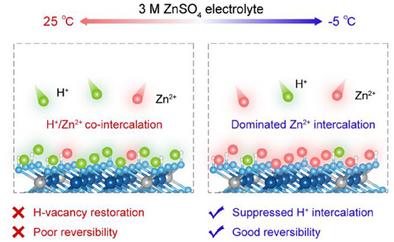
Aqueous zinc-ion batteries (AZIBs) have been extensively studied under room and ultralow temperature conditions. However, mechanism studies at intermediate temperature ranges remain limited. In this work, we investigate the electrochemical performance of an AZIB using a commonly employed 3 M ZnSO4 electrolyte across the intermediate temperature range of 25 to −15 °C. Notably, we find that the battery with a double hydroxide cathode exhibits optimized performance at −5 °C, demonstrating significantly enhanced cycling stability compared to 25 °C. Mechanistic studies reveal that unfavorable H+-associated reactions at both the cathode and anode are effectively alleviated at −5 °C, contributing to improved cycling stability. Spectroscopic and theoretical analyzes show that changes in the electrolyte environment at −5 °C—such as reduced electrochemical activity of H2O, increased H-bond strength, and decreased total number of H bonds—impede H+ diffusion through H-bond network via the Grotthuss mechanism. These effects collectively suppress harmful H+-associated reactions, allowing Zn2+ insertion/deinsertion to dominate the charge storage process. This work provides valuable insights into the enhanced performance of AZIBs at sublow temperatures and presents opportunities for extending battery operation in near-freezing environments.
水溶液锌离子电池(azib)在室温和超低温条件下进行了广泛研究。然而,在中等温度范围内的机理研究仍然有限。在这项工作中,我们研究了在25至-15°C的中间温度范围内,使用常用的3 M ZnSO4电解质的AZIB的电化学性能。值得注意的是,我们发现具有双氢氧化物阴极的电池在-5°C下表现出最佳性能,与25°C相比,循环稳定性显着增强。机理研究表明,在-5°C时,阴极和阳极的不利H+相关反应都得到了有效缓解,有助于提高循环稳定性。光谱和理论分析表明,-5℃下电解质环境的变化,如H2O的电化学活性降低,氢键强度增加,氢键总数减少,通过Grotthuss机制阻碍了H+在氢键网络中的扩散。这些效应共同抑制有害的H+相关反应,允许Zn2+插入/去插入主导电荷存储过程。这项工作为提高azib在亚低温下的性能提供了有价值的见解,并为延长电池在近冰点环境下的运行提供了机会。
期刊介绍:
Angewandte Chemie, a journal of the German Chemical Society (GDCh), maintains a leading position among scholarly journals in general chemistry with an impressive Impact Factor of 16.6 (2022 Journal Citation Reports, Clarivate, 2023). Published weekly in a reader-friendly format, it features new articles almost every day. Established in 1887, Angewandte Chemie is a prominent chemistry journal, offering a dynamic blend of Review-type articles, Highlights, Communications, and Research Articles on a weekly basis, making it unique in the field.




 京公网安备 11010802042870号
京ICP备2023020795号-1
京公网安备 11010802042870号
京ICP备2023020795号-1

 分享
分享
 求助内容:
求助内容: 应助结果提醒方式:
 扫码关注我们
