Yu-Qing Li, Lei Fu, Zhiyuan Jiang, Ermeng Han, Tian Li, Qixia Bai, Ting-Zheng Xie, Zhe Zhang, Pingshan Wang, Tun Wu
{"title":"Controlling the Chirality of Metallo-Cages by Manipulating the Stereochemistry of the Metal Centers","authors":"Yu-Qing Li, Lei Fu, Zhiyuan Jiang, Ermeng Han, Tian Li, Qixia Bai, Ting-Zheng Xie, Zhe Zhang, Pingshan Wang, Tun Wu","doi":"10.1002/anie.202503833","DOIUrl":null,"url":null,"abstract":"<p>Precise control over the chirality of metallo-cages by manipulating the stereochemistry of metal centers is important in many practical applications, but is extremely challenging. In this study, two isostructural metallo-cuboctahedra (<b>1</b>-Zn<sup>II</sup><sub>12</sub><b>L1</b><sub>8</sub> and <b>2</b>-Cd<sup>II</sup><sub>12</sub><b>L1</b><sub>8</sub>) have been assembled using ligand <b>L1</b> and two kinds of metal ions (Zn<sup>II</sup> and Cd<sup>II</sup>) with similar coordination lability. The chiral-induction by the same guests (<i>D</i>-/<i>L</i>-camphorsulfonate, <i>D</i>-/<i>L</i>-SCS) results in a completely opposing stereochemical output of <b>1</b> and <b>2</b>: <i>D</i>-SCS induced host–guest complex of [<i>D</i>-SCS⊂Δ<sub>12</sub>–<b>1</b>] and [<i>D</i>-SCS⊂Λ<sub>12</sub>–<b>2</b>], respectively, with reverse handedness. The distinct stereochemical configuration of metallo-cuboctahedra can be manipulated by participant metal ions that exhibit similar dynamics. Furthermore, a subtle variation of the ligand peripheral substituent group facilitates spontaneous resolution of metallo-cuboctahedra <b>3</b>-Zn<sup>II</sup><sub>12</sub><b>L2</b><sub>8</sub> from a racemic mixture as (<i>R</i><sub>24</sub>, Λ<sub>12</sub>)-<b>3</b>/(<i>S</i><sub>24</sub>, Δ<sub>12</sub>)-<b>3</b> enantiopure entities. The dynamic stereochemistry of M<sup>II</sup><sub>12</sub><b>L</b><sub>8</sub> cuboctahedra described in this work allows a chiral manipulation based on the nature of metal centers and ligands, enabling the design and control of the chirality of metallo-cages.</p>","PeriodicalId":125,"journal":{"name":"Angewandte Chemie International Edition","volume":"64 23","pages":""},"PeriodicalIF":16.9000,"publicationDate":"2025-03-31","publicationTypes":"Journal Article","fieldsOfStudy":null,"isOpenAccess":false,"openAccessPdf":"","citationCount":"0","resultStr":null,"platform":"Semanticscholar","paperid":null,"PeriodicalName":"Angewandte Chemie International Edition","FirstCategoryId":"92","ListUrlMain":"https://onlinelibrary.wiley.com/doi/10.1002/anie.202503833","RegionNum":1,"RegionCategory":"化学","ArticlePicture":[],"TitleCN":null,"AbstractTextCN":null,"PMCID":null,"EPubDate":"","PubModel":"","JCR":"Q1","JCRName":"CHEMISTRY, MULTIDISCIPLINARY","Score":null,"Total":0}
引用次数: 0
Abstract
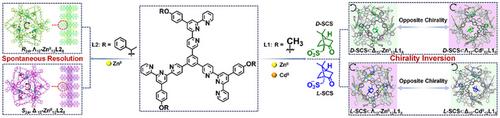
Precise control over the chirality of metallo-cages by manipulating the stereochemistry of metal centers is important in many practical applications, but is extremely challenging. In this study, two isostructural metallo-cuboctahedra (1-ZnII12L18 and 2-CdII12L18) have been assembled using ligand L1 and two kinds of metal ions (ZnII and CdII) with similar coordination lability. The chiral-induction by the same guests (D-/L-camphorsulfonate, D-/L-SCS) results in a completely opposing stereochemical output of 1 and 2: D-SCS induced host–guest complex of [D-SCS⊂Δ12–1] and [D-SCS⊂Λ12–2], respectively, with reverse handedness. The distinct stereochemical configuration of metallo-cuboctahedra can be manipulated by participant metal ions that exhibit similar dynamics. Furthermore, a subtle variation of the ligand peripheral substituent group facilitates spontaneous resolution of metallo-cuboctahedra 3-ZnII12L28 from a racemic mixture as (R24, Λ12)-3/(S24, Δ12)-3 enantiopure entities. The dynamic stereochemistry of MII12L8 cuboctahedra described in this work allows a chiral manipulation based on the nature of metal centers and ligands, enabling the design and control of the chirality of metallo-cages.
期刊介绍:
Angewandte Chemie, a journal of the German Chemical Society (GDCh), maintains a leading position among scholarly journals in general chemistry with an impressive Impact Factor of 16.6 (2022 Journal Citation Reports, Clarivate, 2023). Published weekly in a reader-friendly format, it features new articles almost every day. Established in 1887, Angewandte Chemie is a prominent chemistry journal, offering a dynamic blend of Review-type articles, Highlights, Communications, and Research Articles on a weekly basis, making it unique in the field.



 京公网安备 11010802042870号
京ICP备2023020795号-1
京公网安备 11010802042870号
京ICP备2023020795号-1

 分享
分享
 求助内容:
求助内容: 应助结果提醒方式:
 扫码关注我们
