Zhihua Ren, Junhao Zeng, Lunbi Wu, Sha Liu, Tao Jia, Yang Lv, Liangbin Xiong, Liwen Hu, Zhicai He and Ruihao Xie
{"title":"Synthesis and properties of non-fullerene acceptor materials containing aromatic heterocycle substitutions†","authors":"Zhihua Ren, Junhao Zeng, Lunbi Wu, Sha Liu, Tao Jia, Yang Lv, Liangbin Xiong, Liwen Hu, Zhicai He and Ruihao Xie","doi":"10.1039/D5NJ00246J","DOIUrl":null,"url":null,"abstract":"<p >In recent years, organic solar cells (OSCs) have developed rapidly. Among the various active layer materials, non-fullerene acceptor materials exhibit a well-defined chemical structure, easily controllable energy levels and absorption, and a unique electron cloud distribution, making them a prominent research focus. Through molecular design, a series of acceptor–donor–acceptor (A–D–A) small molecule acceptor (SMA) materials have been developed. These materials, composed of an intermediate core, alkyl side chain groups, and terminal groups, possess more suitable absorption spectra and can effectively regulate the highest occupied molecular orbital (HOMO) and lowest unoccupied molecular orbital (LUMO) energy levels of the acceptor material. This optimization enhances their energy level and absorption spectra alignment with the donor material and improves the photoelectric conversion efficiency. Notably, the introduction of aromatic heterocycles into the terminal groups represents an effective modification strategy. The incorporation of aromatic heterocycles can influence the electron cloud distribution of the terminal groups, exciton dissociation, and charge transport, leading to varying optoelectronic properties of non-fullerene small molecules. In this paper, we designed and synthesized two new SMA materials, <strong>BO-ICTTh</strong> and <strong>BO-ICTFr</strong>, by attaching thiophene and furan rings to the terminal groups of the acceptor materials through a Stille coupling reaction. We investigated the optical, electrochemical, and photovoltaic properties of these materials.</p>","PeriodicalId":95,"journal":{"name":"New Journal of Chemistry","volume":" 14","pages":" 5843-5853"},"PeriodicalIF":2.5000,"publicationDate":"2025-03-06","publicationTypes":"Journal Article","fieldsOfStudy":null,"isOpenAccess":false,"openAccessPdf":"","citationCount":"0","resultStr":null,"platform":"Semanticscholar","paperid":null,"PeriodicalName":"New Journal of Chemistry","FirstCategoryId":"92","ListUrlMain":"https://pubs.rsc.org/en/content/articlelanding/2025/nj/d5nj00246j","RegionNum":3,"RegionCategory":"化学","ArticlePicture":[],"TitleCN":null,"AbstractTextCN":null,"PMCID":null,"EPubDate":"","PubModel":"","JCR":"Q2","JCRName":"CHEMISTRY, MULTIDISCIPLINARY","Score":null,"Total":0}
引用次数: 0
Abstract
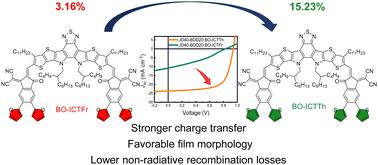
In recent years, organic solar cells (OSCs) have developed rapidly. Among the various active layer materials, non-fullerene acceptor materials exhibit a well-defined chemical structure, easily controllable energy levels and absorption, and a unique electron cloud distribution, making them a prominent research focus. Through molecular design, a series of acceptor–donor–acceptor (A–D–A) small molecule acceptor (SMA) materials have been developed. These materials, composed of an intermediate core, alkyl side chain groups, and terminal groups, possess more suitable absorption spectra and can effectively regulate the highest occupied molecular orbital (HOMO) and lowest unoccupied molecular orbital (LUMO) energy levels of the acceptor material. This optimization enhances their energy level and absorption spectra alignment with the donor material and improves the photoelectric conversion efficiency. Notably, the introduction of aromatic heterocycles into the terminal groups represents an effective modification strategy. The incorporation of aromatic heterocycles can influence the electron cloud distribution of the terminal groups, exciton dissociation, and charge transport, leading to varying optoelectronic properties of non-fullerene small molecules. In this paper, we designed and synthesized two new SMA materials, BO-ICTTh and BO-ICTFr, by attaching thiophene and furan rings to the terminal groups of the acceptor materials through a Stille coupling reaction. We investigated the optical, electrochemical, and photovoltaic properties of these materials.
近年来,有机太阳能电池(OSCs)发展迅速。在各种活性层材料中,非富勒烯受体材料具有明确的化学结构、易于控制的能级和吸收、独特的电子云分布等特点,成为研究热点。通过分子设计,开发了一系列受体-给体-受体(a - d - a)小分子受体(SMA)材料。这些材料由中间核、烷基侧链基团和末端基团组成,具有更合适的吸收光谱,可以有效调节受体材料的最高已占据分子轨道(HOMO)和最低未占据分子轨道(LUMO)能级。这种优化提高了它们的能级和吸收光谱与供体材料的对齐,提高了光电转换效率。值得一提的是,在末端基团中引入芳香族杂环是一种有效的修饰策略。芳香族杂环的掺入会影响末端基团的电子云分布、激子解离和电荷输运,导致非富勒烯小分子的光电性质发生变化。本文设计合成了BO-ICTTh和BO-ICTFr两种新型SMA材料,通过Stille偶联反应将噻吩和呋喃环接在受体材料的末端基团上。我们研究了这些材料的光学、电化学和光伏性能。



 京公网安备 11010802042870号
京ICP备2023020795号-1
京公网安备 11010802042870号
京ICP备2023020795号-1

 分享
分享
 求助内容:
求助内容: 应助结果提醒方式:
 扫码关注我们
