Valber Georgio de Oliveira Duarte, Victor do Santos Azevedo Leite, Danúbia Aparecida da Costa Nobre, Renê Chagas da Silva, Vera Regina Leopoldo Constantino, Gustavo Franco de Castro, Flávio Lemes Fernandes and Jairo Tronto
{"title":"Alginate–kaolinite beads: new bait for controlling leaf-cutting ants†","authors":"Valber Georgio de Oliveira Duarte, Victor do Santos Azevedo Leite, Danúbia Aparecida da Costa Nobre, Renê Chagas da Silva, Vera Regina Leopoldo Constantino, Gustavo Franco de Castro, Flávio Lemes Fernandes and Jairo Tronto","doi":"10.1039/D4NJ04337E","DOIUrl":null,"url":null,"abstract":"<p >Leaf-cutting ants present a significant challenge in tropical countries. Currently, these insects are often controlled using chemical granular baits. While these granules are cost-effective, they have notable drawbacks, particularly their low resistance to humidity. Therefore, there is a need for the development of new formulations that offer improved environmental resilience, gradual release of the active chemical, and effective ant-killing capabilities. This study aimed to create new baits in bead form specifically designed to control leaf-cutting ants (<em>Atta sexdens</em>). The beads were produced through the interaction of organic and inorganic materials, using a mixture of an alginate polymer, clay, sodium tetraborate, <em>Beauveria bassiana</em> spores, and chlorpyrifos. Results from experiments on boron leaching in soil columns indicated that in some cases, 100% of boron leached out after 15 days. Laboratory and field bioassays demonstrated that the beads were attractive and effective in controlling ants. Composites of alginate–kaolinite beads with agrochemicals demonstrated potential as an effective bait option for controlling <em>A. sexdens</em>, performing significant ant-killing results. Composites of alginate–kaolinite beads with agrochemicals demonstrated potential as an effective bait option for controlling <em>A. sexdens</em>, yielding significant ant-killing effects.</p>","PeriodicalId":95,"journal":{"name":"New Journal of Chemistry","volume":" 14","pages":" 5920-5930"},"PeriodicalIF":2.5000,"publicationDate":"2025-03-06","publicationTypes":"Journal Article","fieldsOfStudy":null,"isOpenAccess":false,"openAccessPdf":"","citationCount":"0","resultStr":null,"platform":"Semanticscholar","paperid":null,"PeriodicalName":"New Journal of Chemistry","FirstCategoryId":"92","ListUrlMain":"https://pubs.rsc.org/en/content/articlelanding/2025/nj/d4nj04337e","RegionNum":3,"RegionCategory":"化学","ArticlePicture":[],"TitleCN":null,"AbstractTextCN":null,"PMCID":null,"EPubDate":"","PubModel":"","JCR":"Q2","JCRName":"CHEMISTRY, MULTIDISCIPLINARY","Score":null,"Total":0}
引用次数: 0
Abstract
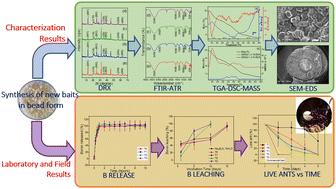
Leaf-cutting ants present a significant challenge in tropical countries. Currently, these insects are often controlled using chemical granular baits. While these granules are cost-effective, they have notable drawbacks, particularly their low resistance to humidity. Therefore, there is a need for the development of new formulations that offer improved environmental resilience, gradual release of the active chemical, and effective ant-killing capabilities. This study aimed to create new baits in bead form specifically designed to control leaf-cutting ants (Atta sexdens). The beads were produced through the interaction of organic and inorganic materials, using a mixture of an alginate polymer, clay, sodium tetraborate, Beauveria bassiana spores, and chlorpyrifos. Results from experiments on boron leaching in soil columns indicated that in some cases, 100% of boron leached out after 15 days. Laboratory and field bioassays demonstrated that the beads were attractive and effective in controlling ants. Composites of alginate–kaolinite beads with agrochemicals demonstrated potential as an effective bait option for controlling A. sexdens, performing significant ant-killing results. Composites of alginate–kaolinite beads with agrochemicals demonstrated potential as an effective bait option for controlling A. sexdens, yielding significant ant-killing effects.



 京公网安备 11010802042870号
京ICP备2023020795号-1
京公网安备 11010802042870号
京ICP备2023020795号-1

 分享
分享
 求助内容:
求助内容: 应助结果提醒方式:
 扫码关注我们
