Nikolaos A. Afratis , Blake T. Riley , Peter G. Chandler , Ashley M. Buckle , Irit Sagi
{"title":"Allosteric Anti-KLK4 Antibody Development for Targeted Anti-cancer Effects in Ovarian Carcinoma","authors":"Nikolaos A. Afratis , Blake T. Riley , Peter G. Chandler , Ashley M. Buckle , Irit Sagi","doi":"10.1016/j.jmb.2025.169101","DOIUrl":null,"url":null,"abstract":"<div><div>Kallikrein-related peptidases (KLKs) have garnered significant interest in the field of biomedical research due to their diverse roles in various physiological and pathological processes. However, the structurally conserved active site of the KLK family presents challenges for the development of specific inhibitors. Given the pro-tumorigenic roles KLKs play in various cancers, identifying new avenues for specific inhibition is therefore vital. Here, we introduce a novel approach to target a distinct KLK4 sequence by a unique immunization approach for monoclonal antibody generation, targeting loop 3, a region of high sequence and structural diversity as a candidate for allosteric control of KLK4 activity. Immunisation produced an antibody capable of interacting with both KLK4 and loop 3 with high affinity, which inhibited KLK4 proteolytic activity, and hindered proliferation and migration in ovarian cancer cell lines. Encouragingly, its potential application extends to preclinical models characterized by KLK4 overexpression. Our findings underscore the promise of this novel approach to addressing the challenges of specifically inhibiting ubiquitous serine proteases, with particular relevance to targeting KLK4, a protease instrumental in the progression of ovarian carcinoma and other cancer types.</div></div>","PeriodicalId":369,"journal":{"name":"Journal of Molecular Biology","volume":"437 20","pages":"Article 169101"},"PeriodicalIF":4.5000,"publicationDate":"2025-10-15","publicationTypes":"Journal Article","fieldsOfStudy":null,"isOpenAccess":false,"openAccessPdf":"","citationCount":"0","resultStr":null,"platform":"Semanticscholar","paperid":null,"PeriodicalName":"Journal of Molecular Biology","FirstCategoryId":"99","ListUrlMain":"https://www.sciencedirect.com/science/article/pii/S0022283625001676","RegionNum":2,"RegionCategory":"生物学","ArticlePicture":[],"TitleCN":null,"AbstractTextCN":null,"PMCID":null,"EPubDate":"2025/3/26 0:00:00","PubModel":"Epub","JCR":"Q1","JCRName":"BIOCHEMISTRY & MOLECULAR BIOLOGY","Score":null,"Total":0}
引用次数: 0
Abstract
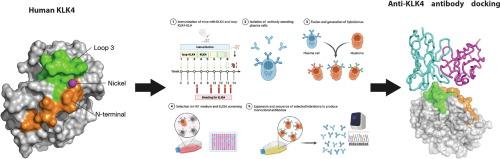
Kallikrein-related peptidases (KLKs) have garnered significant interest in the field of biomedical research due to their diverse roles in various physiological and pathological processes. However, the structurally conserved active site of the KLK family presents challenges for the development of specific inhibitors. Given the pro-tumorigenic roles KLKs play in various cancers, identifying new avenues for specific inhibition is therefore vital. Here, we introduce a novel approach to target a distinct KLK4 sequence by a unique immunization approach for monoclonal antibody generation, targeting loop 3, a region of high sequence and structural diversity as a candidate for allosteric control of KLK4 activity. Immunisation produced an antibody capable of interacting with both KLK4 and loop 3 with high affinity, which inhibited KLK4 proteolytic activity, and hindered proliferation and migration in ovarian cancer cell lines. Encouragingly, its potential application extends to preclinical models characterized by KLK4 overexpression. Our findings underscore the promise of this novel approach to addressing the challenges of specifically inhibiting ubiquitous serine proteases, with particular relevance to targeting KLK4, a protease instrumental in the progression of ovarian carcinoma and other cancer types.
期刊介绍:
Journal of Molecular Biology (JMB) provides high quality, comprehensive and broad coverage in all areas of molecular biology. The journal publishes original scientific research papers that provide mechanistic and functional insights and report a significant advance to the field. The journal encourages the submission of multidisciplinary studies that use complementary experimental and computational approaches to address challenging biological questions.
Research areas include but are not limited to: Biomolecular interactions, signaling networks, systems biology; Cell cycle, cell growth, cell differentiation; Cell death, autophagy; Cell signaling and regulation; Chemical biology; Computational biology, in combination with experimental studies; DNA replication, repair, and recombination; Development, regenerative biology, mechanistic and functional studies of stem cells; Epigenetics, chromatin structure and function; Gene expression; Membrane processes, cell surface proteins and cell-cell interactions; Methodological advances, both experimental and theoretical, including databases; Microbiology, virology, and interactions with the host or environment; Microbiota mechanistic and functional studies; Nuclear organization; Post-translational modifications, proteomics; Processing and function of biologically important macromolecules and complexes; Molecular basis of disease; RNA processing, structure and functions of non-coding RNAs, transcription; Sorting, spatiotemporal organization, trafficking; Structural biology; Synthetic biology; Translation, protein folding, chaperones, protein degradation and quality control.



 京公网安备 11010802042870号
京ICP备2023020795号-1
京公网安备 11010802042870号
京ICP备2023020795号-1

 分享
分享
 求助内容:
求助内容: 应助结果提醒方式:
 扫码关注我们
