David L. Dai , Alexander F.A. Keszei , Elena Kolobova , Jonathan St-Germain , S.M.Naimul Hasan , Alex C.H. Liu , Xu Zhang , Brian Raught , James R. Goldenring , Mohammad T. Mazhab-Jafari
{"title":"Cryo-EM of AKAP350/AKAP9 Reveals Fibrillar Clusters and an Association With DNA","authors":"David L. Dai , Alexander F.A. Keszei , Elena Kolobova , Jonathan St-Germain , S.M.Naimul Hasan , Alex C.H. Liu , Xu Zhang , Brian Raught , James R. Goldenring , Mohammad T. Mazhab-Jafari","doi":"10.1016/j.jmb.2025.169102","DOIUrl":null,"url":null,"abstract":"<div><div>AKAP350 is a massive human scaffolding protein, encoded by <em>AKAP9</em>, that anchors protein kinase A (PKA) to the Golgi apparatus and the centrosome. <em>AKAP9</em> is among the most frequently mutated genes in various human cancers, and dysregulation of AKAP350 function is strongly linked to metastasis. However, the molecular mechanisms underlying these disease processes remain poorly understood due to the challenges of studying its large and unstructured protein sequence. To learn more about AKAP350 basic function and architecture, we successfully expressed and purified full-length AKAP350 from human cells. Its functional state was validated based on the scaffolding protein’s ability to pulldown endogenous CEP170 and CDK5RAP2, and to co-purify with endogenous PKA. Cryo-electron microscopy (cryo-EM) revealed that AKAP350 appears as polydisperse clusters ∼50 nm in diameter, characterized by fibrous outgrowths. Surprisingly, these fibers reconstructed into double-stranded DNA. DNA sequencing and mass spectrometry confirmed that AKAP350 co-purified with human DNA and endogenous DNA-binding proteins, including nuclear factor 1B (NFIB) and nucleolin (NCL). Interestingly, the pull-down of NFIB and NCL, but not the centrosomal proteins CEP290, CDK5RAP2, or CEP170, was reduced in the presence of DNase-I, suggesting that AKAP350’s interaction with these DNA-binding proteins is mediated by DNA. Furthermore, cryo-electron tomography (cryo-ET) revealed that AKAP350 fibrillar clusters form a three-dimensional network of entangled filaments, a structure significantly altered by DNase-I treatment. Overall, our findings suggest AKAP350 forms fibrillar clusters that serve as nucleoprotein scaffolding complexes in human cells.</div></div>","PeriodicalId":369,"journal":{"name":"Journal of Molecular Biology","volume":"437 12","pages":"Article 169102"},"PeriodicalIF":4.5000,"publicationDate":"2025-06-15","publicationTypes":"Journal Article","fieldsOfStudy":null,"isOpenAccess":false,"openAccessPdf":"","citationCount":"0","resultStr":null,"platform":"Semanticscholar","paperid":null,"PeriodicalName":"Journal of Molecular Biology","FirstCategoryId":"99","ListUrlMain":"https://www.sciencedirect.com/science/article/pii/S0022283625001688","RegionNum":2,"RegionCategory":"生物学","ArticlePicture":[],"TitleCN":null,"AbstractTextCN":null,"PMCID":null,"EPubDate":"2025/3/26 0:00:00","PubModel":"Epub","JCR":"Q1","JCRName":"BIOCHEMISTRY & MOLECULAR BIOLOGY","Score":null,"Total":0}
引用次数: 0
Abstract
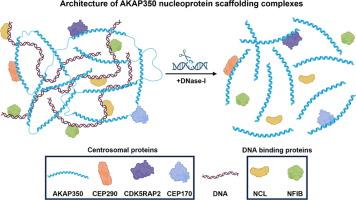
AKAP350 is a massive human scaffolding protein, encoded by AKAP9, that anchors protein kinase A (PKA) to the Golgi apparatus and the centrosome. AKAP9 is among the most frequently mutated genes in various human cancers, and dysregulation of AKAP350 function is strongly linked to metastasis. However, the molecular mechanisms underlying these disease processes remain poorly understood due to the challenges of studying its large and unstructured protein sequence. To learn more about AKAP350 basic function and architecture, we successfully expressed and purified full-length AKAP350 from human cells. Its functional state was validated based on the scaffolding protein’s ability to pulldown endogenous CEP170 and CDK5RAP2, and to co-purify with endogenous PKA. Cryo-electron microscopy (cryo-EM) revealed that AKAP350 appears as polydisperse clusters ∼50 nm in diameter, characterized by fibrous outgrowths. Surprisingly, these fibers reconstructed into double-stranded DNA. DNA sequencing and mass spectrometry confirmed that AKAP350 co-purified with human DNA and endogenous DNA-binding proteins, including nuclear factor 1B (NFIB) and nucleolin (NCL). Interestingly, the pull-down of NFIB and NCL, but not the centrosomal proteins CEP290, CDK5RAP2, or CEP170, was reduced in the presence of DNase-I, suggesting that AKAP350’s interaction with these DNA-binding proteins is mediated by DNA. Furthermore, cryo-electron tomography (cryo-ET) revealed that AKAP350 fibrillar clusters form a three-dimensional network of entangled filaments, a structure significantly altered by DNase-I treatment. Overall, our findings suggest AKAP350 forms fibrillar clusters that serve as nucleoprotein scaffolding complexes in human cells.
期刊介绍:
Journal of Molecular Biology (JMB) provides high quality, comprehensive and broad coverage in all areas of molecular biology. The journal publishes original scientific research papers that provide mechanistic and functional insights and report a significant advance to the field. The journal encourages the submission of multidisciplinary studies that use complementary experimental and computational approaches to address challenging biological questions.
Research areas include but are not limited to: Biomolecular interactions, signaling networks, systems biology; Cell cycle, cell growth, cell differentiation; Cell death, autophagy; Cell signaling and regulation; Chemical biology; Computational biology, in combination with experimental studies; DNA replication, repair, and recombination; Development, regenerative biology, mechanistic and functional studies of stem cells; Epigenetics, chromatin structure and function; Gene expression; Membrane processes, cell surface proteins and cell-cell interactions; Methodological advances, both experimental and theoretical, including databases; Microbiology, virology, and interactions with the host or environment; Microbiota mechanistic and functional studies; Nuclear organization; Post-translational modifications, proteomics; Processing and function of biologically important macromolecules and complexes; Molecular basis of disease; RNA processing, structure and functions of non-coding RNAs, transcription; Sorting, spatiotemporal organization, trafficking; Structural biology; Synthetic biology; Translation, protein folding, chaperones, protein degradation and quality control.



 京公网安备 11010802042870号
京ICP备2023020795号-1
京公网安备 11010802042870号
京ICP备2023020795号-1

 分享
分享
 求助内容:
求助内容: 应助结果提醒方式:
 扫码关注我们
