{"title":"The Biology of tRNA t6A Modification and Hypermodifications—Biogenesis and Disease Relevance","authors":"Wenhua Zhang , Eric Westhof","doi":"10.1016/j.jmb.2025.169091","DOIUrl":null,"url":null,"abstract":"<div><div>The structure and function of transfer RNAs (tRNAs) are highly dependent on post-transcriptional chemical modifications that attach distinct chemical groups to various nucleobase atoms at selected tRNA positions via enzymatic reactions. In all three domains of life, the greatest diversity of chemical modifications is concentrated at positions 34 and 37 of the tRNA anticodon loops. <em>N</em><sup>6</sup>-threonylcarbamoyladenosine (t<sup>6</sup>A) is an essential and universal modification occurring at position 37 of tRNAs that decode codons beginning with an adenine. In a subset of tRNAs from specific organisms, t<sup>6</sup>A is converted into a variety of hypermodified forms, including cyclic <em>N</em><sup>6</sup>-threonylcarbamoyladenosine (ct<sup>6</sup>A), hydroxy-<em>N</em><sup>6</sup>-threonylcarbamoyladenosine (ht<sup>6</sup>A), <em>N</em><sup>6</sup>-methyl-<em>N</em><sup>6</sup>-threonylcarbamoyladenosine (m<sup>6</sup>t<sup>6</sup>A), 2-methylthio-<em>N</em><sup>6</sup>-threonylcarbamoyladenosine (ms<sup>2</sup>t<sup>6</sup>A) and 2-methylthio-cyclic <em>N</em><sup>6</sup>-threonylcarbamoyladenosine (ms<sup>2</sup>ct<sup>6</sup>A). The tRNAs carrying t<sup>6</sup>A or one of its hypermodified derivatives are dubbed as the t<sup>6</sup>A family. The t<sup>6</sup>A family modifications pre-organize the anticodon loop in a conformation that enhances binding to the cognate mRNA codons, thereby promoting translational fidelity. The dysfunctional installation of modifications in the tRNA t<sup>6</sup>A family leads to translation errors, compromises proteostasis and cell viability, interferes with the growth and development of higher eukaryotes and is implicated in several human diseases, such as neurological disorders, mitochondrial encephalomyopathies, type 2 diabetes and cancers. In addition, loss-of-function mutations in KEOPS complex–the tRNA t<sup>6</sup>A-modifying enzyme–are associated with shortened telomeres, defects in DNA damage response and transcriptional dysregulation in eukaryotes. The chemical structures, the molecular functions, the known cellular roles and the biosynthetic pathways of the t<sup>6</sup>A tRNA family are described by integrating and linking biochemical and structural data on these modifications to their biological functions.</div></div>","PeriodicalId":369,"journal":{"name":"Journal of Molecular Biology","volume":"437 16","pages":"Article 169091"},"PeriodicalIF":4.5000,"publicationDate":"2025-08-15","publicationTypes":"Journal Article","fieldsOfStudy":null,"isOpenAccess":false,"openAccessPdf":"","citationCount":"0","resultStr":null,"platform":"Semanticscholar","paperid":null,"PeriodicalName":"Journal of Molecular Biology","FirstCategoryId":"99","ListUrlMain":"https://www.sciencedirect.com/science/article/pii/S0022283625001573","RegionNum":2,"RegionCategory":"生物学","ArticlePicture":[],"TitleCN":null,"AbstractTextCN":null,"PMCID":null,"EPubDate":"2025/3/27 0:00:00","PubModel":"Epub","JCR":"Q1","JCRName":"BIOCHEMISTRY & MOLECULAR BIOLOGY","Score":null,"Total":0}
引用次数: 0
Abstract
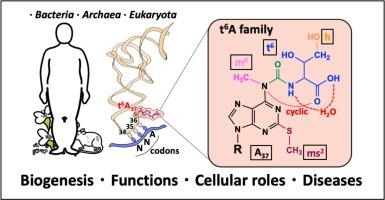
The structure and function of transfer RNAs (tRNAs) are highly dependent on post-transcriptional chemical modifications that attach distinct chemical groups to various nucleobase atoms at selected tRNA positions via enzymatic reactions. In all three domains of life, the greatest diversity of chemical modifications is concentrated at positions 34 and 37 of the tRNA anticodon loops. N6-threonylcarbamoyladenosine (t6A) is an essential and universal modification occurring at position 37 of tRNAs that decode codons beginning with an adenine. In a subset of tRNAs from specific organisms, t6A is converted into a variety of hypermodified forms, including cyclic N6-threonylcarbamoyladenosine (ct6A), hydroxy-N6-threonylcarbamoyladenosine (ht6A), N6-methyl-N6-threonylcarbamoyladenosine (m6t6A), 2-methylthio-N6-threonylcarbamoyladenosine (ms2t6A) and 2-methylthio-cyclic N6-threonylcarbamoyladenosine (ms2ct6A). The tRNAs carrying t6A or one of its hypermodified derivatives are dubbed as the t6A family. The t6A family modifications pre-organize the anticodon loop in a conformation that enhances binding to the cognate mRNA codons, thereby promoting translational fidelity. The dysfunctional installation of modifications in the tRNA t6A family leads to translation errors, compromises proteostasis and cell viability, interferes with the growth and development of higher eukaryotes and is implicated in several human diseases, such as neurological disorders, mitochondrial encephalomyopathies, type 2 diabetes and cancers. In addition, loss-of-function mutations in KEOPS complex–the tRNA t6A-modifying enzyme–are associated with shortened telomeres, defects in DNA damage response and transcriptional dysregulation in eukaryotes. The chemical structures, the molecular functions, the known cellular roles and the biosynthetic pathways of the t6A tRNA family are described by integrating and linking biochemical and structural data on these modifications to their biological functions.
期刊介绍:
Journal of Molecular Biology (JMB) provides high quality, comprehensive and broad coverage in all areas of molecular biology. The journal publishes original scientific research papers that provide mechanistic and functional insights and report a significant advance to the field. The journal encourages the submission of multidisciplinary studies that use complementary experimental and computational approaches to address challenging biological questions.
Research areas include but are not limited to: Biomolecular interactions, signaling networks, systems biology; Cell cycle, cell growth, cell differentiation; Cell death, autophagy; Cell signaling and regulation; Chemical biology; Computational biology, in combination with experimental studies; DNA replication, repair, and recombination; Development, regenerative biology, mechanistic and functional studies of stem cells; Epigenetics, chromatin structure and function; Gene expression; Membrane processes, cell surface proteins and cell-cell interactions; Methodological advances, both experimental and theoretical, including databases; Microbiology, virology, and interactions with the host or environment; Microbiota mechanistic and functional studies; Nuclear organization; Post-translational modifications, proteomics; Processing and function of biologically important macromolecules and complexes; Molecular basis of disease; RNA processing, structure and functions of non-coding RNAs, transcription; Sorting, spatiotemporal organization, trafficking; Structural biology; Synthetic biology; Translation, protein folding, chaperones, protein degradation and quality control.



 京公网安备 11010802042870号
京ICP备2023020795号-1
京公网安备 11010802042870号
京ICP备2023020795号-1

 分享
分享
 求助内容:
求助内容: 应助结果提醒方式:
 扫码关注我们
