Wouter Raven, Bart G J Candel, Nabila Wali, Menno I Gaakeer, Ewoud Ter Avest, Ozcan Sir, Heleen Lameijer, Roger A P A Hessels, Resi Reijnen, Christian H Nickel, Evert de Jonge, Erik van Zwet, Bas de Groot
{"title":"Comparison of Standardized Mortality Ratios in seven Dutch EDs based on presenting complaints.","authors":"Wouter Raven, Bart G J Candel, Nabila Wali, Menno I Gaakeer, Ewoud Ter Avest, Ozcan Sir, Heleen Lameijer, Roger A P A Hessels, Resi Reijnen, Christian H Nickel, Evert de Jonge, Erik van Zwet, Bas de Groot","doi":"10.1186/s12873-025-01200-4","DOIUrl":null,"url":null,"abstract":"<p><strong>Background: </strong>Comparison of emergency departments (EDs) becomes more important, but differences are difficult to interpret because of the heterogeneity of the ED population regarding reason for ED presentation. The aim of this study was two-fold: First to compare patient characteristics (including diagnoses) across 7 EDs. Secondly, to compare Standardized Mortality Ratios (SMRs) across 7 EDs and in subgroups of ED patients categorized by presenting complaints (PCs).</p><p><strong>Methods: </strong>Observational multicenter study including all consecutive visits of 7 Dutch (two tertiary care centre and 5 teaching hospitals) EDs. Patient characteristics, including PCs as part of triage systems, and SMRs (observed divided by expected in-hospital mortality) per ED and for the most common PCs (PC-SMRs) were compared across EDs and presented as funnel plots. The expected mortality was calculated with a prediction model, which was developed using multivariable logistic regression in the overall population and for PCs separately. Demographics, disease severity, diagnoses, proxies for comorbidity and complexity, and PCs (overall population only) were incorporated as covariates.</p><p><strong>Results: </strong>We included 693,289 ED visits from January 1, 2017 to June 31, 2023, with a median age of 56 years, of which 47.9% were women and 1.9% died. Patient characteristics varied markedly among EDs. Expected mortality was similar in prediction models with or without diagnoses as covariate. SMRs differed across EDs, ranging from 0.80 to 1.44. All EDs had SMRs within the 95%-Confidence Intervals of the funnel plot apart from one ED, which had an higher than expected SMR. However, PC-SMRs showed more variation and more EDs had SMRs falling outside the funnel, either higher or lower than expected. The ranking of SMRs across EDs was PC-dependent and differences across EDs are present only for specific PC-SMRs, such as in \"dyspnea\" and \"feeling unwell\".</p><p><strong>Conclusion: </strong>In summary, patient characteristics and mortality varied largely across Dutch EDs, and expected mortality across EDs is well assessed in PC subgroups without adjustment for final diagnoses. Differences in SMRs across EDs are PC-dependent. Future studies should investigate reasons of the differences in PC-SMRs across EDs and whether PC-targeted quality improvement programs can improve outcomes.</p>","PeriodicalId":9002,"journal":{"name":"BMC Emergency Medicine","volume":"25 1","pages":"49"},"PeriodicalIF":2.3000,"publicationDate":"2025-03-28","publicationTypes":"Journal Article","fieldsOfStudy":null,"isOpenAccess":false,"openAccessPdf":"https://www.ncbi.nlm.nih.gov/pmc/articles/PMC11951612/pdf/","citationCount":"0","resultStr":null,"platform":"Semanticscholar","paperid":null,"PeriodicalName":"BMC Emergency Medicine","FirstCategoryId":"3","ListUrlMain":"https://doi.org/10.1186/s12873-025-01200-4","RegionNum":3,"RegionCategory":"医学","ArticlePicture":[],"TitleCN":null,"AbstractTextCN":null,"PMCID":null,"EPubDate":"","PubModel":"","JCR":"Q1","JCRName":"EMERGENCY MEDICINE","Score":null,"Total":0}
引用次数: 0
Abstract
Background: Comparison of emergency departments (EDs) becomes more important, but differences are difficult to interpret because of the heterogeneity of the ED population regarding reason for ED presentation. The aim of this study was two-fold: First to compare patient characteristics (including diagnoses) across 7 EDs. Secondly, to compare Standardized Mortality Ratios (SMRs) across 7 EDs and in subgroups of ED patients categorized by presenting complaints (PCs).
Methods: Observational multicenter study including all consecutive visits of 7 Dutch (two tertiary care centre and 5 teaching hospitals) EDs. Patient characteristics, including PCs as part of triage systems, and SMRs (observed divided by expected in-hospital mortality) per ED and for the most common PCs (PC-SMRs) were compared across EDs and presented as funnel plots. The expected mortality was calculated with a prediction model, which was developed using multivariable logistic regression in the overall population and for PCs separately. Demographics, disease severity, diagnoses, proxies for comorbidity and complexity, and PCs (overall population only) were incorporated as covariates.
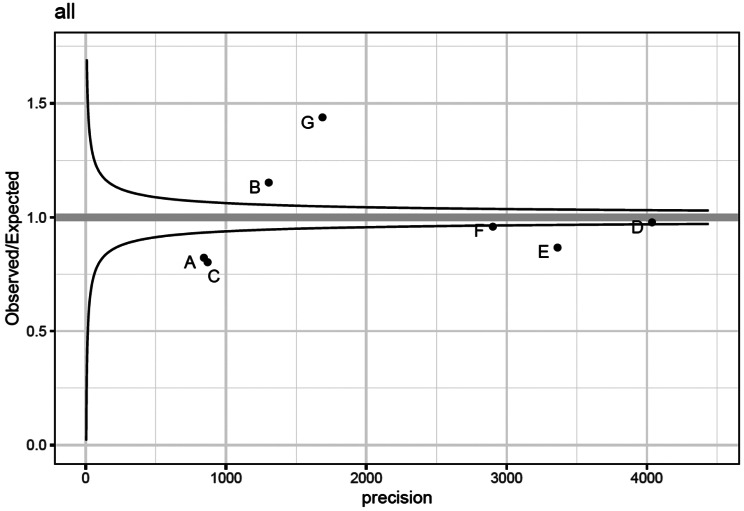
Results: We included 693,289 ED visits from January 1, 2017 to June 31, 2023, with a median age of 56 years, of which 47.9% were women and 1.9% died. Patient characteristics varied markedly among EDs. Expected mortality was similar in prediction models with or without diagnoses as covariate. SMRs differed across EDs, ranging from 0.80 to 1.44. All EDs had SMRs within the 95%-Confidence Intervals of the funnel plot apart from one ED, which had an higher than expected SMR. However, PC-SMRs showed more variation and more EDs had SMRs falling outside the funnel, either higher or lower than expected. The ranking of SMRs across EDs was PC-dependent and differences across EDs are present only for specific PC-SMRs, such as in "dyspnea" and "feeling unwell".
Conclusion: In summary, patient characteristics and mortality varied largely across Dutch EDs, and expected mortality across EDs is well assessed in PC subgroups without adjustment for final diagnoses. Differences in SMRs across EDs are PC-dependent. Future studies should investigate reasons of the differences in PC-SMRs across EDs and whether PC-targeted quality improvement programs can improve outcomes.
期刊介绍:
BMC Emergency Medicine is an open access, peer-reviewed journal that considers articles on all urgent and emergency aspects of medicine, in both practice and basic research. In addition, the journal covers aspects of disaster medicine and medicine in special locations, such as conflict areas and military medicine, together with articles concerning healthcare services in the emergency departments.





 京公网安备 11010802042870号
京ICP备2023020795号-1
京公网安备 11010802042870号
京ICP备2023020795号-1

 分享
分享
 求助内容:
求助内容: 应助结果提醒方式:
 扫码关注我们
