{"title":"The incidence and risk factors of phobic movement disorder after hip fracture internal fixation surgery.","authors":"Liming Xu, Wenjie Chen","doi":"10.1186/s13018-025-05750-y","DOIUrl":null,"url":null,"abstract":"<p><strong>Objective: </strong>This study aims to analyze the cumulative incidence and associated risk factors of phobic movement disorder (PMD) after hip fracture internal fixation surgery, with the goal of optimizing postoperative rehabilitation management and improving the quality of life in elderly patients.</p><p><strong>Methods: </strong>A total of 269 patients who underwent hip fracture internal fixation surgery at our hospital from June 2022 to June 2024 were retrospectively included. Clinical data, including age, sex, BMI, underlying diseases, psychological status, postoperative hip joint function, and self-efficacy, were collected. PMD was assessed using the Tampa Scale for Kinesiophobia (TSK), pain acceptance was evaluated using the Chronic Pain Acceptance Questionnaire (CPAQ-8), anxiety and depression status were assessed with the Hospital Anxiety and Depression Scale (HADS), hip joint function was measured using the Harris Hip Score, and self-efficacy was evaluated using the General Self-Efficacy Scale (GSE). Univariate analysis and multivariate binary logistic regression analysis were used to identify independent risk factors for PMD. The variance inflation factor (VIF) was calculated to assess multicollinearity.</p><p><strong>Results: </strong>The cumulative incidence of PMD was 34.9%. Univariate analysis revealed that BMI ≥ 30 kg/m², low pain acceptance, anxiety and depression, poor postoperative hip joint function, and low self-efficacy were significantly associated with PMD (P < 0.001). Multivariate logistic regression analysis further confirmed that BMI ≥ 30 kg/m² (OR = 4.07, 95% CI [2.39, 6.94]), low pain acceptance (OR = 4.67, 95% CI [2.69, 8.10]), anxiety and depression (OR = 4.14, 95% CI [2.44, 7.04]), poor postoperative hip joint function (OR = 10.61, 95% CI [5.67, 19.87]), and low self-efficacy (OR = 4.19, 95% CI [2.44, 7.18]) were independent risk factors for PMD. All VIF values were < 5, indicating no significant multicollinearity.</p><p><strong>Conclusion: </strong>PMD is common after hip fracture internal fixation surgery and is closely associated with high BMI, low pain acceptance, anxiety and depression, poor postoperative hip joint function, and low self-efficacy. The VIF analysis showed no significant multicollinearity, indicating stable results. Comprehensive interventions targeting high-risk factors may help reduce the incidence of PMD and improve postoperative recovery.</p>","PeriodicalId":16629,"journal":{"name":"Journal of Orthopaedic Surgery and Research","volume":"20 1","pages":"323"},"PeriodicalIF":2.8000,"publicationDate":"2025-03-29","publicationTypes":"Journal Article","fieldsOfStudy":null,"isOpenAccess":false,"openAccessPdf":"https://www.ncbi.nlm.nih.gov/pmc/articles/PMC11954312/pdf/","citationCount":"0","resultStr":null,"platform":"Semanticscholar","paperid":null,"PeriodicalName":"Journal of Orthopaedic Surgery and Research","FirstCategoryId":"3","ListUrlMain":"https://doi.org/10.1186/s13018-025-05750-y","RegionNum":3,"RegionCategory":"医学","ArticlePicture":[],"TitleCN":null,"AbstractTextCN":null,"PMCID":null,"EPubDate":"","PubModel":"","JCR":"Q1","JCRName":"ORTHOPEDICS","Score":null,"Total":0}
引用次数: 0
Abstract
Objective: This study aims to analyze the cumulative incidence and associated risk factors of phobic movement disorder (PMD) after hip fracture internal fixation surgery, with the goal of optimizing postoperative rehabilitation management and improving the quality of life in elderly patients.
Methods: A total of 269 patients who underwent hip fracture internal fixation surgery at our hospital from June 2022 to June 2024 were retrospectively included. Clinical data, including age, sex, BMI, underlying diseases, psychological status, postoperative hip joint function, and self-efficacy, were collected. PMD was assessed using the Tampa Scale for Kinesiophobia (TSK), pain acceptance was evaluated using the Chronic Pain Acceptance Questionnaire (CPAQ-8), anxiety and depression status were assessed with the Hospital Anxiety and Depression Scale (HADS), hip joint function was measured using the Harris Hip Score, and self-efficacy was evaluated using the General Self-Efficacy Scale (GSE). Univariate analysis and multivariate binary logistic regression analysis were used to identify independent risk factors for PMD. The variance inflation factor (VIF) was calculated to assess multicollinearity.
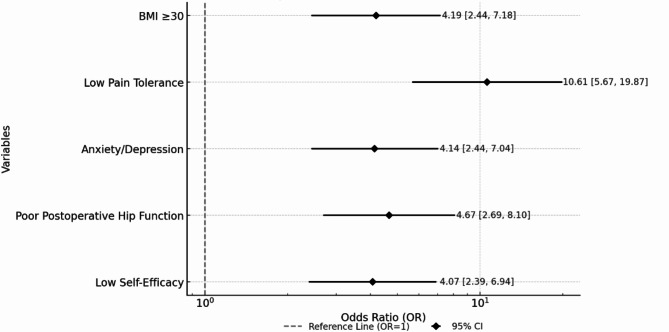
Results: The cumulative incidence of PMD was 34.9%. Univariate analysis revealed that BMI ≥ 30 kg/m², low pain acceptance, anxiety and depression, poor postoperative hip joint function, and low self-efficacy were significantly associated with PMD (P < 0.001). Multivariate logistic regression analysis further confirmed that BMI ≥ 30 kg/m² (OR = 4.07, 95% CI [2.39, 6.94]), low pain acceptance (OR = 4.67, 95% CI [2.69, 8.10]), anxiety and depression (OR = 4.14, 95% CI [2.44, 7.04]), poor postoperative hip joint function (OR = 10.61, 95% CI [5.67, 19.87]), and low self-efficacy (OR = 4.19, 95% CI [2.44, 7.18]) were independent risk factors for PMD. All VIF values were < 5, indicating no significant multicollinearity.
Conclusion: PMD is common after hip fracture internal fixation surgery and is closely associated with high BMI, low pain acceptance, anxiety and depression, poor postoperative hip joint function, and low self-efficacy. The VIF analysis showed no significant multicollinearity, indicating stable results. Comprehensive interventions targeting high-risk factors may help reduce the incidence of PMD and improve postoperative recovery.
期刊介绍:
Journal of Orthopaedic Surgery and Research is an open access journal that encompasses all aspects of clinical and basic research studies related to musculoskeletal issues.
Orthopaedic research is conducted at clinical and basic science levels. With the advancement of new technologies and the increasing expectation and demand from doctors and patients, we are witnessing an enormous growth in clinical orthopaedic research, particularly in the fields of traumatology, spinal surgery, joint replacement, sports medicine, musculoskeletal tumour management, hand microsurgery, foot and ankle surgery, paediatric orthopaedic, and orthopaedic rehabilitation. The involvement of basic science ranges from molecular, cellular, structural and functional perspectives to tissue engineering, gait analysis, automation and robotic surgery. Implant and biomaterial designs are new disciplines that complement clinical applications.
JOSR encourages the publication of multidisciplinary research with collaboration amongst clinicians and scientists from different disciplines, which will be the trend in the coming decades.




 京公网安备 11010802042870号
京ICP备2023020795号-1
京公网安备 11010802042870号
京ICP备2023020795号-1

 分享
分享
 求助内容:
求助内容: 应助结果提醒方式:
 扫码关注我们
