{"title":"Exploring the concept of Total Pain in contemporary oncology palliative care: a qualitative study on patients' resources.","authors":"Maya Corman, Michaël Dambrun, Angeline Ginzac, Katell Ménard","doi":"10.1186/s12904-025-01719-0","DOIUrl":null,"url":null,"abstract":"<p><strong>Background: </strong>According to the concept of Total Pain proposed by Cicely Saunders (1967), the treatment of pain for patients in need of palliative care requires considering its multidimensional nature, encompassing physical, social, psychological, and spiritual aspects. The aim of this study was to update the concept of Total Pain and explore the resources used by patients with cancer.</p><p><strong>Methods: </strong>Fourteen semi-structured interviews were conducted in one oncology center and one oncology rehabilitation center (median age = 70.5, range [55-77]; 8 women). The interview guide explored various dimensions of suffering, including physical (e.g., pain), social (e.g., isolation), psychological (e.g., emotional state), and spiritual (e.g., the role of spirituality in illness experience), as well as connections to nature, and patients' internal and external resources related to each sphere of suffering. Interpretative Phenomenological Approach (IPA) was employed to analyze the interviews.</p><p><strong>Results: </strong>The findings highlight several important aspects of suffering: the unpredictability of pain (physical sphere), loss of social roles (social sphere), negative affects (psychological sphere), evocation of the end of life (spiritual sphere), and loss of contact with nature. Besides in terms of resources, the study identifies several key coping mechanisms, such as mind-body practices for relieving physical and psychological pain, distraction engaging with the environment, nature as a source of positive emotions, and the search for meaning.</p><p><strong>Conclusions: </strong>Despite experiencing total pain, some patients utilize internal and external protective resources in the face of life-threatening illness. These findings underscore the importance of viewing Total Pain under its multidimensional aspect and as a dynamic process involving the individual's connection with their community and environment.</p><p><strong>Trial registration: </strong>This study received approval from the Ethical Committee of CPP SUD EST 1 (National number: 2019-A02263-54).</p>","PeriodicalId":48945,"journal":{"name":"BMC Palliative Care","volume":"24 1","pages":"85"},"PeriodicalIF":2.5000,"publicationDate":"2025-03-29","publicationTypes":"Journal Article","fieldsOfStudy":null,"isOpenAccess":false,"openAccessPdf":"https://www.ncbi.nlm.nih.gov/pmc/articles/PMC11954188/pdf/","citationCount":"0","resultStr":null,"platform":"Semanticscholar","paperid":null,"PeriodicalName":"BMC Palliative Care","FirstCategoryId":"3","ListUrlMain":"https://doi.org/10.1186/s12904-025-01719-0","RegionNum":2,"RegionCategory":"医学","ArticlePicture":[],"TitleCN":null,"AbstractTextCN":null,"PMCID":null,"EPubDate":"","PubModel":"","JCR":"Q2","JCRName":"HEALTH CARE SCIENCES & SERVICES","Score":null,"Total":0}
引用次数: 0
Abstract
Background: According to the concept of Total Pain proposed by Cicely Saunders (1967), the treatment of pain for patients in need of palliative care requires considering its multidimensional nature, encompassing physical, social, psychological, and spiritual aspects. The aim of this study was to update the concept of Total Pain and explore the resources used by patients with cancer.
Methods: Fourteen semi-structured interviews were conducted in one oncology center and one oncology rehabilitation center (median age = 70.5, range [55-77]; 8 women). The interview guide explored various dimensions of suffering, including physical (e.g., pain), social (e.g., isolation), psychological (e.g., emotional state), and spiritual (e.g., the role of spirituality in illness experience), as well as connections to nature, and patients' internal and external resources related to each sphere of suffering. Interpretative Phenomenological Approach (IPA) was employed to analyze the interviews.
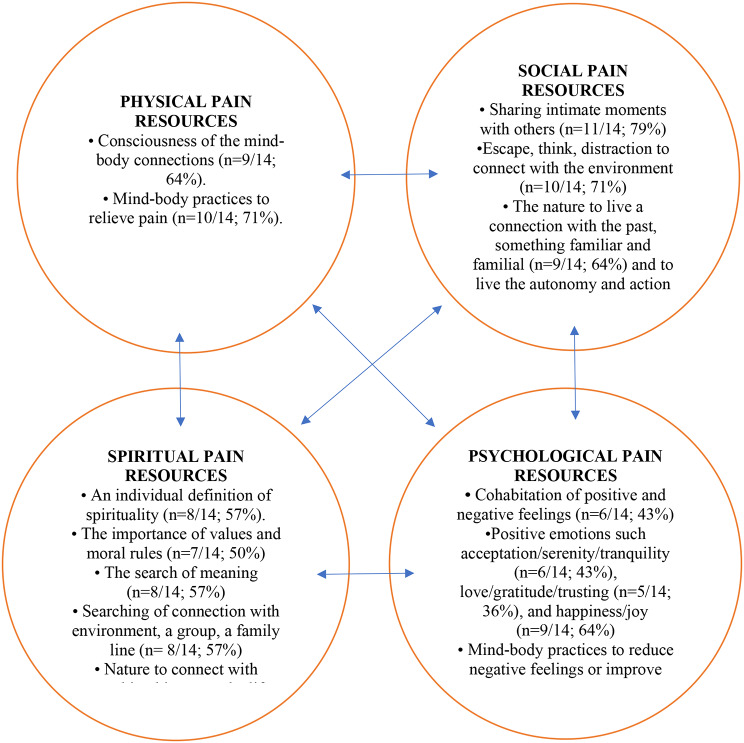
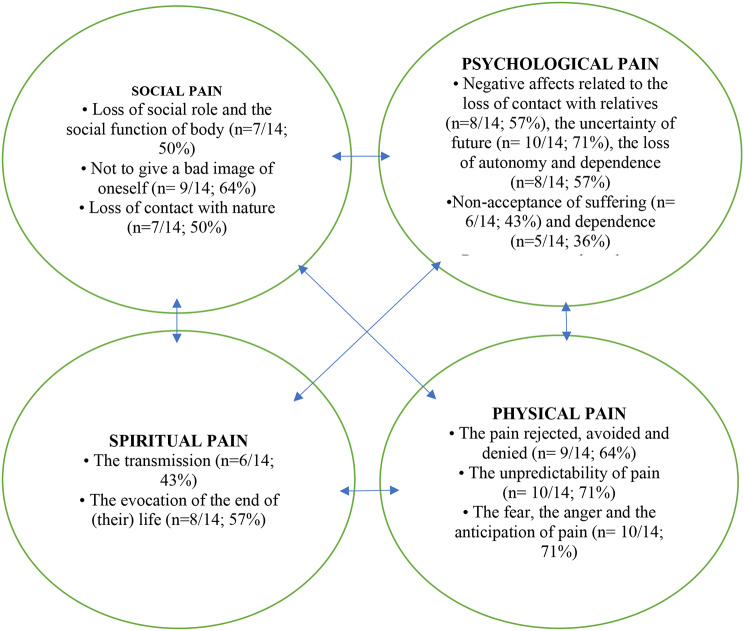
Results: The findings highlight several important aspects of suffering: the unpredictability of pain (physical sphere), loss of social roles (social sphere), negative affects (psychological sphere), evocation of the end of life (spiritual sphere), and loss of contact with nature. Besides in terms of resources, the study identifies several key coping mechanisms, such as mind-body practices for relieving physical and psychological pain, distraction engaging with the environment, nature as a source of positive emotions, and the search for meaning.
Conclusions: Despite experiencing total pain, some patients utilize internal and external protective resources in the face of life-threatening illness. These findings underscore the importance of viewing Total Pain under its multidimensional aspect and as a dynamic process involving the individual's connection with their community and environment.
Trial registration: This study received approval from the Ethical Committee of CPP SUD EST 1 (National number: 2019-A02263-54).
背景:根据Cicely Saunders(1967)提出的Total Pain概念,对需要姑息治疗的患者进行疼痛治疗需要考虑其多维性,包括身体、社会、心理和精神方面。本研究的目的是更新全痛的概念,并探索癌症患者使用的资源。方法:在1家肿瘤中心和1家肿瘤康复中心进行14次半结构化访谈(年龄中位数= 70.5,范围[55 ~ 77];8妇女)。访谈指南探讨了痛苦的各个方面,包括身体(例如疼痛)、社会(例如孤立)、心理(例如情绪状态)和精神(例如精神在疾病经历中的作用),以及与自然的联系,以及患者与每个痛苦领域相关的内部和外部资源。采用解释现象学方法(IPA)对访谈进行分析。结果:研究结果强调了痛苦的几个重要方面:痛苦的不可预测性(身体领域),社会角色的丧失(社会领域),负面影响(心理领域),生命终结的召唤(精神领域),以及与自然的失去联系。除了在资源方面,该研究还确定了几个关键的应对机制,比如缓解身心疼痛的身心练习,与环境接触的分心,作为积极情绪来源的自然,以及寻找意义。结论:面对危及生命的疾病,一些患者尽管经历了全身疼痛,但仍会利用内部和外部的保护资源。这些发现强调了从多维角度看待全面疼痛的重要性,并将其视为一个涉及个人与社区和环境联系的动态过程。试验注册:本研究已获得CPP SUD EST 1伦理委员会批准(国家编号:2019-A02263-54)。
期刊介绍:
BMC Palliative Care is an open access journal publishing original peer-reviewed research articles in the clinical, scientific, ethical and policy issues, local and international, regarding all aspects of hospice and palliative care for the dying and for those with profound suffering related to chronic illness.



 京公网安备 11010802042870号
京ICP备2023020795号-1
京公网安备 11010802042870号
京ICP备2023020795号-1

 分享
分享
 求助内容:
求助内容: 应助结果提醒方式:
 扫码关注我们
