Increased expression of PTCH1 and GLI1 in Bangladeshi TNBC Patients after Treatment with Doxorubicin and Cyclophosphamide Suggests a Favorable Response to Chemotherapy.
Ramendu Parial, Shafiqul Islam, Ridwan Ahmed, Nusrat Jerin, S M Sabbir Alam, Md Mizanur Rahman, Ali Asgar Chowdhury, Shakera Ahmed, Mohammed Moinul Islam, Abu Shadat Mohammod Noman, Muhammad Mosaraf Hossain
{"title":"Increased expression of PTCH1 and GLI1 in Bangladeshi TNBC Patients after Treatment with Doxorubicin and Cyclophosphamide Suggests a Favorable Response to Chemotherapy.","authors":"Ramendu Parial, Shafiqul Islam, Ridwan Ahmed, Nusrat Jerin, S M Sabbir Alam, Md Mizanur Rahman, Ali Asgar Chowdhury, Shakera Ahmed, Mohammed Moinul Islam, Abu Shadat Mohammod Noman, Muhammad Mosaraf Hossain","doi":"10.31557/APJCP.2025.26.3.949","DOIUrl":null,"url":null,"abstract":"<p><strong>Background: </strong>The Hedgehog (Hh) signaling pathway is commonly exploited for intercellular communication throughout development and organogenesis. Disruption of Hh signaling contributes to benign and malignant growth including breast cancer (BC). The distinct expression pattern of genes can be used as a sign of treatment efficacy and to make a new treatment plan. The present study was designed to evaluate the expression pattern of Hh signaling pathway genes such as Sonic Hedgehog (SHH), Smoothend (SMO), Glioma-associated Oncogene Homolog 1 (GLI1), and Patched 1 (PTCH1) in TNBC before and after chemotherapeutic treatment.</p><p><strong>Methods: </strong>A total of 18 (eighteen) TNBC patients were included in this study. Expression of the Hh signaling pathway genes was measured in the TNBC patient's tumor tissue and blood sample before and after chemotherapy by qRT-PCR. GraphPad Prism was used to analyze the experimental data.</p><p><strong>Results: </strong>SHH and SMO expression were found to increase in tissue samples of TNBC subtypes, whereas GLI1 and PTCH1 expression were decreased compared to adjacent noncancerous tissue. After chemotherapeutic treatment, upregulation was found for GLI1 and PTCH1 expression in blood samples when compared to the expression in blood samples of untreated-stage patients or healthy control group. Moreover, SHH and SMO expression were found to decrease compared to the untreated group.</p><p><strong>Conclusion: </strong>Upregulation of GLI1 and PTCH1 expression, with substantially decreased expression of SHH and SMO after the chemotherapeutic treatment may be associated with positive outcome of chemotherapy.</p>","PeriodicalId":55451,"journal":{"name":"Asian Pacific Journal of Cancer Prevention","volume":"26 3","pages":"949-958"},"PeriodicalIF":0.0000,"publicationDate":"2025-03-01","publicationTypes":"Journal Article","fieldsOfStudy":null,"isOpenAccess":false,"openAccessPdf":"https://www.ncbi.nlm.nih.gov/pmc/articles/PMC12174530/pdf/","citationCount":"0","resultStr":null,"platform":"Semanticscholar","paperid":null,"PeriodicalName":"Asian Pacific Journal of Cancer Prevention","FirstCategoryId":"1085","ListUrlMain":"https://doi.org/10.31557/APJCP.2025.26.3.949","RegionNum":0,"RegionCategory":null,"ArticlePicture":[],"TitleCN":null,"AbstractTextCN":null,"PMCID":null,"EPubDate":"","PubModel":"","JCR":"Q2","JCRName":"Medicine","Score":null,"Total":0}
引用次数: 0
Abstract
Background: The Hedgehog (Hh) signaling pathway is commonly exploited for intercellular communication throughout development and organogenesis. Disruption of Hh signaling contributes to benign and malignant growth including breast cancer (BC). The distinct expression pattern of genes can be used as a sign of treatment efficacy and to make a new treatment plan. The present study was designed to evaluate the expression pattern of Hh signaling pathway genes such as Sonic Hedgehog (SHH), Smoothend (SMO), Glioma-associated Oncogene Homolog 1 (GLI1), and Patched 1 (PTCH1) in TNBC before and after chemotherapeutic treatment.
Methods: A total of 18 (eighteen) TNBC patients were included in this study. Expression of the Hh signaling pathway genes was measured in the TNBC patient's tumor tissue and blood sample before and after chemotherapy by qRT-PCR. GraphPad Prism was used to analyze the experimental data.
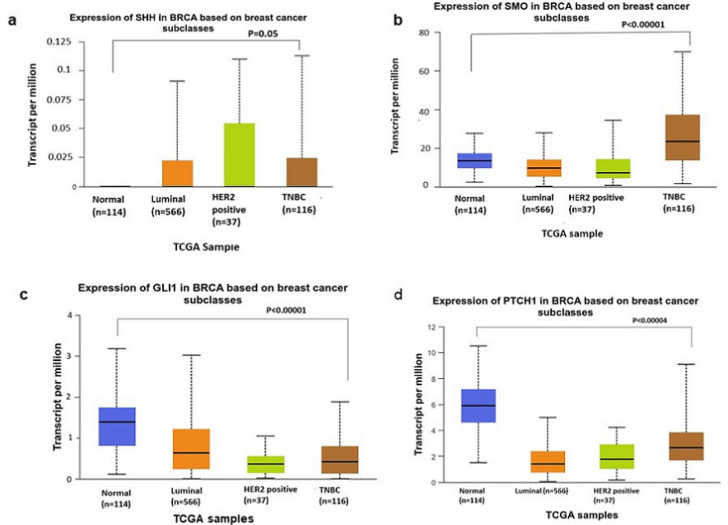
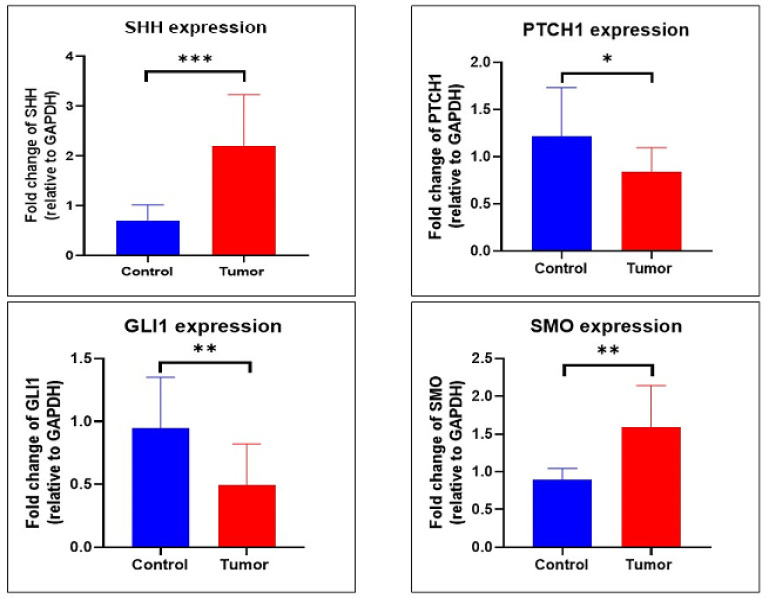
Results: SHH and SMO expression were found to increase in tissue samples of TNBC subtypes, whereas GLI1 and PTCH1 expression were decreased compared to adjacent noncancerous tissue. After chemotherapeutic treatment, upregulation was found for GLI1 and PTCH1 expression in blood samples when compared to the expression in blood samples of untreated-stage patients or healthy control group. Moreover, SHH and SMO expression were found to decrease compared to the untreated group.
Conclusion: Upregulation of GLI1 and PTCH1 expression, with substantially decreased expression of SHH and SMO after the chemotherapeutic treatment may be associated with positive outcome of chemotherapy.
期刊介绍:
Cancer is a very complex disease. While many aspects of carcinoge-nesis and oncogenesis are known, cancer control and prevention at the community level is however still in its infancy. Much more work needs to be done and many more steps need to be taken before effective strategies are developed. The multidisciplinary approaches and efforts to understand and control cancer in an effective and efficient manner, require highly trained scientists in all branches of the cancer sciences, from cellular and molecular aspects to patient care and palliation.
The Asia Pacific Organization for Cancer Prevention (APOCP) and its official publication, the Asia Pacific Journal of Cancer Prevention (APJCP), have served the community of cancer scientists very well and intends to continue to serve in this capacity to the best of its abilities. One of the objectives of the APOCP is to provide all relevant and current scientific information on the whole spectrum of cancer sciences. They aim to do this by providing a forum for communication and propagation of original and innovative research findings that have relevance to understanding the etiology, progression, treatment, and survival of patients, through their journal. The APJCP with its distinguished, diverse, and Asia-wide team of editors, reviewers, and readers, ensure the highest standards of research communication within the cancer sciences community across Asia as well as globally.
The APJCP publishes original research results under the following categories:
-Epidemiology, detection and screening.
-Cellular research and bio-markers.
-Identification of bio-targets and agents with novel mechanisms of action.
-Optimal clinical use of existing anti-cancer agents, including combination therapies.
-Radiation and surgery.
-Palliative care.
-Patient adherence, quality of life, satisfaction.
-Health economic evaluations.




 京公网安备 11010802042870号
京ICP备2023020795号-1
京公网安备 11010802042870号
京ICP备2023020795号-1

 分享
分享
 求助内容:
求助内容: 应助结果提醒方式:
 扫码关注我们
