The Synergistic and Anticancer Potential of Withania Somnifera (Ashwagandha) Ethanol Extract as an Adjuvant with Doxorubicin in MCF7 Breast Cancer Cell Line.
Emad M Elzayat, Ghada E Elsamahy, Ghada H Mansour, Ahmed A El-Sherif, Nourhan Hassan
{"title":"The Synergistic and Anticancer Potential of Withania Somnifera (Ashwagandha) Ethanol Extract as an Adjuvant with Doxorubicin in MCF7 Breast Cancer Cell Line.","authors":"Emad M Elzayat, Ghada E Elsamahy, Ghada H Mansour, Ahmed A El-Sherif, Nourhan Hassan","doi":"10.31557/APJCP.2025.26.3.757","DOIUrl":null,"url":null,"abstract":"<p><strong>Background: </strong>Recent approaches in breast cancer treatment involve exploring natural extracts either as substitutes for traditional chemotherapeutic agents or as adjuvants to enhance their effectiveness. In this context, ethanolic extracts from Withania Somnifera (WS) and Arctium Lappa (AL) have gained attention for their potential anticancer properties across various cancer types.</p><p><strong>Objective: </strong>This study aimed to investigate the in vitro anticancer efficacy of ethanolic extracts from both WS and AL in the MCF7 breast cancer cell line.</p><p><strong>Methods: </strong>The study encompassed assessments of total antioxidant activity, total flavonoids, total phenolic compounds, and cytotoxicity for each extract. Unraveling the molecular mechanisms underlying the action of these extracts involved Real-time PCR and flow cytometry to analyze apoptotic markers and cell cycle dynamics, respectively.</p><p><strong>Results: </strong>Results indicated that the WS ethanolic extract exhibited better efficacy, especially in terms of IC50. To explore its potential as an adjuvant with doxorubicin (DOX) in breast cancer therapy, 16 non-constant combination ratios were tested. The combination of 1/2 WS to 1/4 DOX, with a combination index (CI) of -0.229 was selected for further downstream molecular analysis. Gene expression analysis revealed a significant upregulation (p < 0.05) of P53, Cas3, Cas7, and Bax. Flow cytometric analysis further highlighted cell cycle arrest at the S phase. Additionally, the study explored the synergistic inhibitory effects of WS and DOX on key enzymes in the glycolytic pathway, namely, pyruvate kinase and aldolase.</p><p><strong>Conclusion: </strong>In conclusion, the ethanolic extract of WS demonstrated a synergistic effect as an adjuvant with DOX, showing promise as a combination therapy for breast cancer.</p>","PeriodicalId":55451,"journal":{"name":"Asian Pacific Journal of Cancer Prevention","volume":"26 3","pages":"757-766"},"PeriodicalIF":0.0000,"publicationDate":"2025-03-01","publicationTypes":"Journal Article","fieldsOfStudy":null,"isOpenAccess":false,"openAccessPdf":"https://www.ncbi.nlm.nih.gov/pmc/articles/PMC12174532/pdf/","citationCount":"0","resultStr":null,"platform":"Semanticscholar","paperid":null,"PeriodicalName":"Asian Pacific Journal of Cancer Prevention","FirstCategoryId":"1085","ListUrlMain":"https://doi.org/10.31557/APJCP.2025.26.3.757","RegionNum":0,"RegionCategory":null,"ArticlePicture":[],"TitleCN":null,"AbstractTextCN":null,"PMCID":null,"EPubDate":"","PubModel":"","JCR":"Q2","JCRName":"Medicine","Score":null,"Total":0}
引用次数: 0
Abstract
Background: Recent approaches in breast cancer treatment involve exploring natural extracts either as substitutes for traditional chemotherapeutic agents or as adjuvants to enhance their effectiveness. In this context, ethanolic extracts from Withania Somnifera (WS) and Arctium Lappa (AL) have gained attention for their potential anticancer properties across various cancer types.
Objective: This study aimed to investigate the in vitro anticancer efficacy of ethanolic extracts from both WS and AL in the MCF7 breast cancer cell line.
Methods: The study encompassed assessments of total antioxidant activity, total flavonoids, total phenolic compounds, and cytotoxicity for each extract. Unraveling the molecular mechanisms underlying the action of these extracts involved Real-time PCR and flow cytometry to analyze apoptotic markers and cell cycle dynamics, respectively.
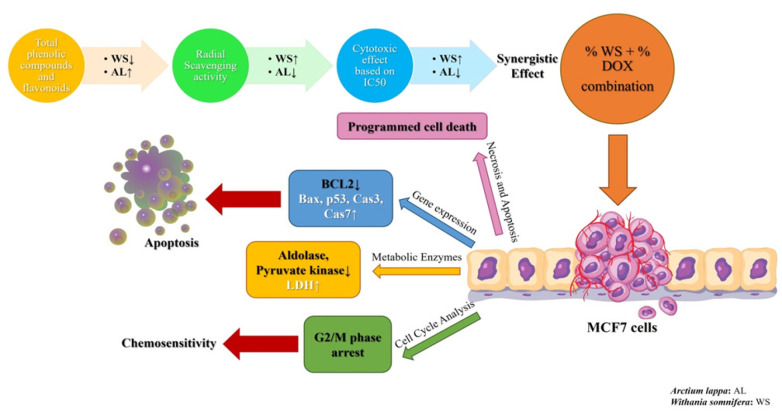
Results: Results indicated that the WS ethanolic extract exhibited better efficacy, especially in terms of IC50. To explore its potential as an adjuvant with doxorubicin (DOX) in breast cancer therapy, 16 non-constant combination ratios were tested. The combination of 1/2 WS to 1/4 DOX, with a combination index (CI) of -0.229 was selected for further downstream molecular analysis. Gene expression analysis revealed a significant upregulation (p < 0.05) of P53, Cas3, Cas7, and Bax. Flow cytometric analysis further highlighted cell cycle arrest at the S phase. Additionally, the study explored the synergistic inhibitory effects of WS and DOX on key enzymes in the glycolytic pathway, namely, pyruvate kinase and aldolase.
Conclusion: In conclusion, the ethanolic extract of WS demonstrated a synergistic effect as an adjuvant with DOX, showing promise as a combination therapy for breast cancer.
期刊介绍:
Cancer is a very complex disease. While many aspects of carcinoge-nesis and oncogenesis are known, cancer control and prevention at the community level is however still in its infancy. Much more work needs to be done and many more steps need to be taken before effective strategies are developed. The multidisciplinary approaches and efforts to understand and control cancer in an effective and efficient manner, require highly trained scientists in all branches of the cancer sciences, from cellular and molecular aspects to patient care and palliation.
The Asia Pacific Organization for Cancer Prevention (APOCP) and its official publication, the Asia Pacific Journal of Cancer Prevention (APJCP), have served the community of cancer scientists very well and intends to continue to serve in this capacity to the best of its abilities. One of the objectives of the APOCP is to provide all relevant and current scientific information on the whole spectrum of cancer sciences. They aim to do this by providing a forum for communication and propagation of original and innovative research findings that have relevance to understanding the etiology, progression, treatment, and survival of patients, through their journal. The APJCP with its distinguished, diverse, and Asia-wide team of editors, reviewers, and readers, ensure the highest standards of research communication within the cancer sciences community across Asia as well as globally.
The APJCP publishes original research results under the following categories:
-Epidemiology, detection and screening.
-Cellular research and bio-markers.
-Identification of bio-targets and agents with novel mechanisms of action.
-Optimal clinical use of existing anti-cancer agents, including combination therapies.
-Radiation and surgery.
-Palliative care.
-Patient adherence, quality of life, satisfaction.
-Health economic evaluations.





 京公网安备 11010802042870号
京ICP备2023020795号-1
京公网安备 11010802042870号
京ICP备2023020795号-1

 分享
分享
 求助内容:
求助内容: 应助结果提醒方式:
 扫码关注我们
