Fanjie Xu, Wentao Guo, Feng Wang, Lin Yao, Hongshuai Wang, Fujie Tang, Zhifeng Gao, Linfeng Zhang, Weinan E, Zhong-Qun Tian, Jun Cheng
{"title":"Toward a unified benchmark and framework for deep learning-based prediction of nuclear magnetic resonance chemical shifts","authors":"Fanjie Xu, Wentao Guo, Feng Wang, Lin Yao, Hongshuai Wang, Fujie Tang, Zhifeng Gao, Linfeng Zhang, Weinan E, Zhong-Qun Tian, Jun Cheng","doi":"10.1038/s43588-025-00783-z","DOIUrl":null,"url":null,"abstract":"The study of structure–spectrum relationships is essential for spectral interpretation, impacting structural elucidation and material design. Predicting spectra from molecular structures is challenging due to their complex relationships. Here we introduce NMRNet, a deep learning framework using the SE(3) Transformer for atomic environment modeling, following a pretraining and fine-tuning paradigm. To support the evaluation of nuclear magnetic resonance chemical shift prediction models, we have established a comprehensive benchmark based on previous research and databases, covering diverse chemical systems. Applying NMRNet to these benchmark datasets, we achieve competitive performance in both liquid-state and solid-state nuclear magnetic resonance datasets, demonstrating its robustness and practical utility in real-world scenarios. Our work helps to advance deep learning applications in analytical and structural chemistry. A deep learning framework (NMRNet) is developed to model atomic environments for predicting NMR chemical shifts. A benchmark dataset, nmrshiftdb2-2024, is also established to provide a standardized source for evaluating NMR models.","PeriodicalId":74246,"journal":{"name":"Nature computational science","volume":"5 4","pages":"292-300"},"PeriodicalIF":18.3000,"publicationDate":"2025-03-28","publicationTypes":"Journal Article","fieldsOfStudy":null,"isOpenAccess":false,"openAccessPdf":"","citationCount":"0","resultStr":null,"platform":"Semanticscholar","paperid":null,"PeriodicalName":"Nature computational science","FirstCategoryId":"1085","ListUrlMain":"https://www.nature.com/articles/s43588-025-00783-z","RegionNum":0,"RegionCategory":null,"ArticlePicture":[],"TitleCN":null,"AbstractTextCN":null,"PMCID":null,"EPubDate":"","PubModel":"","JCR":"Q1","JCRName":"COMPUTER SCIENCE, INTERDISCIPLINARY APPLICATIONS","Score":null,"Total":0}
引用次数: 0
Abstract
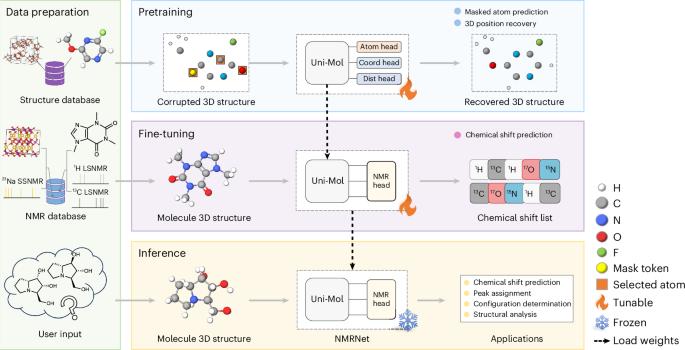
The study of structure–spectrum relationships is essential for spectral interpretation, impacting structural elucidation and material design. Predicting spectra from molecular structures is challenging due to their complex relationships. Here we introduce NMRNet, a deep learning framework using the SE(3) Transformer for atomic environment modeling, following a pretraining and fine-tuning paradigm. To support the evaluation of nuclear magnetic resonance chemical shift prediction models, we have established a comprehensive benchmark based on previous research and databases, covering diverse chemical systems. Applying NMRNet to these benchmark datasets, we achieve competitive performance in both liquid-state and solid-state nuclear magnetic resonance datasets, demonstrating its robustness and practical utility in real-world scenarios. Our work helps to advance deep learning applications in analytical and structural chemistry. A deep learning framework (NMRNet) is developed to model atomic environments for predicting NMR chemical shifts. A benchmark dataset, nmrshiftdb2-2024, is also established to provide a standardized source for evaluating NMR models.



 京公网安备 11010802042870号
京ICP备2023020795号-1
京公网安备 11010802042870号
京ICP备2023020795号-1

 分享
分享

 求助内容:
求助内容: 应助结果提醒方式:
 扫码关注我们
