Yi-Yin Yang, Lin He, Peng-Fei Xie, Peng Dong, Hao Quan, Tao Li, Lingzhe Fang, Dong Feng, Yubo Xing and Jin-Cheng Li
{"title":"Carbon-nanotube wall nanoengineering strategy to stabilize FeNi nanoparticles and Fe single atoms for rechargeable Zn–air batteries†","authors":"Yi-Yin Yang, Lin He, Peng-Fei Xie, Peng Dong, Hao Quan, Tao Li, Lingzhe Fang, Dong Feng, Yubo Xing and Jin-Cheng Li","doi":"10.1039/D4QI03361B","DOIUrl":null,"url":null,"abstract":"<p >The great interest in rechargeable Zn–air batteries (ZABs) stimulates extensive research on efficient and robust electrocatalysts for the oxygen reduction reaction (ORR) and oxygen evolution reaction (OER). Herein, a novel ORR/OER bifunctional catalyst is developed using carbon-nanotube wall nanoengineering. In this design, FeNi nanoparticles are inserted into the wall <em>via</em> a carbothermic reaction to enhance the OER, while isolated Fe atoms in iron-phthalocyanine anchored on the wall <em>via</em> π–π coupling interaction are used to catalyze the ORR. Accordingly, the resulting electrocatalyst exhibits outstanding ORR and OER activities such as a small potential difference of 0.67 V. <em>In situ</em> Raman spectroscopy measurements verify the presence of reconstruction transformation from an alloy phase to a high-activity spinel phase during the OER process. When used in ZABs, high peak power densities of 208.5 mW cm<small><sup>−2</sup></small> under a liquid-state electrolyte and 150.1 mW cm<small><sup>−2</sup></small> in a solid-state electrolyte are demonstrated. Furthermore, outstanding battery durability is illustrated by a small and stable charge–discharge voltage gap of 0.78 V at 10 mA cm<small><sup>−2</sup></small> after 1400 cycles. This study offers a novel method to fabricate bifunctional ORR/OER electrocatalysts and possibly extends to multi-site catalysts.</p>","PeriodicalId":79,"journal":{"name":"Inorganic Chemistry Frontiers","volume":" 14","pages":" 4409-4416"},"PeriodicalIF":6.4000,"publicationDate":"2025-04-01","publicationTypes":"Journal Article","fieldsOfStudy":null,"isOpenAccess":false,"openAccessPdf":"","citationCount":"0","resultStr":null,"platform":"Semanticscholar","paperid":null,"PeriodicalName":"Inorganic Chemistry Frontiers","FirstCategoryId":"92","ListUrlMain":"https://pubs.rsc.org/en/content/articlelanding/2025/qi/d4qi03361b","RegionNum":1,"RegionCategory":"化学","ArticlePicture":[],"TitleCN":null,"AbstractTextCN":null,"PMCID":null,"EPubDate":"","PubModel":"","JCR":"Q1","JCRName":"CHEMISTRY, INORGANIC & NUCLEAR","Score":null,"Total":0}
引用次数: 0
Abstract
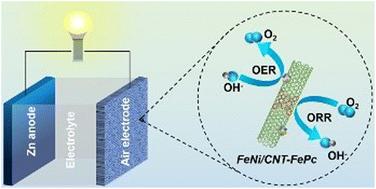
The great interest in rechargeable Zn–air batteries (ZABs) stimulates extensive research on efficient and robust electrocatalysts for the oxygen reduction reaction (ORR) and oxygen evolution reaction (OER). Herein, a novel ORR/OER bifunctional catalyst is developed using carbon-nanotube wall nanoengineering. In this design, FeNi nanoparticles are inserted into the wall via a carbothermic reaction to enhance the OER, while isolated Fe atoms in iron-phthalocyanine anchored on the wall via π–π coupling interaction are used to catalyze the ORR. Accordingly, the resulting electrocatalyst exhibits outstanding ORR and OER activities such as a small potential difference of 0.67 V. In situ Raman spectroscopy measurements verify the presence of reconstruction transformation from an alloy phase to a high-activity spinel phase during the OER process. When used in ZABs, high peak power densities of 208.5 mW cm−2 under a liquid-state electrolyte and 150.1 mW cm−2 in a solid-state electrolyte are demonstrated. Furthermore, outstanding battery durability is illustrated by a small and stable charge–discharge voltage gap of 0.78 V at 10 mA cm−2 after 1400 cycles. This study offers a novel method to fabricate bifunctional ORR/OER electrocatalysts and possibly extends to multi-site catalysts.




 京公网安备 11010802042870号
京ICP备2023020795号-1
京公网安备 11010802042870号
京ICP备2023020795号-1

 分享
分享
 求助内容:
求助内容: 应助结果提醒方式:
 扫码关注我们
