Xu Ding, Xin Zhou, Xiao Wang, Hailong Wang and Jianzhuang Jiang
{"title":"Linker engineering of covalent organic frameworks for efficient photocatalytic hydrogen evolution†","authors":"Xu Ding, Xin Zhou, Xiao Wang, Hailong Wang and Jianzhuang Jiang","doi":"10.1039/D5QI00417A","DOIUrl":null,"url":null,"abstract":"<p >Interfacial charge transfer and active sites play important roles in the performance of heterogeneous photocatalysts. Reticular chemistry in covalent organic frameworks (COFs) allows the construction of isomeric architectures made of different donor and acceptor monomers for tuning the charge transfer dynamics and active sites. Herein, five D–A dual-pore COFs were prepared from the reaction of naphthalene-2,6-diamine (electron donor) with different tetraaldehyde electron acceptors. Experimental results disclosed that linker engineering, by changing the conjugation systems using heteroatoms of benzooxadiazole, benzothiadiazole, benzoselenadiazole, naphthothiadiazole, and naphthoselenadiazole, tuned the electron-accepting capacity of the corresponding D–A COFs. Among the five samples, the naphthothiadiazole-derived COF demonstrated optimal charge transfer and active sites, exhibiting the highest hydrogen evolution rate of <em>ca.</em> 35 mmol g<small><sup>−1</sup></small> h<small><sup>−1</sup></small> in the presence of 3 wt% Pt under visible-light irradiation (>420 nm). This work illustrates linker engineering as a strategy for the simultaneous adjustment of interfacial charge transfer and active sites to enhance the hydrogen generation efficiency, offering new vigor to develop the COF photocatalysts on the basis of reticular synthesis.</p>","PeriodicalId":79,"journal":{"name":"Inorganic Chemistry Frontiers","volume":" 14","pages":" 4417-4427"},"PeriodicalIF":6.4000,"publicationDate":"2025-04-01","publicationTypes":"Journal Article","fieldsOfStudy":null,"isOpenAccess":false,"openAccessPdf":"","citationCount":"0","resultStr":null,"platform":"Semanticscholar","paperid":null,"PeriodicalName":"Inorganic Chemistry Frontiers","FirstCategoryId":"92","ListUrlMain":"https://pubs.rsc.org/en/content/articlelanding/2025/qi/d5qi00417a","RegionNum":1,"RegionCategory":"化学","ArticlePicture":[],"TitleCN":null,"AbstractTextCN":null,"PMCID":null,"EPubDate":"","PubModel":"","JCR":"Q1","JCRName":"CHEMISTRY, INORGANIC & NUCLEAR","Score":null,"Total":0}
引用次数: 0
Abstract
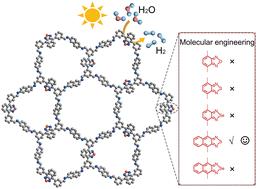
Interfacial charge transfer and active sites play important roles in the performance of heterogeneous photocatalysts. Reticular chemistry in covalent organic frameworks (COFs) allows the construction of isomeric architectures made of different donor and acceptor monomers for tuning the charge transfer dynamics and active sites. Herein, five D–A dual-pore COFs were prepared from the reaction of naphthalene-2,6-diamine (electron donor) with different tetraaldehyde electron acceptors. Experimental results disclosed that linker engineering, by changing the conjugation systems using heteroatoms of benzooxadiazole, benzothiadiazole, benzoselenadiazole, naphthothiadiazole, and naphthoselenadiazole, tuned the electron-accepting capacity of the corresponding D–A COFs. Among the five samples, the naphthothiadiazole-derived COF demonstrated optimal charge transfer and active sites, exhibiting the highest hydrogen evolution rate of ca. 35 mmol g−1 h−1 in the presence of 3 wt% Pt under visible-light irradiation (>420 nm). This work illustrates linker engineering as a strategy for the simultaneous adjustment of interfacial charge transfer and active sites to enhance the hydrogen generation efficiency, offering new vigor to develop the COF photocatalysts on the basis of reticular synthesis.



 京公网安备 11010802042870号
京ICP备2023020795号-1
京公网安备 11010802042870号
京ICP备2023020795号-1

 分享
分享
 求助内容:
求助内容: 应助结果提醒方式:
 扫码关注我们
