Unveiling the mechanism of enhanced alkaline hydrogen evolution kinetics on molybdenum–cobalt sulfides for efficient anion exchange membrane water electrolyzers†
Jingbin Huang, Bin Hu, Yunlin Li, Jie Zhu, Jing Jiang, Han Zhao, Jingxian Zhou, Lin Jin and Renbing Wu
{"title":"Unveiling the mechanism of enhanced alkaline hydrogen evolution kinetics on molybdenum–cobalt sulfides for efficient anion exchange membrane water electrolyzers†","authors":"Jingbin Huang, Bin Hu, Yunlin Li, Jie Zhu, Jing Jiang, Han Zhao, Jingxian Zhou, Lin Jin and Renbing Wu","doi":"10.1039/D4QI03314K","DOIUrl":null,"url":null,"abstract":"<p >The rational design of highly efficient and stable electrocatalysts for the alkaline hydrogen evolution reaction (HER) for anion exchange membrane water electrolyzers (AEMWEs) is urgently needed but remains quite challenging. Herein, we develop a core–shell-structured MoS<small><sub>2</sub></small>/CoS heterostructure (MCS-1) with an optimized shell thickness (60 nm) to address this challenge. Experimental and density functional theory (DFT) calculations disclose that the introduction of CoS into MoS<small><sub>2</sub></small> can not only promote the initial H<small><sub>2</sub></small>O adsorption/dissociation process and optimize the Gibbs free energy of hydrogen adsorption (Δ<em>G</em><small><sub>H*</sub></small>) but also induce the fast transfer of the adsorbed hydroxyl, thus avoiding the blocking and poisoning of active sites. Accordingly, MCS-1 exhibits a remarkably enhanced HER performance with lower overpotentials of 64 and 149 mV at 10 and 100 mA cm<small><sup>−2</sup></small>, respectively. More importantly, using MCS-1 as the cathode and anode to assemble an AEMWE device, we achieved a current density of 200 mA cm<small><sup>−2</sup></small> at a low voltage of 1.63 V and stable operation over 500 h in alkaline media. This work provides a new perspective on designing highly efficient and stable alkaline HER catalysts for AEMWEs.</p>","PeriodicalId":79,"journal":{"name":"Inorganic Chemistry Frontiers","volume":" 17","pages":" 5159-5169"},"PeriodicalIF":6.4000,"publicationDate":"2025-04-01","publicationTypes":"Journal Article","fieldsOfStudy":null,"isOpenAccess":false,"openAccessPdf":"","citationCount":"0","resultStr":null,"platform":"Semanticscholar","paperid":null,"PeriodicalName":"Inorganic Chemistry Frontiers","FirstCategoryId":"92","ListUrlMain":"https://pubs.rsc.org/en/content/articlelanding/2025/qi/d4qi03314k","RegionNum":1,"RegionCategory":"化学","ArticlePicture":[],"TitleCN":null,"AbstractTextCN":null,"PMCID":null,"EPubDate":"","PubModel":"","JCR":"Q1","JCRName":"CHEMISTRY, INORGANIC & NUCLEAR","Score":null,"Total":0}
引用次数: 0
Abstract
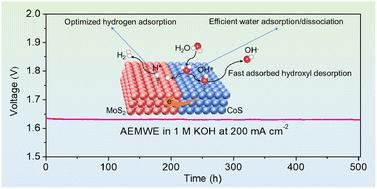
The rational design of highly efficient and stable electrocatalysts for the alkaline hydrogen evolution reaction (HER) for anion exchange membrane water electrolyzers (AEMWEs) is urgently needed but remains quite challenging. Herein, we develop a core–shell-structured MoS2/CoS heterostructure (MCS-1) with an optimized shell thickness (60 nm) to address this challenge. Experimental and density functional theory (DFT) calculations disclose that the introduction of CoS into MoS2 can not only promote the initial H2O adsorption/dissociation process and optimize the Gibbs free energy of hydrogen adsorption (ΔGH*) but also induce the fast transfer of the adsorbed hydroxyl, thus avoiding the blocking and poisoning of active sites. Accordingly, MCS-1 exhibits a remarkably enhanced HER performance with lower overpotentials of 64 and 149 mV at 10 and 100 mA cm−2, respectively. More importantly, using MCS-1 as the cathode and anode to assemble an AEMWE device, we achieved a current density of 200 mA cm−2 at a low voltage of 1.63 V and stable operation over 500 h in alkaline media. This work provides a new perspective on designing highly efficient and stable alkaline HER catalysts for AEMWEs.
合理设计高效稳定的电催化剂用于阴离子交换膜水电解槽(AEMWE)的碱性析氢反应(HER)是迫切需要的,但仍然具有很大的挑战性。为此,我们开发了具有优化壳厚(60 nm)的核壳结构MoS2/CoS异质结构(MCS-1)。实验和密度泛函数理论(DFT)计算表明,在MoS2中引入CoS不仅可以促进初始的H2O吸附/解离过程,优化氢吸附的吉布斯自由能(ΔGH*),还可以诱导吸附的羟基快速转移,从而避免活性位点的阻塞和中毒。因此,MCS-1在10和100 mA cm−2下的过电位分别为64和149 mV,具有显著增强的HER性能。更重要的是,采用MCS-1作为阴极和阳极组装的AEMWE器件,在1.63 V的低电压下,电流密度可达200 mA cm−2,在碱性介质中稳定工作500 h以上。本研究为设计高效稳定的AEMWE碱性HER催化剂提供了新的思路。



 京公网安备 11010802042870号
京ICP备2023020795号-1
京公网安备 11010802042870号
京ICP备2023020795号-1

 分享
分享
 求助内容:
求助内容: 应助结果提醒方式:
 扫码关注我们
