Hucheng Fu, Yanchen Chen, Yizhang Yang, Ningjun Zhou, Juguo Dai, Dongxu Li, Qiuyan Luo, Xiaohong Wang, Rong Jia, Hanzhong Ren, Qiaoyun Qin, Yiting Xu and Lizong Dai
{"title":"Polyaniline interface engineering-enabled oxygen vacancy-enriched NiCo-LDHs for ammonium-ion supercapacitors†","authors":"Hucheng Fu, Yanchen Chen, Yizhang Yang, Ningjun Zhou, Juguo Dai, Dongxu Li, Qiuyan Luo, Xiaohong Wang, Rong Jia, Hanzhong Ren, Qiaoyun Qin, Yiting Xu and Lizong Dai","doi":"10.1039/D5QI00083A","DOIUrl":null,"url":null,"abstract":"<p >Aqueous ammonium-ion supercapacitors have attracted much attention due to their high safety and economic and environmental advantages, but the development of high-performance electrode materials for NH<small><sub>4</sub></small><small><sup>+</sup></small> storage has lagged behind that of other carriers. Herein, we designed an organic–inorganic hybrid material (LDH-Vo@PANI) as the cathode for efficient NH<small><sub>4</sub></small><small><sup>+</sup></small> storage <em>via</em> interface engineering and defect engineering. The polyaniline coating enhanced the structural stability of NiCo-LDHs by constructing Ni/Co–N bonds, which inhibited their dissolution during charging and discharging. The oxygen vacancies effectively buffered the electrostatic interaction between NH<small><sub>4</sub></small><small><sup>+</sup></small> and NiCo-LDHs, thereby increasing the diffusion rate of NH<small><sub>4</sub></small><small><sup>+</sup></small>. Furthermore, density functional theory (DFT) calculations strongly demonstrate the positive effects of PANI coating and oxygen vacancies on the NH<small><sub>4</sub></small><small><sup>+</sup></small> adsorption capacity and conductive properties of the electrode material. Therefore, the LDH-Vo@PANI exhibits an area capacitance of up to 2091 mF cm<small><sup>−2</sup></small> at 1 mA cm<small><sup>−2</sup></small> while maintaining a high rate performance of 55.8%. The assembled supercapacitor exhibits an ultrahigh energy density of 75 W h kg<small><sup>−1</sup></small> and a power density of 788 W kg<small><sup>−1</sup></small> and retains 99.48% of its initial capacitance and 100% Coulomb efficiency after 10 000 cycles. This work provides a strategy with universal applicability for the development of high-performance ammonium storage electrode materials.</p>","PeriodicalId":79,"journal":{"name":"Inorganic Chemistry Frontiers","volume":" 15","pages":" 4653-4665"},"PeriodicalIF":6.4000,"publicationDate":"2025-04-01","publicationTypes":"Journal Article","fieldsOfStudy":null,"isOpenAccess":false,"openAccessPdf":"","citationCount":"0","resultStr":null,"platform":"Semanticscholar","paperid":null,"PeriodicalName":"Inorganic Chemistry Frontiers","FirstCategoryId":"92","ListUrlMain":"https://pubs.rsc.org/en/content/articlelanding/2025/qi/d5qi00083a","RegionNum":1,"RegionCategory":"化学","ArticlePicture":[],"TitleCN":null,"AbstractTextCN":null,"PMCID":null,"EPubDate":"","PubModel":"","JCR":"Q1","JCRName":"CHEMISTRY, INORGANIC & NUCLEAR","Score":null,"Total":0}
引用次数: 0
Abstract
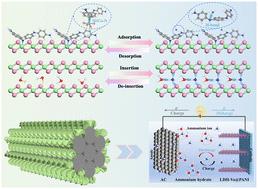
Aqueous ammonium-ion supercapacitors have attracted much attention due to their high safety and economic and environmental advantages, but the development of high-performance electrode materials for NH4+ storage has lagged behind that of other carriers. Herein, we designed an organic–inorganic hybrid material (LDH-Vo@PANI) as the cathode for efficient NH4+ storage via interface engineering and defect engineering. The polyaniline coating enhanced the structural stability of NiCo-LDHs by constructing Ni/Co–N bonds, which inhibited their dissolution during charging and discharging. The oxygen vacancies effectively buffered the electrostatic interaction between NH4+ and NiCo-LDHs, thereby increasing the diffusion rate of NH4+. Furthermore, density functional theory (DFT) calculations strongly demonstrate the positive effects of PANI coating and oxygen vacancies on the NH4+ adsorption capacity and conductive properties of the electrode material. Therefore, the LDH-Vo@PANI exhibits an area capacitance of up to 2091 mF cm−2 at 1 mA cm−2 while maintaining a high rate performance of 55.8%. The assembled supercapacitor exhibits an ultrahigh energy density of 75 W h kg−1 and a power density of 788 W kg−1 and retains 99.48% of its initial capacitance and 100% Coulomb efficiency after 10 000 cycles. This work provides a strategy with universal applicability for the development of high-performance ammonium storage electrode materials.



 京公网安备 11010802042870号
京ICP备2023020795号-1
京公网安备 11010802042870号
京ICP备2023020795号-1

 分享
分享
 求助内容:
求助内容: 应助结果提醒方式:
 扫码关注我们
