Zhentian Xu, Yangyang Zhu, Yun Ai, Zhongyi Yuan, Chunquan Li, Dan Zhou and Lie Chen
{"title":"Synchronous differential orientation of liquid crystal elastomers based on dual dynamic covalent bonds†","authors":"Zhentian Xu, Yangyang Zhu, Yun Ai, Zhongyi Yuan, Chunquan Li, Dan Zhou and Lie Chen","doi":"10.1039/D5TA00568J","DOIUrl":null,"url":null,"abstract":"<p >As a unique type of intelligent material, liquid crystal elastomers (LCEs) have numerous valuable advantages and show significant potential for application in the design of flexible actuators. Nevertheless, attaining controllable and precise orientation of LCEs using easily operated methods continues to pose a considerable challenge. In this study, a synchronous differential orientation strategy based on dual dynamic covalent bonds (DCBs) was proposed to solve these problems. Through the integration of dynamic boronic ester bonds and dynamic siloxane bonds into the LCE network, bilayer LCE films that exhibit distinct orientation configurations can be easily fabricated. Meanwhile, the variation in the bond energy between these two chemical bonds provides the ability to control the orientation of each layer separately, resulting in LCE films with adjustable bending angles. Furthermore, the addition of azobenzene to the LCE composition enables the material to undergo reversible bending when illuminated with alternating ultraviolet and visible light, revealing the potential for various actuation capabilities in innovative materials. This approach not only dramatically enhances the self-healing, programming, and recycling of LCEs, but also paves the way for the development of advanced flexible actuators with complex deformation properties, holding substantial potential for applications in robotics, biomedicine, and intelligent devices.</p>","PeriodicalId":82,"journal":{"name":"Journal of Materials Chemistry A","volume":" 18","pages":" 13091-13099"},"PeriodicalIF":9.5000,"publicationDate":"2025-04-01","publicationTypes":"Journal Article","fieldsOfStudy":null,"isOpenAccess":false,"openAccessPdf":"","citationCount":"0","resultStr":null,"platform":"Semanticscholar","paperid":null,"PeriodicalName":"Journal of Materials Chemistry A","FirstCategoryId":"88","ListUrlMain":"https://pubs.rsc.org/en/content/articlelanding/2025/ta/d5ta00568j","RegionNum":2,"RegionCategory":"材料科学","ArticlePicture":[],"TitleCN":null,"AbstractTextCN":null,"PMCID":null,"EPubDate":"","PubModel":"","JCR":"Q1","JCRName":"CHEMISTRY, PHYSICAL","Score":null,"Total":0}
引用次数: 0
Abstract
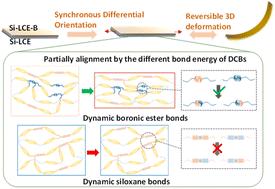
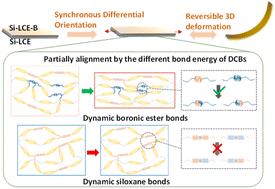
As a unique type of intelligent material, liquid crystal elastomers (LCEs) have numerous valuable advantages and show significant potential for application in the design of flexible actuators. Nevertheless, attaining controllable and precise orientation of LCEs using easily operated methods continues to pose a considerable challenge. In this study, a synchronous differential orientation strategy based on dual dynamic covalent bonds (DCBs) was proposed to solve these problems. Through the integration of dynamic boronic ester bonds and dynamic siloxane bonds into the LCE network, bilayer LCE films that exhibit distinct orientation configurations can be easily fabricated. Meanwhile, the variation in the bond energy between these two chemical bonds provides the ability to control the orientation of each layer separately, resulting in LCE films with adjustable bending angles. Furthermore, the addition of azobenzene to the LCE composition enables the material to undergo reversible bending when illuminated with alternating ultraviolet and visible light, revealing the potential for various actuation capabilities in innovative materials. This approach not only dramatically enhances the self-healing, programming, and recycling of LCEs, but also paves the way for the development of advanced flexible actuators with complex deformation properties, holding substantial potential for applications in robotics, biomedicine, and intelligent devices.
期刊介绍:
The Journal of Materials Chemistry A, B & C covers a wide range of high-quality studies in the field of materials chemistry, with each section focusing on specific applications of the materials studied. Journal of Materials Chemistry A emphasizes applications in energy and sustainability, including topics such as artificial photosynthesis, batteries, and fuel cells. Journal of Materials Chemistry B focuses on applications in biology and medicine, while Journal of Materials Chemistry C covers applications in optical, magnetic, and electronic devices. Example topic areas within the scope of Journal of Materials Chemistry A include catalysis, green/sustainable materials, sensors, and water treatment, among others.



 京公网安备 11010802042870号
京ICP备2023020795号-1
京公网安备 11010802042870号
京ICP备2023020795号-1

 分享
分享
 求助内容:
求助内容: 应助结果提醒方式:
 扫码关注我们
