Resonant defect states of the SnO2:Ta transparent conductive oxide revealed by excitation wavelength-dependent Raman spectroscopy and hybrid functional DFT calculations†
Matthias Krause, Carlos Romero-Muñiz, Oleksandr Selyshchev, Dietrich R. T. Zahn and Ramon Escobar-Galindo
{"title":"Resonant defect states of the SnO2:Ta transparent conductive oxide revealed by excitation wavelength-dependent Raman spectroscopy and hybrid functional DFT calculations†","authors":"Matthias Krause, Carlos Romero-Muñiz, Oleksandr Selyshchev, Dietrich R. T. Zahn and Ramon Escobar-Galindo","doi":"10.1039/D4TA08693G","DOIUrl":null,"url":null,"abstract":"<p >Excitation wavelength-dependent Raman spectroscopy, optical spectroscopy, and density functional theory (DFT) calculations with hybrid functionals were used to analyse the electronic structure of defects in SnO<small><sub>2</sub></small>:Ta (1.25 at% Ta) transparent conductive oxide thin films. Based on the Raman excitation profiles of the characteristic D<small><sub>1</sub></small> and D<small><sub>2</sub></small> defect modes of two tin vacancy V<small><sub>Sn</sub></small>-type defects and one oxygen interstitial O<small><sub>i</sub></small>-type defect, we derived the corresponding defect-induced electronic transitions of the involved defect states. DFT calculations revealed additional density-of-states for the three point defects at the top of the valence band (VB) in comparison to defect-free SnO<small><sub>2</sub></small> and SnO<small><sub>2</sub></small>:Ta. The largest distortion of the VB electronic structure was caused by the V<small><sub>Sn</sub></small>-type defect with the farthest possible distance from the Ta dopant in the studied 96-atom supercell, and the smallest distortion was caused by the O<small><sub>i</sub></small>-type defect. Accordingly, the amount of VB splitting showed a reverse order to the electronic transition energies. From the projected defect-density-of-states, we found a delocalized nature of the V<small><sub>Sn</sub></small>-type defects and a localized nature of the O<small><sub>i</sub></small>-type defect, accounting for the different degrees of distortion of the SnO<small><sub>2</sub></small>:Ta electronic structure. Based on these complementary experimental and theoretical results, the electronic structure of point defects in the SnO<small><sub>2</sub></small>:Ta transparent conductive oxide was elucidated in detail. Thus, the proposed approach has great potential to resolve the ongoing controversy about point defects in SnO<small><sub>2</sub></small>.</p>","PeriodicalId":82,"journal":{"name":"Journal of Materials Chemistry A","volume":" 20","pages":" 15128-15139"},"PeriodicalIF":9.5000,"publicationDate":"2025-04-01","publicationTypes":"Journal Article","fieldsOfStudy":null,"isOpenAccess":false,"openAccessPdf":"https://pubs.rsc.org/en/content/articlepdf/2025/ta/d4ta08693g?page=search","citationCount":"0","resultStr":null,"platform":"Semanticscholar","paperid":null,"PeriodicalName":"Journal of Materials Chemistry A","FirstCategoryId":"88","ListUrlMain":"https://pubs.rsc.org/en/content/articlelanding/2025/ta/d4ta08693g","RegionNum":2,"RegionCategory":"材料科学","ArticlePicture":[],"TitleCN":null,"AbstractTextCN":null,"PMCID":null,"EPubDate":"","PubModel":"","JCR":"Q1","JCRName":"CHEMISTRY, PHYSICAL","Score":null,"Total":0}
引用次数: 0
Abstract
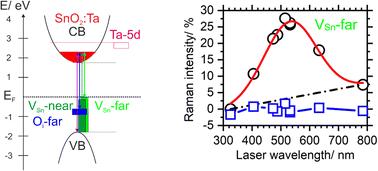
Excitation wavelength-dependent Raman spectroscopy, optical spectroscopy, and density functional theory (DFT) calculations with hybrid functionals were used to analyse the electronic structure of defects in SnO2:Ta (1.25 at% Ta) transparent conductive oxide thin films. Based on the Raman excitation profiles of the characteristic D1 and D2 defect modes of two tin vacancy VSn-type defects and one oxygen interstitial Oi-type defect, we derived the corresponding defect-induced electronic transitions of the involved defect states. DFT calculations revealed additional density-of-states for the three point defects at the top of the valence band (VB) in comparison to defect-free SnO2 and SnO2:Ta. The largest distortion of the VB electronic structure was caused by the VSn-type defect with the farthest possible distance from the Ta dopant in the studied 96-atom supercell, and the smallest distortion was caused by the Oi-type defect. Accordingly, the amount of VB splitting showed a reverse order to the electronic transition energies. From the projected defect-density-of-states, we found a delocalized nature of the VSn-type defects and a localized nature of the Oi-type defect, accounting for the different degrees of distortion of the SnO2:Ta electronic structure. Based on these complementary experimental and theoretical results, the electronic structure of point defects in the SnO2:Ta transparent conductive oxide was elucidated in detail. Thus, the proposed approach has great potential to resolve the ongoing controversy about point defects in SnO2.
期刊介绍:
The Journal of Materials Chemistry A, B & C covers a wide range of high-quality studies in the field of materials chemistry, with each section focusing on specific applications of the materials studied. Journal of Materials Chemistry A emphasizes applications in energy and sustainability, including topics such as artificial photosynthesis, batteries, and fuel cells. Journal of Materials Chemistry B focuses on applications in biology and medicine, while Journal of Materials Chemistry C covers applications in optical, magnetic, and electronic devices. Example topic areas within the scope of Journal of Materials Chemistry A include catalysis, green/sustainable materials, sensors, and water treatment, among others.



 京公网安备 11010802042870号
京ICP备2023020795号-1
京公网安备 11010802042870号
京ICP备2023020795号-1

 分享
分享
 求助内容:
求助内容: 应助结果提醒方式:
 扫码关注我们
