Qihang Wang, Jiqiong Liu, Huichao Lu, Shuo Liu, Liangyu Wang, Chenran Hao, Jing Han, Jun Yang, Yanna NuLi and Jiulin Wang
{"title":"A Rigid-flexible binder for sulfurized polyacrylonitrile cathodes for rechargeable lithium batteries†","authors":"Qihang Wang, Jiqiong Liu, Huichao Lu, Shuo Liu, Liangyu Wang, Chenran Hao, Jing Han, Jun Yang, Yanna NuLi and Jiulin Wang","doi":"10.1039/D5TA01612F","DOIUrl":null,"url":null,"abstract":"<p >With the growing concern over increasing energy density, lithium–sulfur batteries have garnered significant interest from researchers. However, the volume expansion of the sulfur cathode, which leads to poor cycling stability at high loadings, poses a major challenge to their practical application. Traditional binders are highly susceptible to cracking and structural collapse as the coating thickness increases. Our study presents a dual-component composite binder (G2CEA) that harmoniously blends rigidity and flexibility, with each component serving a specific function. Guar gum (GG), the rigid component, envelops the SPAN interface and contributes to the formation of the CEI film, ensuring interface stability. Poly(2-Carboxyethyl acrylate) (PCEA), the flexible component, retains adhesion and ductility in the electrolyte, cushioning the volume changes of SPAN particles and maintaining the structural integrity of the electrode. This innovative design endows the G2CEA-based cathode with superior cycling stability (97.6% retention after 164 cycles at 0.1C) under high loadings (7.5 mg cm<small><sup>−2</sup></small>), offering a valuable perspective for the design of practical binders in the future.</p>","PeriodicalId":82,"journal":{"name":"Journal of Materials Chemistry A","volume":" 18","pages":" 13010-13019"},"PeriodicalIF":9.5000,"publicationDate":"2025-04-01","publicationTypes":"Journal Article","fieldsOfStudy":null,"isOpenAccess":false,"openAccessPdf":"","citationCount":"0","resultStr":null,"platform":"Semanticscholar","paperid":null,"PeriodicalName":"Journal of Materials Chemistry A","FirstCategoryId":"88","ListUrlMain":"https://pubs.rsc.org/en/content/articlelanding/2025/ta/d5ta01612f","RegionNum":2,"RegionCategory":"材料科学","ArticlePicture":[],"TitleCN":null,"AbstractTextCN":null,"PMCID":null,"EPubDate":"","PubModel":"","JCR":"Q1","JCRName":"CHEMISTRY, PHYSICAL","Score":null,"Total":0}
引用次数: 0
Abstract
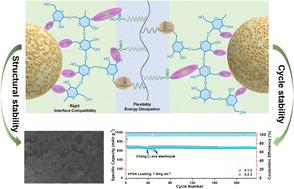
With the growing concern over increasing energy density, lithium–sulfur batteries have garnered significant interest from researchers. However, the volume expansion of the sulfur cathode, which leads to poor cycling stability at high loadings, poses a major challenge to their practical application. Traditional binders are highly susceptible to cracking and structural collapse as the coating thickness increases. Our study presents a dual-component composite binder (G2CEA) that harmoniously blends rigidity and flexibility, with each component serving a specific function. Guar gum (GG), the rigid component, envelops the SPAN interface and contributes to the formation of the CEI film, ensuring interface stability. Poly(2-Carboxyethyl acrylate) (PCEA), the flexible component, retains adhesion and ductility in the electrolyte, cushioning the volume changes of SPAN particles and maintaining the structural integrity of the electrode. This innovative design endows the G2CEA-based cathode with superior cycling stability (97.6% retention after 164 cycles at 0.1C) under high loadings (7.5 mg cm−2), offering a valuable perspective for the design of practical binders in the future.
期刊介绍:
The Journal of Materials Chemistry A, B & C covers a wide range of high-quality studies in the field of materials chemistry, with each section focusing on specific applications of the materials studied. Journal of Materials Chemistry A emphasizes applications in energy and sustainability, including topics such as artificial photosynthesis, batteries, and fuel cells. Journal of Materials Chemistry B focuses on applications in biology and medicine, while Journal of Materials Chemistry C covers applications in optical, magnetic, and electronic devices. Example topic areas within the scope of Journal of Materials Chemistry A include catalysis, green/sustainable materials, sensors, and water treatment, among others.



 京公网安备 11010802042870号
京ICP备2023020795号-1
京公网安备 11010802042870号
京ICP备2023020795号-1

 分享
分享
 求助内容:
求助内容: 应助结果提醒方式:
 扫码关注我们
