{"title":"Probing the E3 Ligase Adapter Cereblon with Chemical Biology","authors":"Wenqing Xu, Christina M. Woo","doi":"10.1021/acs.accounts.5c00059","DOIUrl":null,"url":null,"abstract":"The E3 ligase substrate adapter cereblon (CRBN) has garnered widespread interest from the research laboratory to the clinic. CRBN was first discovered for its association with neurological development and subsequently identified as the target of thalidomide and lenalidomide, therapeutic agents used in the treatment of hematopoietic malignancies. Both thalidomide and lenalidomide have been repurposed as ligands for targeted protein degradation therapeutic modalities. These agents were proposed to mimic a naturally occurring ligand, although the native substrate recognition mechanism of CRBN remained elusive. Chemical biology, which involves the use of chemical tools to modulate and probe biological systems, can provide unique insights into the molecular mechanisms and interactions of proteins with their cognate ligands. Here we describe our use of chemical biology approaches, including photoaffinity labeling, chemical proteomics, and targeted protein degradation, to interrogate the biological activities of CRBN in the presence or absence of its ligands. Our development of a photoaffinity labeling probe derived from lenalidomide, termed photolenalidomide, enabled mapping of the binding site on CRBN and identification of a new target recruited to CRBN by lenalidomide through chemical proteomics. Further derivatization of the lenalidomide scaffold afforded DEG-77, a potent degrader with therapeutic efficacy against acute myeloid leukemia. Our parallel development of chemically defined probes that are inspired by heterobifunctional targeted protein degradation agents and functionally engage CRBN in cells revealed that thalidomide is a peptidomimetic of an underappreciated protein modification termed the C-terminal cyclic imide, which arises from intramolecular cyclization of asparagine or glutamine residues and represents a degron endogenously recognized by CRBN. Protein engineering and proteomic efforts validated the CRBN-dependent regulation of proteins bearing the C-terminal cyclic imide modification in vitro and in cells and the prevalence of the C-terminal cyclic imide in the biological system. Application of C-terminal cyclic imides as a class of cyclimid ligands for targeted protein degradation led to the development of a variety of heterobifunctional degraders with distinct efficacy and target selectivity, whereas examination of the occurrence of C-terminal cyclic imides as a form of protein damage uncovered the intrinsic and extrinsic factors that predispose peptides and proteins to C-terminal cyclic imide formation and the role of CRBN in mitigating the accumulation of damaged proteins with a propensity for aggregation. Future investigation of C-terminal cyclic imides, synthetic ligands, and their relationship to CRBN biology will illuminate regulatory mechanisms that are controlled by CRBN and drive the pursuit of additional functional chemistries on proteins and the biological pathways that intercept them.","PeriodicalId":1,"journal":{"name":"Accounts of Chemical Research","volume":"8 1","pages":""},"PeriodicalIF":17.7000,"publicationDate":"2025-04-01","publicationTypes":"Journal Article","fieldsOfStudy":null,"isOpenAccess":false,"openAccessPdf":"","citationCount":"0","resultStr":null,"platform":"Semanticscholar","paperid":null,"PeriodicalName":"Accounts of Chemical Research","FirstCategoryId":"92","ListUrlMain":"https://doi.org/10.1021/acs.accounts.5c00059","RegionNum":1,"RegionCategory":"化学","ArticlePicture":[],"TitleCN":null,"AbstractTextCN":null,"PMCID":null,"EPubDate":"","PubModel":"","JCR":"Q1","JCRName":"CHEMISTRY, MULTIDISCIPLINARY","Score":null,"Total":0}
引用次数: 0
Abstract
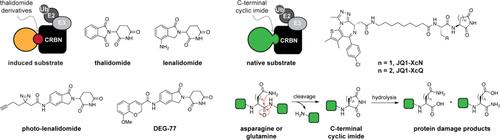
The E3 ligase substrate adapter cereblon (CRBN) has garnered widespread interest from the research laboratory to the clinic. CRBN was first discovered for its association with neurological development and subsequently identified as the target of thalidomide and lenalidomide, therapeutic agents used in the treatment of hematopoietic malignancies. Both thalidomide and lenalidomide have been repurposed as ligands for targeted protein degradation therapeutic modalities. These agents were proposed to mimic a naturally occurring ligand, although the native substrate recognition mechanism of CRBN remained elusive. Chemical biology, which involves the use of chemical tools to modulate and probe biological systems, can provide unique insights into the molecular mechanisms and interactions of proteins with their cognate ligands. Here we describe our use of chemical biology approaches, including photoaffinity labeling, chemical proteomics, and targeted protein degradation, to interrogate the biological activities of CRBN in the presence or absence of its ligands. Our development of a photoaffinity labeling probe derived from lenalidomide, termed photolenalidomide, enabled mapping of the binding site on CRBN and identification of a new target recruited to CRBN by lenalidomide through chemical proteomics. Further derivatization of the lenalidomide scaffold afforded DEG-77, a potent degrader with therapeutic efficacy against acute myeloid leukemia. Our parallel development of chemically defined probes that are inspired by heterobifunctional targeted protein degradation agents and functionally engage CRBN in cells revealed that thalidomide is a peptidomimetic of an underappreciated protein modification termed the C-terminal cyclic imide, which arises from intramolecular cyclization of asparagine or glutamine residues and represents a degron endogenously recognized by CRBN. Protein engineering and proteomic efforts validated the CRBN-dependent regulation of proteins bearing the C-terminal cyclic imide modification in vitro and in cells and the prevalence of the C-terminal cyclic imide in the biological system. Application of C-terminal cyclic imides as a class of cyclimid ligands for targeted protein degradation led to the development of a variety of heterobifunctional degraders with distinct efficacy and target selectivity, whereas examination of the occurrence of C-terminal cyclic imides as a form of protein damage uncovered the intrinsic and extrinsic factors that predispose peptides and proteins to C-terminal cyclic imide formation and the role of CRBN in mitigating the accumulation of damaged proteins with a propensity for aggregation. Future investigation of C-terminal cyclic imides, synthetic ligands, and their relationship to CRBN biology will illuminate regulatory mechanisms that are controlled by CRBN and drive the pursuit of additional functional chemistries on proteins and the biological pathways that intercept them.
期刊介绍:
Accounts of Chemical Research presents short, concise and critical articles offering easy-to-read overviews of basic research and applications in all areas of chemistry and biochemistry. These short reviews focus on research from the author’s own laboratory and are designed to teach the reader about a research project. In addition, Accounts of Chemical Research publishes commentaries that give an informed opinion on a current research problem. Special Issues online are devoted to a single topic of unusual activity and significance.
Accounts of Chemical Research replaces the traditional article abstract with an article "Conspectus." These entries synopsize the research affording the reader a closer look at the content and significance of an article. Through this provision of a more detailed description of the article contents, the Conspectus enhances the article's discoverability by search engines and the exposure for the research.




 京公网安备 11010802042870号
京ICP备2023020795号-1
京公网安备 11010802042870号
京ICP备2023020795号-1

 分享
分享
 求助内容:
求助内容: 应助结果提醒方式:
 扫码关注我们
