Chao Miao, Shaohan Xu, Ziwen An, Xun Pan, Yanbo Li, Nan Hu, Lina Li, Yongxin Zhou, Guohua Zhao
{"title":"Self-Optimized Reconstruction of Metal–Organic Frameworks Introduces Cation Vacancies for Selective Electrosynthesis of Hydrogen Peroxide","authors":"Chao Miao, Shaohan Xu, Ziwen An, Xun Pan, Yanbo Li, Nan Hu, Lina Li, Yongxin Zhou, Guohua Zhao","doi":"10.1002/anie.202501930","DOIUrl":null,"url":null,"abstract":"<p>The electrocatalytic synthesis of hydrogen peroxide (H<sub>2</sub>O<sub>2</sub>) through the two-electron oxygen reduction pathway represents a green production process that has gained increasing importance. Nevertheless, there is a dearth of efficacious catalysts to attain high activity under industrial current density. In this study, we present a strategy for cation vacancy generation through metal–organic frameworks self-optimized reconfiguration for the efficient electrosynthesis of H<sub>2</sub>O<sub>2</sub> under industrial current densities in solid-electrolyte cell. The ZIF-ZC91@Co(OH)<sub>2</sub>-V<sub>Co</sub> electrocatalyst exhibits significant H<sub>2</sub>O<sub>2</sub> selectivity of 97.8%, and the H<sub>2</sub>O<sub>2</sub> productivity is up to 24.53 mol g<sub>catalyst</sub><sup>−1</sup> h<sup>−1</sup> with a direct and continuous output of ∼3.36 wt% H<sub>2</sub>O<sub>2</sub> aqueous solutions under industrial current density (400 mA cm<sup>−2</sup>). Impressively, the ZIF-ZC91@Co(OH)<sub>2</sub>-V<sub>Co</sub> possesses superb long-term durability for over 220 h and can output H<sub>2</sub>O<sub>2</sub> aqueous solution with a concentration of ∼8.03 wt% in the pilot experiment. Theoretical calculations confirm that the introduction of modest cation vacancies optimizes the adsorption strength of *OOH intermediate and reduces both thermodynamic and kinetic barriers, thus balancing the selectivity of the two-electron oxygen reduction. This work provides valuable insights into the rapid, eco-friendly synthesis of H<sub>2</sub>O<sub>2</sub> and the rational design of highly active catalysts.</p>","PeriodicalId":125,"journal":{"name":"Angewandte Chemie International Edition","volume":"64 24","pages":""},"PeriodicalIF":16.9000,"publicationDate":"2025-04-01","publicationTypes":"Journal Article","fieldsOfStudy":null,"isOpenAccess":false,"openAccessPdf":"","citationCount":"0","resultStr":null,"platform":"Semanticscholar","paperid":null,"PeriodicalName":"Angewandte Chemie International Edition","FirstCategoryId":"92","ListUrlMain":"https://onlinelibrary.wiley.com/doi/10.1002/anie.202501930","RegionNum":1,"RegionCategory":"化学","ArticlePicture":[],"TitleCN":null,"AbstractTextCN":null,"PMCID":null,"EPubDate":"","PubModel":"","JCR":"Q1","JCRName":"CHEMISTRY, MULTIDISCIPLINARY","Score":null,"Total":0}
引用次数: 0
Abstract
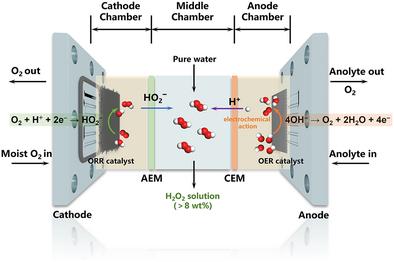
The electrocatalytic synthesis of hydrogen peroxide (H2O2) through the two-electron oxygen reduction pathway represents a green production process that has gained increasing importance. Nevertheless, there is a dearth of efficacious catalysts to attain high activity under industrial current density. In this study, we present a strategy for cation vacancy generation through metal–organic frameworks self-optimized reconfiguration for the efficient electrosynthesis of H2O2 under industrial current densities in solid-electrolyte cell. The ZIF-ZC91@Co(OH)2-VCo electrocatalyst exhibits significant H2O2 selectivity of 97.8%, and the H2O2 productivity is up to 24.53 mol gcatalyst−1 h−1 with a direct and continuous output of ∼3.36 wt% H2O2 aqueous solutions under industrial current density (400 mA cm−2). Impressively, the ZIF-ZC91@Co(OH)2-VCo possesses superb long-term durability for over 220 h and can output H2O2 aqueous solution with a concentration of ∼8.03 wt% in the pilot experiment. Theoretical calculations confirm that the introduction of modest cation vacancies optimizes the adsorption strength of *OOH intermediate and reduces both thermodynamic and kinetic barriers, thus balancing the selectivity of the two-electron oxygen reduction. This work provides valuable insights into the rapid, eco-friendly synthesis of H2O2 and the rational design of highly active catalysts.
期刊介绍:
Angewandte Chemie, a journal of the German Chemical Society (GDCh), maintains a leading position among scholarly journals in general chemistry with an impressive Impact Factor of 16.6 (2022 Journal Citation Reports, Clarivate, 2023). Published weekly in a reader-friendly format, it features new articles almost every day. Established in 1887, Angewandte Chemie is a prominent chemistry journal, offering a dynamic blend of Review-type articles, Highlights, Communications, and Research Articles on a weekly basis, making it unique in the field.



 京公网安备 11010802042870号
京ICP备2023020795号-1
京公网安备 11010802042870号
京ICP备2023020795号-1

 分享
分享
 求助内容:
求助内容: 应助结果提醒方式:
 扫码关注我们
