Min Zeng, William Parsons, Yixuan Chen, David K. Chalmers, Sébastien Perrier
{"title":"Hydrophobicity-Controlled Self-Assembly of Supramolecular Peptide Nanotubes in Water","authors":"Min Zeng, William Parsons, Yixuan Chen, David K. Chalmers, Sébastien Perrier","doi":"10.1002/anie.202423828","DOIUrl":null,"url":null,"abstract":"<p>Polymer-conjugated peptides are attractive building blocks for the construction of new nanomaterials. However, the ability to control the self-assembly of these materials remains a major limitation to their wider utilization. Herein, we report a facile strategy to fine-tune the assembly of water-soluble hydrophilic polymer-conjugated cyclic peptides by incorporating a defined, short hydrocarbon linker between the polymer and peptide. This addition creates a well-defined hydrophobic “inner shell” that suppresses water from disrupting the organized peptide hydrogen bond network. Our approach is demonstrated using a series of cyclic peptide-linker-PDMA conjugates that were evaluated by asymmetric flow field flow fractionation, small angle neutron scattering and transmission electron microscopy. Molecular dynamics simulations were also used to show how the polymer and the peptide stacks interact and illustrate the impact of this hydrophobic inner shell approach. This strategy provides a modular approach to fine control the nanotube self-assembling behavior. We expect that this technique will improve the versatility of peptide nanotubes for the engineering of advanced nanomaterials.</p>","PeriodicalId":125,"journal":{"name":"Angewandte Chemie International Edition","volume":"64 22","pages":""},"PeriodicalIF":16.9000,"publicationDate":"2025-03-31","publicationTypes":"Journal Article","fieldsOfStudy":null,"isOpenAccess":false,"openAccessPdf":"https://onlinelibrary.wiley.com/doi/epdf/10.1002/anie.202423828","citationCount":"0","resultStr":null,"platform":"Semanticscholar","paperid":null,"PeriodicalName":"Angewandte Chemie International Edition","FirstCategoryId":"92","ListUrlMain":"https://onlinelibrary.wiley.com/doi/10.1002/anie.202423828","RegionNum":1,"RegionCategory":"化学","ArticlePicture":[],"TitleCN":null,"AbstractTextCN":null,"PMCID":null,"EPubDate":"","PubModel":"","JCR":"Q1","JCRName":"CHEMISTRY, MULTIDISCIPLINARY","Score":null,"Total":0}
引用次数: 0
Abstract
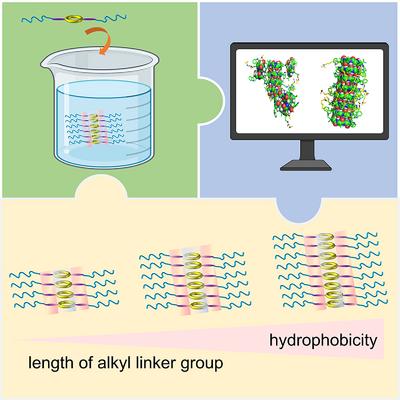
Polymer-conjugated peptides are attractive building blocks for the construction of new nanomaterials. However, the ability to control the self-assembly of these materials remains a major limitation to their wider utilization. Herein, we report a facile strategy to fine-tune the assembly of water-soluble hydrophilic polymer-conjugated cyclic peptides by incorporating a defined, short hydrocarbon linker between the polymer and peptide. This addition creates a well-defined hydrophobic “inner shell” that suppresses water from disrupting the organized peptide hydrogen bond network. Our approach is demonstrated using a series of cyclic peptide-linker-PDMA conjugates that were evaluated by asymmetric flow field flow fractionation, small angle neutron scattering and transmission electron microscopy. Molecular dynamics simulations were also used to show how the polymer and the peptide stacks interact and illustrate the impact of this hydrophobic inner shell approach. This strategy provides a modular approach to fine control the nanotube self-assembling behavior. We expect that this technique will improve the versatility of peptide nanotubes for the engineering of advanced nanomaterials.
期刊介绍:
Angewandte Chemie, a journal of the German Chemical Society (GDCh), maintains a leading position among scholarly journals in general chemistry with an impressive Impact Factor of 16.6 (2022 Journal Citation Reports, Clarivate, 2023). Published weekly in a reader-friendly format, it features new articles almost every day. Established in 1887, Angewandte Chemie is a prominent chemistry journal, offering a dynamic blend of Review-type articles, Highlights, Communications, and Research Articles on a weekly basis, making it unique in the field.



 京公网安备 11010802042870号
京ICP备2023020795号-1
京公网安备 11010802042870号
京ICP备2023020795号-1

 分享
分享
 求助内容:
求助内容: 应助结果提醒方式:
 扫码关注我们
