Jay Shukla, Xiaohui Qu, Zubin Darbari, Marija Iloska, J. Anibal Boscoboinik, Qin Wu
{"title":"Discovering CO Adsorption and Desorption Pathways from Chemical Reaction Neural Network Modeling of Transient Kinetics Spectroscopy","authors":"Jay Shukla, Xiaohui Qu, Zubin Darbari, Marija Iloska, J. Anibal Boscoboinik, Qin Wu","doi":"10.1021/acs.jpclett.5c00665","DOIUrl":null,"url":null,"abstract":"We demonstrate a data-driven approach to interpreting surface reactions by combining time-resolved gas pulsing infrared spectroscopy with chemical reaction neural networks (CRNNs). Using CO adsorption and desorption on Pd(111) at 460–490 K as a model system, we show how transient kinetic data can reveal detailed reaction mechanisms. Starting with a simple one-species model, we systematically evaluate increasingly complex mechanisms involving hollow and bridge site adsorption. Despite the similar goodness of fit to the same experimental absorbance data, our models predict distinct coverage dynamics for different adsorption sites. Through analysis of spectral peak stability and predicted dynamics, we identify a mechanism in which CO primarily adsorbs on bridge sites followed by rapid conversion to hollow sites as being the most physically consistent with experimental observations. This work provides a framework for extracting mechanistic insights from limited experimental data, demonstrating how machine learning can bridge the gap between transient kinetic measurements and a molecular-level understanding of surface reactions.","PeriodicalId":62,"journal":{"name":"The Journal of Physical Chemistry Letters","volume":"5 1","pages":""},"PeriodicalIF":4.6000,"publicationDate":"2025-04-01","publicationTypes":"Journal Article","fieldsOfStudy":null,"isOpenAccess":false,"openAccessPdf":"","citationCount":"0","resultStr":null,"platform":"Semanticscholar","paperid":null,"PeriodicalName":"The Journal of Physical Chemistry Letters","FirstCategoryId":"1","ListUrlMain":"https://doi.org/10.1021/acs.jpclett.5c00665","RegionNum":2,"RegionCategory":"化学","ArticlePicture":[],"TitleCN":null,"AbstractTextCN":null,"PMCID":null,"EPubDate":"","PubModel":"","JCR":"Q2","JCRName":"CHEMISTRY, PHYSICAL","Score":null,"Total":0}
引用次数: 0
Abstract
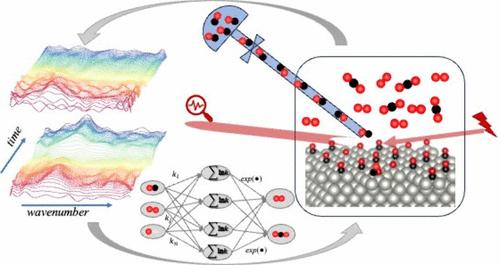
We demonstrate a data-driven approach to interpreting surface reactions by combining time-resolved gas pulsing infrared spectroscopy with chemical reaction neural networks (CRNNs). Using CO adsorption and desorption on Pd(111) at 460–490 K as a model system, we show how transient kinetic data can reveal detailed reaction mechanisms. Starting with a simple one-species model, we systematically evaluate increasingly complex mechanisms involving hollow and bridge site adsorption. Despite the similar goodness of fit to the same experimental absorbance data, our models predict distinct coverage dynamics for different adsorption sites. Through analysis of spectral peak stability and predicted dynamics, we identify a mechanism in which CO primarily adsorbs on bridge sites followed by rapid conversion to hollow sites as being the most physically consistent with experimental observations. This work provides a framework for extracting mechanistic insights from limited experimental data, demonstrating how machine learning can bridge the gap between transient kinetic measurements and a molecular-level understanding of surface reactions.
期刊介绍:
The Journal of Physical Chemistry (JPC) Letters is devoted to reporting new and original experimental and theoretical basic research of interest to physical chemists, biophysical chemists, chemical physicists, physicists, material scientists, and engineers. An important criterion for acceptance is that the paper reports a significant scientific advance and/or physical insight such that rapid publication is essential. Two issues of JPC Letters are published each month.



 京公网安备 11010802042870号
京ICP备2023020795号-1
京公网安备 11010802042870号
京ICP备2023020795号-1

 分享
分享
 求助内容:
求助内容: 应助结果提醒方式:
 扫码关注我们
