{"title":"Chemisorbed O2-Driven Radical-Mediated Baeyer–Villiger Oxidation on Cu Surface","authors":"Manisha Shaw, Dipanjan Samanta, Pijush Sardar, Rajarshi Basu, Md Abdus Salam Shaik, Imran Mondal, Angana Bhattacharya, Daulat Phapale, Chirag Barvalia, Ahin Roy, Amita Pathak","doi":"10.1021/acs.jpcc.4c07131","DOIUrl":null,"url":null,"abstract":"Our study addresses the critical gap in understanding the aerobic Baeyer–Villiger oxidation (BVO) of cyclohexanone on transition-metal oxide and their heavily reduced metallic surfaces. BVO, which produces caprolactone, is rarely reported on metallic surfaces and lacks a complete mechanistic pathway comparison for these two surfaces. Moreover, identifying intermediates, reactive species, or nucleophilic oxidants in the BVO reaction and justifying the catalyst’s role in their formation and overall reaction remain challenging. The study attempts to reveal the feasibility of the formation of adsorbed O<sub>2</sub><sup>•–</sup> on the metallic Cu(111) surface and that the O<sub>2</sub><sup>•–</sup> adsorption on the Cu(111) surface could make it an active catalyst for BVO. In this regard, four different Cu-based catalysts (S1, S2, S3, and S4) were prepared using an aqueous method with increasing concentrations of the reducing agent of <span>l</span>-ascorbic acid. S1, S2, and S3 are Cu-oxide-rich, while S4 is predominantly metallic Cu. A multiscale experimental and theoretical approach proposed that the BVO reaction, in the presence of benzaldehyde as a sacrificial agent and molecular oxygen (O<sub>2</sub>) as an oxidant, follows a radical-mediated pathway on the Cu metallic surface (S4). The S4 catalyst achieved 97% oxidation of cyclohexanone, attributed to an optimal density of chemisorbed O<sub>2</sub><sup>•–</sup> and abundant Cu(111) surfaces compared with 45% observed with the S1 catalyst. Nudge elastic band (NEB) calculations, in situ Fourier transform infrared (FTIR) studies, and spectroscopic analysis revealed that the reaction proceeds via a benzoyl radical intermediate, formed through the abstraction of the α-H atom from benzaldehyde (by chemisorbed O<sub>2</sub><sup>•–</sup>) and activation of the carbonyl group of cyclohexanone via Lewis’s acid–base interaction. Adsorption energy interpretations further corroborate the higher reactivity of O<sub>2</sub><sup>•–</sup> radical over peroxide radical (O<sub>2</sub><sup>2–</sup>), which are formed by O<sub>2</sub> adsorption on the Cu(111) surface in parallel and perpendicular configurations.","PeriodicalId":61,"journal":{"name":"The Journal of Physical Chemistry C","volume":"1 1","pages":""},"PeriodicalIF":3.2000,"publicationDate":"2025-04-01","publicationTypes":"Journal Article","fieldsOfStudy":null,"isOpenAccess":false,"openAccessPdf":"","citationCount":"0","resultStr":null,"platform":"Semanticscholar","paperid":null,"PeriodicalName":"The Journal of Physical Chemistry C","FirstCategoryId":"1","ListUrlMain":"https://doi.org/10.1021/acs.jpcc.4c07131","RegionNum":3,"RegionCategory":"化学","ArticlePicture":[],"TitleCN":null,"AbstractTextCN":null,"PMCID":null,"EPubDate":"","PubModel":"","JCR":"Q2","JCRName":"CHEMISTRY, PHYSICAL","Score":null,"Total":0}
引用次数: 0
Abstract
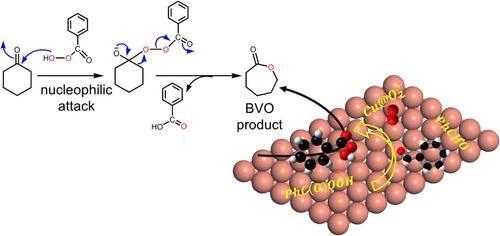
Our study addresses the critical gap in understanding the aerobic Baeyer–Villiger oxidation (BVO) of cyclohexanone on transition-metal oxide and their heavily reduced metallic surfaces. BVO, which produces caprolactone, is rarely reported on metallic surfaces and lacks a complete mechanistic pathway comparison for these two surfaces. Moreover, identifying intermediates, reactive species, or nucleophilic oxidants in the BVO reaction and justifying the catalyst’s role in their formation and overall reaction remain challenging. The study attempts to reveal the feasibility of the formation of adsorbed O2•– on the metallic Cu(111) surface and that the O2•– adsorption on the Cu(111) surface could make it an active catalyst for BVO. In this regard, four different Cu-based catalysts (S1, S2, S3, and S4) were prepared using an aqueous method with increasing concentrations of the reducing agent of l-ascorbic acid. S1, S2, and S3 are Cu-oxide-rich, while S4 is predominantly metallic Cu. A multiscale experimental and theoretical approach proposed that the BVO reaction, in the presence of benzaldehyde as a sacrificial agent and molecular oxygen (O2) as an oxidant, follows a radical-mediated pathway on the Cu metallic surface (S4). The S4 catalyst achieved 97% oxidation of cyclohexanone, attributed to an optimal density of chemisorbed O2•– and abundant Cu(111) surfaces compared with 45% observed with the S1 catalyst. Nudge elastic band (NEB) calculations, in situ Fourier transform infrared (FTIR) studies, and spectroscopic analysis revealed that the reaction proceeds via a benzoyl radical intermediate, formed through the abstraction of the α-H atom from benzaldehyde (by chemisorbed O2•–) and activation of the carbonyl group of cyclohexanone via Lewis’s acid–base interaction. Adsorption energy interpretations further corroborate the higher reactivity of O2•– radical over peroxide radical (O22–), which are formed by O2 adsorption on the Cu(111) surface in parallel and perpendicular configurations.
期刊介绍:
The Journal of Physical Chemistry A/B/C is devoted to reporting new and original experimental and theoretical basic research of interest to physical chemists, biophysical chemists, and chemical physicists.




 京公网安备 11010802042870号
京ICP备2023020795号-1
京公网安备 11010802042870号
京ICP备2023020795号-1

 分享
分享
 求助内容:
求助内容: 应助结果提醒方式:
 扫码关注我们
