{"title":"Switching Conjugation Is the Predominant Factor Contributing to Complete Reversal of Amide cis–trans (Z-E) Preference through N-Methylation","authors":"Junjun Huang, Luying Chen, Hirotaka Ikeda, Tadashi Hyodo, Yulan Tang, Yuko Otani, Kentaro Yamaguchi, Satoshi Inagaki, Tomohiko Ohwada","doi":"10.1021/acs.joc.4c02929","DOIUrl":null,"url":null,"abstract":"<i>N</i>-Methylation strongly influences the <i>cis–trans</i> (Z-E) preference of amides, especially in benzanilide. While the <i>trans</i> (E) conformation is preferred in NH-benzanilide, <i>N</i>-methylation shifts the balance to favor the <i>cis</i> (Z) form. This switch, often attributed to steric hindrance, is frequently utilized in molecular design. However, our findings suggest an alternative mechanism. Through bond model analysis (BMA), we explored the structural preferences driven by bond orbital interactions and assessed the stability of <i>cis–trans</i> (Z-E) preferences in response to electronic perturbations via electron-donating or -withdrawing groups on the benzene rings. Our results reveal that <i>N</i>-methylation rebalances conjugation: NH-benzanilides prefer the <i>trans</i> (E) form due to phenyl-amine conjugation, while N-Me benzanilides favor the <i>cis</i> form due to phenyl-carbonyl conjugation.","PeriodicalId":57,"journal":{"name":"Journal of Organic Chemistry","volume":"25 1","pages":""},"PeriodicalIF":3.6000,"publicationDate":"2025-04-01","publicationTypes":"Journal Article","fieldsOfStudy":null,"isOpenAccess":false,"openAccessPdf":"","citationCount":"0","resultStr":null,"platform":"Semanticscholar","paperid":null,"PeriodicalName":"Journal of Organic Chemistry","FirstCategoryId":"1","ListUrlMain":"https://doi.org/10.1021/acs.joc.4c02929","RegionNum":2,"RegionCategory":"化学","ArticlePicture":[],"TitleCN":null,"AbstractTextCN":null,"PMCID":null,"EPubDate":"","PubModel":"","JCR":"Q1","JCRName":"CHEMISTRY, ORGANIC","Score":null,"Total":0}
引用次数: 0
Abstract
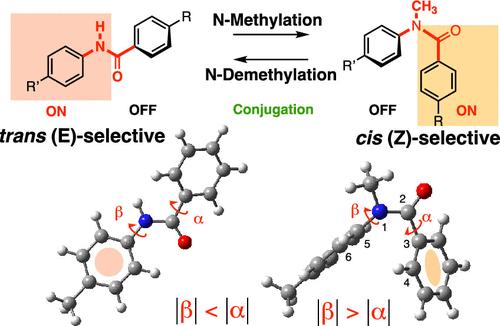
N-Methylation strongly influences the cis–trans (Z-E) preference of amides, especially in benzanilide. While the trans (E) conformation is preferred in NH-benzanilide, N-methylation shifts the balance to favor the cis (Z) form. This switch, often attributed to steric hindrance, is frequently utilized in molecular design. However, our findings suggest an alternative mechanism. Through bond model analysis (BMA), we explored the structural preferences driven by bond orbital interactions and assessed the stability of cis–trans (Z-E) preferences in response to electronic perturbations via electron-donating or -withdrawing groups on the benzene rings. Our results reveal that N-methylation rebalances conjugation: NH-benzanilides prefer the trans (E) form due to phenyl-amine conjugation, while N-Me benzanilides favor the cis form due to phenyl-carbonyl conjugation.
期刊介绍:
Journal of Organic Chemistry welcomes original contributions of fundamental research in all branches of the theory and practice of organic chemistry. In selecting manuscripts for publication, the editors place emphasis on the quality and novelty of the work, as well as the breadth of interest to the organic chemistry community.



 京公网安备 11010802042870号
京ICP备2023020795号-1
京公网安备 11010802042870号
京ICP备2023020795号-1

 分享
分享
 求助内容:
求助内容: 应助结果提醒方式:
 扫码关注我们
