{"title":"KMC study on the promotion of the water–gas shift reaction by CO-induced clustering on Cu(111)","authors":"Zi-Qiao Xue, Gui-Chang Wang","doi":"10.1016/j.jcat.2025.116115","DOIUrl":null,"url":null,"abstract":"<div><div>The Water–Gas Shift Reaction (WGSR) is a critical process for hydrogen production and purification. However, typically employed low-index metal surface models have limitations in capturing the catalytic active sites under actual reaction conditions. Inspired by the recently surface science studies that CO can induce the formation of copper clusters on the Cu(111) surface, we investigated<!--> <!-->the dynamic process of copper cluster formation induced by CO on the Cu(111) surface and its impact on the WGSR by employing Density Functional Theory (DFT) combined with kinetic Monte Carlo (kMC) simulation. The kMC results indicated that ejection barriers that detachment of a copper atom from the step edges of adjacent terraces, defect density on Cu(111), and CO adsorption free energy significantly influence cluster formation and morphology, <em>with lower ejection barrier and higher defect density as well as more negative of CO adsorption free energy favors the formation of high-density small copper cluster like Cu<sub>7</sub> or smaller observed by experiment.</em> Models for Cu<sub>3</sub> and Cu<sub>7</sub> clusters were established to assess their effect on WGSR by mean-field microkinetic simulation modeling (MF-MKM) as well as kMC. Our results revealed that the adsorption energy on the clusters is higher than on the Cu(111) surface, due to the decrease in the coordination number of copper atoms. The activation energy for water dissociation on the clusters is lower than on Cu(111). Microkinetic analysis indicated that the a<em>ctivity order for WGSR is Cu<sub>7</sub>/Cu(111) > Cu<sub>3</sub>/Cu(111) > Cu(111</em>), and the reliability of the MF-MKM method was confirmed by comparing the WGSR rates with those predicted by kMC. The activity order is attributed to the reduced activation energy for water dissociation and the ability of the clusters to recombine H<sub>2</sub> on the terrace. This work elucidates the rules of cluster formation induced by CO and its potential impact on the reactivity of the WGSR.</div></div>","PeriodicalId":346,"journal":{"name":"Journal of Catalysis","volume":"447 ","pages":"Article 116115"},"PeriodicalIF":6.5000,"publicationDate":"2025-07-01","publicationTypes":"Journal Article","fieldsOfStudy":null,"isOpenAccess":false,"openAccessPdf":"","citationCount":"0","resultStr":null,"platform":"Semanticscholar","paperid":null,"PeriodicalName":"Journal of Catalysis","FirstCategoryId":"92","ListUrlMain":"https://www.sciencedirect.com/science/article/pii/S0021951725001800","RegionNum":1,"RegionCategory":"化学","ArticlePicture":[],"TitleCN":null,"AbstractTextCN":null,"PMCID":null,"EPubDate":"2025/3/31 0:00:00","PubModel":"Epub","JCR":"Q2","JCRName":"CHEMISTRY, PHYSICAL","Score":null,"Total":0}
引用次数: 0
Abstract
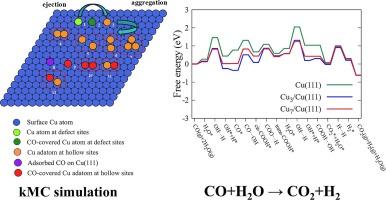
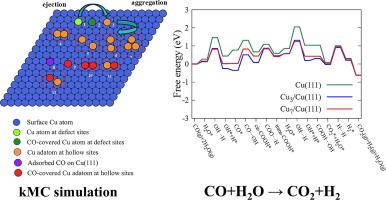
The Water–Gas Shift Reaction (WGSR) is a critical process for hydrogen production and purification. However, typically employed low-index metal surface models have limitations in capturing the catalytic active sites under actual reaction conditions. Inspired by the recently surface science studies that CO can induce the formation of copper clusters on the Cu(111) surface, we investigated the dynamic process of copper cluster formation induced by CO on the Cu(111) surface and its impact on the WGSR by employing Density Functional Theory (DFT) combined with kinetic Monte Carlo (kMC) simulation. The kMC results indicated that ejection barriers that detachment of a copper atom from the step edges of adjacent terraces, defect density on Cu(111), and CO adsorption free energy significantly influence cluster formation and morphology, with lower ejection barrier and higher defect density as well as more negative of CO adsorption free energy favors the formation of high-density small copper cluster like Cu7 or smaller observed by experiment. Models for Cu3 and Cu7 clusters were established to assess their effect on WGSR by mean-field microkinetic simulation modeling (MF-MKM) as well as kMC. Our results revealed that the adsorption energy on the clusters is higher than on the Cu(111) surface, due to the decrease in the coordination number of copper atoms. The activation energy for water dissociation on the clusters is lower than on Cu(111). Microkinetic analysis indicated that the activity order for WGSR is Cu7/Cu(111) > Cu3/Cu(111) > Cu(111), and the reliability of the MF-MKM method was confirmed by comparing the WGSR rates with those predicted by kMC. The activity order is attributed to the reduced activation energy for water dissociation and the ability of the clusters to recombine H2 on the terrace. This work elucidates the rules of cluster formation induced by CO and its potential impact on the reactivity of the WGSR.
期刊介绍:
The Journal of Catalysis publishes scholarly articles on both heterogeneous and homogeneous catalysis, covering a wide range of chemical transformations. These include various types of catalysis, such as those mediated by photons, plasmons, and electrons. The focus of the studies is to understand the relationship between catalytic function and the underlying chemical properties of surfaces and metal complexes.
The articles in the journal offer innovative concepts and explore the synthesis and kinetics of inorganic solids and homogeneous complexes. Furthermore, they discuss spectroscopic techniques for characterizing catalysts, investigate the interaction of probes and reacting species with catalysts, and employ theoretical methods.
The research presented in the journal should have direct relevance to the field of catalytic processes, addressing either fundamental aspects or applications of catalysis.




 京公网安备 11010802042870号
京ICP备2023020795号-1
京公网安备 11010802042870号
京ICP备2023020795号-1

 分享
分享
 求助内容:
求助内容: 应助结果提醒方式:
 扫码关注我们
