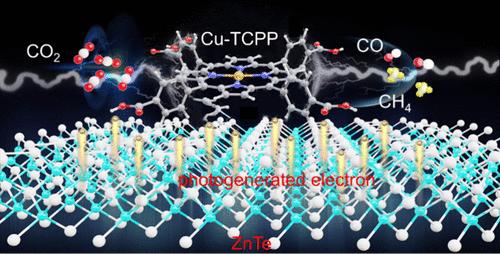
{"title":"Ultrathin Cu-Based Porphyrin Metal–Organic Framework Modified with ZnTe Promotes Highly Selective Photocatalytic CO2 Reduction to CO","authors":"Guilin Yin, Hui Shen, Xiu Gong","doi":"10.1021/acs.inorgchem.5c00062","DOIUrl":null,"url":null,"abstract":"The photocatalytic reduction of carbon dioxide (CO<sub>2</sub>) into value-added chemical fuels is an effective strategy to address the fossil fuel crisis and global warming. Herein, a novel p–n junction composed of ZnTe nanoparticles and Cu-TCPP nanosheets was successfully constructed for efficient CO<sub>2</sub>-to-CO conversion. Structural and spectroscopic characterization confirmed the establishment of the p–n junction, which enhances charge separation and transfer. The ZnTe/Cu-TCPP composite exhibits enhanced photocatalytic CO<sub>2</sub> reduction with CO as the primary product (120.53 μmol g<sup>–1</sup>), achieving 4.8- and 5.9-fold yield improvements over pristine ZnTe and Cu-TCPP, respectively. DFT calculations revealed a significantly enhanced CO<sub>2</sub> adsorption energy (−0.549 eV) on the ZnTe/Cu-TCPP heterojunction, promoting the reaction. In situ DRIFTS analysis confirmed the presence of key intermediates (*COOH, *CH<sub>3</sub>, and *CO), validating their roles in the selective CO<sub>2</sub>-to-CO conversion pathways. A mechanistic study further elucidated the contribution of each component in the reaction process. Additionally, the ZnTe/Cu-TCPP photocatalyst exhibited excellent stability, demonstrating its potential for sustainable CO<sub>2</sub> reduction.","PeriodicalId":40,"journal":{"name":"Inorganic Chemistry","volume":"19 1","pages":""},"PeriodicalIF":4.7000,"publicationDate":"2025-04-01","publicationTypes":"Journal Article","fieldsOfStudy":null,"isOpenAccess":false,"openAccessPdf":"","citationCount":"0","resultStr":null,"platform":"Semanticscholar","paperid":null,"PeriodicalName":"Inorganic Chemistry","FirstCategoryId":"92","ListUrlMain":"https://doi.org/10.1021/acs.inorgchem.5c00062","RegionNum":2,"RegionCategory":"化学","ArticlePicture":[],"TitleCN":null,"AbstractTextCN":null,"PMCID":null,"EPubDate":"","PubModel":"","JCR":"Q1","JCRName":"CHEMISTRY, INORGANIC & NUCLEAR","Score":null,"Total":0}
引用次数: 0
Abstract
The photocatalytic reduction of carbon dioxide (CO2) into value-added chemical fuels is an effective strategy to address the fossil fuel crisis and global warming. Herein, a novel p–n junction composed of ZnTe nanoparticles and Cu-TCPP nanosheets was successfully constructed for efficient CO2-to-CO conversion. Structural and spectroscopic characterization confirmed the establishment of the p–n junction, which enhances charge separation and transfer. The ZnTe/Cu-TCPP composite exhibits enhanced photocatalytic CO2 reduction with CO as the primary product (120.53 μmol g–1), achieving 4.8- and 5.9-fold yield improvements over pristine ZnTe and Cu-TCPP, respectively. DFT calculations revealed a significantly enhanced CO2 adsorption energy (−0.549 eV) on the ZnTe/Cu-TCPP heterojunction, promoting the reaction. In situ DRIFTS analysis confirmed the presence of key intermediates (*COOH, *CH3, and *CO), validating their roles in the selective CO2-to-CO conversion pathways. A mechanistic study further elucidated the contribution of each component in the reaction process. Additionally, the ZnTe/Cu-TCPP photocatalyst exhibited excellent stability, demonstrating its potential for sustainable CO2 reduction.
期刊介绍:
Inorganic Chemistry publishes fundamental studies in all phases of inorganic chemistry. Coverage includes experimental and theoretical reports on quantitative studies of structure and thermodynamics, kinetics, mechanisms of inorganic reactions, bioinorganic chemistry, and relevant aspects of organometallic chemistry, solid-state phenomena, and chemical bonding theory. Emphasis is placed on the synthesis, structure, thermodynamics, reactivity, spectroscopy, and bonding properties of significant new and known compounds.



 京公网安备 11010802042870号
京ICP备2023020795号-1
京公网安备 11010802042870号
京ICP备2023020795号-1

 分享
分享
 求助内容:
求助内容: 应助结果提醒方式:
 扫码关注我们
