Shiyi Bi , Jieyu Shen , Yu Zhu , Lei Fan , Huangxian Ju , Ying Liu
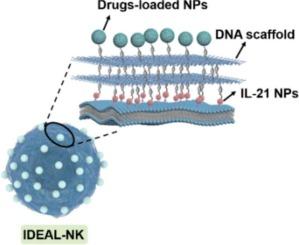
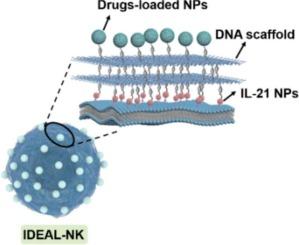
{"title":"DNA scaffold-framed natural killer cell with programmed drug release for chemo-adoptive cell therapy","authors":"Shiyi Bi , Jieyu Shen , Yu Zhu , Lei Fan , Huangxian Ju , Ying Liu","doi":"10.1016/j.jconrel.2025.113679","DOIUrl":null,"url":null,"abstract":"<div><div>Choosing appropriate delivery system for chemotherapeutic drugs as well as arranging the time spots for adoptive cells administrations is the key to achieve efficient combined chemo-adoptive cell therapy. Tumor-homing character makes adoptive immune cells appropriate targeting delivery carriers, but they are rarely used for chemtoxic payloads considering payloads internalization during administration which impairs adoptive cells. Herein, we frame adoptive NK cells using DNA scaffold with chemotherapeutic payloads fastened exterior, and achieves time-programmed drugs release and NK cell decapsulation to minimize side effects and enhance therapeutic effect. IL-21 nanoparticles are prepared by conjugating cytokine IL-21 with a GSH cleavable linker and act as anchor points for DNA scaffold assembly. Chemotherapeutic payloads are prepared by loading DOX/verapamil drugs to PLGA nanoparticles (PLGA<sub>drugs</sub> NPs), and connected to the exterior of DNA scaffold with a ROS cleavable linker. Porous DNA scaffold protects NK cells functions from impairing by chemotherapeutic payloads, while guarantees efficient communication of NK cells with exterior environment to keep tumor homing capability. Reactive oxygen species (ROS) in tumor microenvironment releases PLGA<sub>drugs</sub> NPs to perform chemotherapy, which subsequently generates a reductive environment to detach DNA scaffold for NK cell and IL-21 release to achieve combined chemo-adoptive cell therapy with enhanced therapeutic efficiency.</div></div>","PeriodicalId":15450,"journal":{"name":"Journal of Controlled Release","volume":"382 ","pages":"Article 113679"},"PeriodicalIF":11.5000,"publicationDate":"2025-06-10","publicationTypes":"Journal Article","fieldsOfStudy":null,"isOpenAccess":false,"openAccessPdf":"","citationCount":"0","resultStr":null,"platform":"Semanticscholar","paperid":null,"PeriodicalName":"Journal of Controlled Release","FirstCategoryId":"3","ListUrlMain":"https://www.sciencedirect.com/science/article/pii/S0168365925002998","RegionNum":1,"RegionCategory":"医学","ArticlePicture":[],"TitleCN":null,"AbstractTextCN":null,"PMCID":null,"EPubDate":"2025/4/1 0:00:00","PubModel":"Epub","JCR":"Q1","JCRName":"CHEMISTRY, MULTIDISCIPLINARY","Score":null,"Total":0}
引用次数: 0
Abstract
Choosing appropriate delivery system for chemotherapeutic drugs as well as arranging the time spots for adoptive cells administrations is the key to achieve efficient combined chemo-adoptive cell therapy. Tumor-homing character makes adoptive immune cells appropriate targeting delivery carriers, but they are rarely used for chemtoxic payloads considering payloads internalization during administration which impairs adoptive cells. Herein, we frame adoptive NK cells using DNA scaffold with chemotherapeutic payloads fastened exterior, and achieves time-programmed drugs release and NK cell decapsulation to minimize side effects and enhance therapeutic effect. IL-21 nanoparticles are prepared by conjugating cytokine IL-21 with a GSH cleavable linker and act as anchor points for DNA scaffold assembly. Chemotherapeutic payloads are prepared by loading DOX/verapamil drugs to PLGA nanoparticles (PLGAdrugs NPs), and connected to the exterior of DNA scaffold with a ROS cleavable linker. Porous DNA scaffold protects NK cells functions from impairing by chemotherapeutic payloads, while guarantees efficient communication of NK cells with exterior environment to keep tumor homing capability. Reactive oxygen species (ROS) in tumor microenvironment releases PLGAdrugs NPs to perform chemotherapy, which subsequently generates a reductive environment to detach DNA scaffold for NK cell and IL-21 release to achieve combined chemo-adoptive cell therapy with enhanced therapeutic efficiency.
期刊介绍:
The Journal of Controlled Release (JCR) proudly serves as the Official Journal of the Controlled Release Society and the Japan Society of Drug Delivery System.
Dedicated to the broad field of delivery science and technology, JCR publishes high-quality research articles covering drug delivery systems and all facets of formulations. This includes the physicochemical and biological properties of drugs, design and characterization of dosage forms, release mechanisms, in vivo testing, and formulation research and development across pharmaceutical, diagnostic, agricultural, environmental, cosmetic, and food industries.
Priority is given to manuscripts that contribute to the fundamental understanding of principles or demonstrate the advantages of novel technologies in terms of safety and efficacy over current clinical standards. JCR strives to be a leading platform for advancements in delivery science and technology.



 京公网安备 11010802042870号
京ICP备2023020795号-1
京公网安备 11010802042870号
京ICP备2023020795号-1

 分享
分享
 求助内容:
求助内容: 应助结果提醒方式:
 扫码关注我们
