Pei Liu, Bing Yu, Boxiang Peng, Xia Sun, Wenting Chen, Sijie Yang, Ruijie Lu, Jiahao Zhang, Dan Yang, Huahua Cui, Peihui Yang and Yin Ning*,
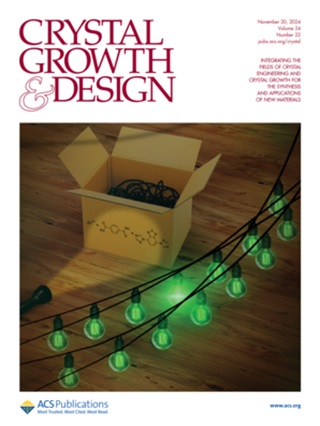
{"title":"Spatially Controlled Distribution of Copolymer Nanoparticles within Calcite Crystals Enabled by Engineering Surface Chemistry","authors":"Pei Liu, Bing Yu, Boxiang Peng, Xia Sun, Wenting Chen, Sijie Yang, Ruijie Lu, Jiahao Zhang, Dan Yang, Huahua Cui, Peihui Yang and Yin Ning*, ","doi":"10.1021/acs.cgd.4c01599","DOIUrl":null,"url":null,"abstract":"<p >The incorporation of nanoparticles into a growing crystal is rather counterintuitive due to interfacial incompatibility between the guest nanoparticles and the host crystals. Furthermore, achieving precise control over the spatial distribution of these nanoparticles within the host crystals presents a significant challenge. In this study, we judiciously synthesize three types of well-defined copolymer nanoparticles, each with different steric stabilizers─poly(methacrylic acid), poly(3-sulfopropyl methacrylate potassium), or poly(methacrylic acid-<i>stat</i>-3-sulfopropyl methacrylate potassium)─via polymerization-induced self-assembly. Such nanoparticles are then used as model additives in the crystallization of calcite under varying initial calcium ion concentrations. Remarkably, systematic investigations reveal that the spatial distribution of these copolymer nanoparticles within a calcite single crystal is governed by their surface chemistry and the initial calcium ion concentration. The underlying mechanisms are proposed to rationalize these intriguing phenomena of spatially tunable nanoparticle incorporation. This work provides important “design rules” for rationally regulating the spatial incorporation of guest nanoparticles into host crystals, thereby offering a straightforward and effective approach for making crystalline nanocomposites with controllable internal compositions and structures.</p>","PeriodicalId":34,"journal":{"name":"Crystal Growth & Design","volume":"25 7","pages":"2031–2042 2031–2042"},"PeriodicalIF":3.4000,"publicationDate":"2025-03-22","publicationTypes":"Journal Article","fieldsOfStudy":null,"isOpenAccess":false,"openAccessPdf":"","citationCount":"0","resultStr":null,"platform":"Semanticscholar","paperid":null,"PeriodicalName":"Crystal Growth & Design","FirstCategoryId":"92","ListUrlMain":"https://pubs.acs.org/doi/10.1021/acs.cgd.4c01599","RegionNum":2,"RegionCategory":"化学","ArticlePicture":[],"TitleCN":null,"AbstractTextCN":null,"PMCID":null,"EPubDate":"","PubModel":"","JCR":"Q2","JCRName":"CHEMISTRY, MULTIDISCIPLINARY","Score":null,"Total":0}
引用次数: 0
Abstract
The incorporation of nanoparticles into a growing crystal is rather counterintuitive due to interfacial incompatibility between the guest nanoparticles and the host crystals. Furthermore, achieving precise control over the spatial distribution of these nanoparticles within the host crystals presents a significant challenge. In this study, we judiciously synthesize three types of well-defined copolymer nanoparticles, each with different steric stabilizers─poly(methacrylic acid), poly(3-sulfopropyl methacrylate potassium), or poly(methacrylic acid-stat-3-sulfopropyl methacrylate potassium)─via polymerization-induced self-assembly. Such nanoparticles are then used as model additives in the crystallization of calcite under varying initial calcium ion concentrations. Remarkably, systematic investigations reveal that the spatial distribution of these copolymer nanoparticles within a calcite single crystal is governed by their surface chemistry and the initial calcium ion concentration. The underlying mechanisms are proposed to rationalize these intriguing phenomena of spatially tunable nanoparticle incorporation. This work provides important “design rules” for rationally regulating the spatial incorporation of guest nanoparticles into host crystals, thereby offering a straightforward and effective approach for making crystalline nanocomposites with controllable internal compositions and structures.
期刊介绍:
The aim of Crystal Growth & Design is to stimulate crossfertilization of knowledge among scientists and engineers working in the fields of crystal growth, crystal engineering, and the industrial application of crystalline materials.
Crystal Growth & Design publishes theoretical and experimental studies of the physical, chemical, and biological phenomena and processes related to the design, growth, and application of crystalline materials. Synergistic approaches originating from different disciplines and technologies and integrating the fields of crystal growth, crystal engineering, intermolecular interactions, and industrial application are encouraged.




 京公网安备 11010802042870号
京ICP备2023020795号-1
京公网安备 11010802042870号
京ICP备2023020795号-1

 分享
分享
 求助内容:
求助内容: 应助结果提醒方式:
 扫码关注我们
