Rui Jing, Yao Yu, Xuerong Di, Xu Qin, Lijie Zhao, Xuefeng Liang, Yuebing Sun and Qingqing Huang
{"title":"Supplying silicon reduces cadmium accumulation in pak choi by decreasing soil Cd bioavailability and altering the microbial community†","authors":"Rui Jing, Yao Yu, Xuerong Di, Xu Qin, Lijie Zhao, Xuefeng Liang, Yuebing Sun and Qingqing Huang","doi":"10.1039/D4EM00583J","DOIUrl":null,"url":null,"abstract":"<p >Silicon-containing materials have been widely used in Cd-contaminated soil remediation. However, the immobilization effects of sodium silicate on Cd migration and transformation in an acidic soil–vegetable system have not been thoroughly studied. Herein, a pot experiment was performed to investigate the effects of sodium silicate application on pak choi growth, oxidative status, Cd uptake and accumulation in pak choi, soil Cd bioavailability and fractions, and soil bacterial communities. The results showed that sodium silicate application significantly increased soil pH (0.29–1.61 units) and induced the transformation of the Cd fraction from an exchangeable fraction (Exc-Cd) into an iron and manganese oxide-bound fraction (OX-Cd) and organic matter-bound fraction (OM-Cd), decreasing Cd bioavailability by 13.7–20.8% in Cd-contaminated acidic soil. As a result, sodium silicate application significantly alleviated Cd toxicity, enhanced pak choi growth, and reduced Cd concentration in roots by 23.5–89.0% and in shoots by 58.5–81.0%, with Cd concentration in the edible part at a Si application rate equal to or greater than 0.4 g Si per kg soil falling below the safety limits for Cd as defined in China's food safety standard (GB 2762-2022). In addition, sodium silicate application significantly increased soil bacterial richness (Ace index and Chao1) and diversity (Shannon and Simpson index) and altered the soil microbial structure. These findings suggested that sodium silicate has great potential as an environmentally friendly amendment to immobilize Cd-contaminated acidic soil and reduce Cd accumulation in vegetables.</p>","PeriodicalId":74,"journal":{"name":"Environmental Science: Processes & Impacts","volume":" 4","pages":" 1145-1156"},"PeriodicalIF":3.9000,"publicationDate":"2025-03-20","publicationTypes":"Journal Article","fieldsOfStudy":null,"isOpenAccess":false,"openAccessPdf":"https://pubs.rsc.org/en/content/articlepdf/2025/em/d4em00583j?page=search","citationCount":"0","resultStr":null,"platform":"Semanticscholar","paperid":null,"PeriodicalName":"Environmental Science: Processes & Impacts","FirstCategoryId":"93","ListUrlMain":"https://pubs.rsc.org/en/content/articlelanding/2025/em/d4em00583j","RegionNum":3,"RegionCategory":"环境科学与生态学","ArticlePicture":[],"TitleCN":null,"AbstractTextCN":null,"PMCID":null,"EPubDate":"","PubModel":"","JCR":"Q1","JCRName":"CHEMISTRY, ANALYTICAL","Score":null,"Total":0}
引用次数: 0
Abstract
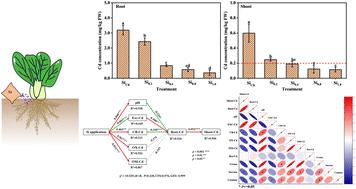
Silicon-containing materials have been widely used in Cd-contaminated soil remediation. However, the immobilization effects of sodium silicate on Cd migration and transformation in an acidic soil–vegetable system have not been thoroughly studied. Herein, a pot experiment was performed to investigate the effects of sodium silicate application on pak choi growth, oxidative status, Cd uptake and accumulation in pak choi, soil Cd bioavailability and fractions, and soil bacterial communities. The results showed that sodium silicate application significantly increased soil pH (0.29–1.61 units) and induced the transformation of the Cd fraction from an exchangeable fraction (Exc-Cd) into an iron and manganese oxide-bound fraction (OX-Cd) and organic matter-bound fraction (OM-Cd), decreasing Cd bioavailability by 13.7–20.8% in Cd-contaminated acidic soil. As a result, sodium silicate application significantly alleviated Cd toxicity, enhanced pak choi growth, and reduced Cd concentration in roots by 23.5–89.0% and in shoots by 58.5–81.0%, with Cd concentration in the edible part at a Si application rate equal to or greater than 0.4 g Si per kg soil falling below the safety limits for Cd as defined in China's food safety standard (GB 2762-2022). In addition, sodium silicate application significantly increased soil bacterial richness (Ace index and Chao1) and diversity (Shannon and Simpson index) and altered the soil microbial structure. These findings suggested that sodium silicate has great potential as an environmentally friendly amendment to immobilize Cd-contaminated acidic soil and reduce Cd accumulation in vegetables.
期刊介绍:
Environmental Science: Processes & Impacts publishes high quality papers in all areas of the environmental chemical sciences, including chemistry of the air, water, soil and sediment. We welcome studies on the environmental fate and effects of anthropogenic and naturally occurring contaminants, both chemical and microbiological, as well as related natural element cycling processes.



 京公网安备 11010802042870号
京ICP备2023020795号-1
京公网安备 11010802042870号
京ICP备2023020795号-1

 分享
分享
 求助内容:
求助内容: 应助结果提醒方式:
 扫码关注我们
