{"title":"Extracting Lignin with Superior Photothermal Performance from Wood in Molten Salt Hydrate for Preparation of a Solar-Driven Gradient Evaporator","authors":"Qizhao Shao, Xuan Zhou, Yiting Li, Xiaopu Dong, Xueqing Qiu, Dafeng Zheng","doi":"10.1002/cssc.202500538","DOIUrl":null,"url":null,"abstract":"<p>Developing sustainable solar-driven evaporators requires efficient photothermal materials and rational structural design. This study presents a green strategy for extracting lignin with enhanced photothermal performance from wood using molten salt hydrate (MSH) and citric acid under mild conditions. Systematic investigations reveal that elevated reaction temperatures (170 °C) promoted lignin depolymerization (<i>M</i><sub>w</sub> = 1206) and increased phenolic hydroxyl content (3.5 mmol g<sup>−1</sup>), enhancing π-π stacking interactions to achieve a photothermal conversion efficiency of 36.31%. Structural analyses through 2D-HSQC NMR confirm β<span></span>O<span></span>4 bond cleavage and demethylation, while fluorescence quenching validates reduced radiative losses. Leveraging this lignin, a gradient evaporator is fabricated by integrating polyvinyl alcohol (PVA)-modified melamine foam (MF) with a hydrophobic lignin-polyvinylidene fluoride (PVDF) photothermal layer. The evaporator exhibits hierarchical wettability, enabling gravity-guided water transport. It demonstrates robust performance in hypersaline water (1.85 kg m<sup>−2</sup> h<sup>−1</sup> for 10.5 wt.% brine) and dye removal (>99.98% rejection) under 0.1 W cm<sup>−2</sup> sun irradiation and environmental heat harvesting. Additionally, lignin-coated thermoelectric devices generate stable power (27.69 W m<sup>−2</sup>) by solar-thermal conversion. This work provides an eco-friendly pathway for lignin valorization and scalable solar evaporation systems, addressing energy-water challenges through biomass resource utilization.</p>","PeriodicalId":149,"journal":{"name":"ChemSusChem","volume":"18 12","pages":""},"PeriodicalIF":6.6000,"publicationDate":"2025-04-01","publicationTypes":"Journal Article","fieldsOfStudy":null,"isOpenAccess":false,"openAccessPdf":"","citationCount":"0","resultStr":null,"platform":"Semanticscholar","paperid":null,"PeriodicalName":"ChemSusChem","FirstCategoryId":"92","ListUrlMain":"https://chemistry-europe.onlinelibrary.wiley.com/doi/10.1002/cssc.202500538","RegionNum":2,"RegionCategory":"化学","ArticlePicture":[],"TitleCN":null,"AbstractTextCN":null,"PMCID":null,"EPubDate":"","PubModel":"","JCR":"Q1","JCRName":"CHEMISTRY, MULTIDISCIPLINARY","Score":null,"Total":0}
引用次数: 0
Abstract
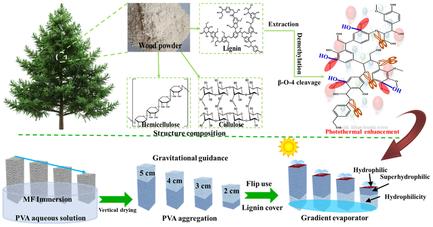
Developing sustainable solar-driven evaporators requires efficient photothermal materials and rational structural design. This study presents a green strategy for extracting lignin with enhanced photothermal performance from wood using molten salt hydrate (MSH) and citric acid under mild conditions. Systematic investigations reveal that elevated reaction temperatures (170 °C) promoted lignin depolymerization (Mw = 1206) and increased phenolic hydroxyl content (3.5 mmol g−1), enhancing π-π stacking interactions to achieve a photothermal conversion efficiency of 36.31%. Structural analyses through 2D-HSQC NMR confirm βO4 bond cleavage and demethylation, while fluorescence quenching validates reduced radiative losses. Leveraging this lignin, a gradient evaporator is fabricated by integrating polyvinyl alcohol (PVA)-modified melamine foam (MF) with a hydrophobic lignin-polyvinylidene fluoride (PVDF) photothermal layer. The evaporator exhibits hierarchical wettability, enabling gravity-guided water transport. It demonstrates robust performance in hypersaline water (1.85 kg m−2 h−1 for 10.5 wt.% brine) and dye removal (>99.98% rejection) under 0.1 W cm−2 sun irradiation and environmental heat harvesting. Additionally, lignin-coated thermoelectric devices generate stable power (27.69 W m−2) by solar-thermal conversion. This work provides an eco-friendly pathway for lignin valorization and scalable solar evaporation systems, addressing energy-water challenges through biomass resource utilization.
期刊介绍:
ChemSusChem
Impact Factor (2016): 7.226
Scope:
Interdisciplinary journal
Focuses on research at the interface of chemistry and sustainability
Features the best research on sustainability and energy
Areas Covered:
Chemistry
Materials Science
Chemical Engineering
Biotechnology





 京公网安备 11010802042870号
京ICP备2023020795号-1
京公网安备 11010802042870号
京ICP备2023020795号-1

 分享
分享
 求助内容:
求助内容: 应助结果提醒方式:
 扫码关注我们
