Shun Gao , Yanna Jia , Feifei Cui , Junlin Xu , Yajie Meng , Leyi Wei , Qingchen Zhang , Quan Zou , Zilong Zhang
{"title":"PLPTP: A Motif-based Interpretable Deep Learning Framework Based on Protein Language Models for Peptide Toxicity Prediction","authors":"Shun Gao , Yanna Jia , Feifei Cui , Junlin Xu , Yajie Meng , Leyi Wei , Qingchen Zhang , Quan Zou , Zilong Zhang","doi":"10.1016/j.jmb.2025.169115","DOIUrl":null,"url":null,"abstract":"<div><div>Peptide toxicity prediction holds significant importance in drug development and biotechnology, as accurately identifying toxic peptide sequences is crucial for designing safer peptide-based drugs. This study proposes a deep learning-based model for peptide toxicity prediction, integrating Evolutionary Scale Modeling (ESM2), Bidirectional Long Short-Term Memory (BiLSTM), and Deep Neural Network (DNN). The ESM2 model captures evolutionary information from peptide sequences, providing a rich context for the sequences; the BiLSTM network focuses on extracting contextual dependencies, thereby capturing long-range dependencies within the sequence; and the DNN further classifies the extracted features to achieve the final toxicity prediction. To enhance the reliability and transparency of the model, we also conducted motif analysis to identify key patterns in the data, which helps to explain the model’s attention mechanism and its classification performance. To address the class imbalance in the dataset, we employed Focal Loss as the loss function, which enhances the model’s ability to identify minority class samples by reducing the contribution of easily classified samples. Experimental results demonstrate that the proposed model performs exceptionally well across multiple evaluation metrics, particularly in handling imbalanced data, achieving significant improvements over traditional methods. This result highlights the model’s potential to improve the accuracy of peptide toxicity prediction and its valuable role in drug development and biotechnology research. The PLPTP web server is available at <span><span>https://www.bioai-lab.com/PLPTP</span><svg><path></path></svg></span>.</div></div>","PeriodicalId":369,"journal":{"name":"Journal of Molecular Biology","volume":"437 12","pages":"Article 169115"},"PeriodicalIF":4.5000,"publicationDate":"2025-06-15","publicationTypes":"Journal Article","fieldsOfStudy":null,"isOpenAccess":false,"openAccessPdf":"","citationCount":"0","resultStr":null,"platform":"Semanticscholar","paperid":null,"PeriodicalName":"Journal of Molecular Biology","FirstCategoryId":"99","ListUrlMain":"https://www.sciencedirect.com/science/article/pii/S0022283625001810","RegionNum":2,"RegionCategory":"生物学","ArticlePicture":[],"TitleCN":null,"AbstractTextCN":null,"PMCID":null,"EPubDate":"2025/3/28 0:00:00","PubModel":"Epub","JCR":"Q1","JCRName":"BIOCHEMISTRY & MOLECULAR BIOLOGY","Score":null,"Total":0}
引用次数: 0
Abstract
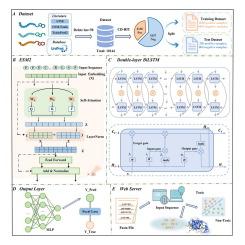
Peptide toxicity prediction holds significant importance in drug development and biotechnology, as accurately identifying toxic peptide sequences is crucial for designing safer peptide-based drugs. This study proposes a deep learning-based model for peptide toxicity prediction, integrating Evolutionary Scale Modeling (ESM2), Bidirectional Long Short-Term Memory (BiLSTM), and Deep Neural Network (DNN). The ESM2 model captures evolutionary information from peptide sequences, providing a rich context for the sequences; the BiLSTM network focuses on extracting contextual dependencies, thereby capturing long-range dependencies within the sequence; and the DNN further classifies the extracted features to achieve the final toxicity prediction. To enhance the reliability and transparency of the model, we also conducted motif analysis to identify key patterns in the data, which helps to explain the model’s attention mechanism and its classification performance. To address the class imbalance in the dataset, we employed Focal Loss as the loss function, which enhances the model’s ability to identify minority class samples by reducing the contribution of easily classified samples. Experimental results demonstrate that the proposed model performs exceptionally well across multiple evaluation metrics, particularly in handling imbalanced data, achieving significant improvements over traditional methods. This result highlights the model’s potential to improve the accuracy of peptide toxicity prediction and its valuable role in drug development and biotechnology research. The PLPTP web server is available at https://www.bioai-lab.com/PLPTP.
期刊介绍:
Journal of Molecular Biology (JMB) provides high quality, comprehensive and broad coverage in all areas of molecular biology. The journal publishes original scientific research papers that provide mechanistic and functional insights and report a significant advance to the field. The journal encourages the submission of multidisciplinary studies that use complementary experimental and computational approaches to address challenging biological questions.
Research areas include but are not limited to: Biomolecular interactions, signaling networks, systems biology; Cell cycle, cell growth, cell differentiation; Cell death, autophagy; Cell signaling and regulation; Chemical biology; Computational biology, in combination with experimental studies; DNA replication, repair, and recombination; Development, regenerative biology, mechanistic and functional studies of stem cells; Epigenetics, chromatin structure and function; Gene expression; Membrane processes, cell surface proteins and cell-cell interactions; Methodological advances, both experimental and theoretical, including databases; Microbiology, virology, and interactions with the host or environment; Microbiota mechanistic and functional studies; Nuclear organization; Post-translational modifications, proteomics; Processing and function of biologically important macromolecules and complexes; Molecular basis of disease; RNA processing, structure and functions of non-coding RNAs, transcription; Sorting, spatiotemporal organization, trafficking; Structural biology; Synthetic biology; Translation, protein folding, chaperones, protein degradation and quality control.



 京公网安备 11010802042870号
京ICP备2023020795号-1
京公网安备 11010802042870号
京ICP备2023020795号-1

 分享
分享
 求助内容:
求助内容: 应助结果提醒方式:
 扫码关注我们
