Kyle D. Berger , Anees M.K. Puthenpeedikakkal , David H. Mathews , Dragony Fu
{"title":"Structural Impact of 3-methylcytosine Modification on the Anticodon Stem-loop of a Neuronally-enriched Arginine tRNA","authors":"Kyle D. Berger , Anees M.K. Puthenpeedikakkal , David H. Mathews , Dragony Fu","doi":"10.1016/j.jmb.2025.169096","DOIUrl":null,"url":null,"abstract":"<div><div>All tRNAs undergo a series of chemical modifications to fold and function correctly. In mammals, the C32 nucleotide in the anticodon loop of tRNA-Arg-CCU and UCU is methylated to form 3-methylcytosine (m3C). Deficiency of m3C in arginine tRNAs has been linked to human neurodevelopmental disorders, indicating a critical biological role for m3C modification. However, the structural repercussions of m3C modification are not well understood. Here, we examine the structural effects of m3C32 modification on the anticodon stem loop (ASL) of human tRNA-Arg-UCU-4-1, a unique tRNA with enriched expression in the central nervous system. Optical melting experiments demonstrate that m3C modification can locally disrupt nearby base pairing within the ASL while simultaneously stabilizing the ASL electrostatically, resulting in little net change thermodynamically. The isoenergetic nature of the C32–A38 pair versus the m3C32–A38 pair may help discriminate against structures not adopting canonical C32–A38 pairings, as most other m3C pairings are unfavorable. Furthermore, multidimensional NMR reveals that after m3C modification there are changes in hairpin loop structure and dynamics, the structure of A37, and the neighboring A31–U39 base pair. However, these structural changes after modification are made while maintaining the shape of the C32–A38 pairing, which is essential for efficient tRNA function in translation. These findings suggest that m3C32 modification could alter interactions of tRNA-Arg isodecoders with one or more binding partners while simultaneously maintaining the tRNA’s ability to function in translation.</div></div>","PeriodicalId":369,"journal":{"name":"Journal of Molecular Biology","volume":"437 16","pages":"Article 169096"},"PeriodicalIF":4.5000,"publicationDate":"2025-08-15","publicationTypes":"Journal Article","fieldsOfStudy":null,"isOpenAccess":false,"openAccessPdf":"","citationCount":"0","resultStr":null,"platform":"Semanticscholar","paperid":null,"PeriodicalName":"Journal of Molecular Biology","FirstCategoryId":"99","ListUrlMain":"https://www.sciencedirect.com/science/article/pii/S0022283625001627","RegionNum":2,"RegionCategory":"生物学","ArticlePicture":[],"TitleCN":null,"AbstractTextCN":null,"PMCID":null,"EPubDate":"2025/3/29 0:00:00","PubModel":"Epub","JCR":"Q1","JCRName":"BIOCHEMISTRY & MOLECULAR BIOLOGY","Score":null,"Total":0}
引用次数: 0
Abstract
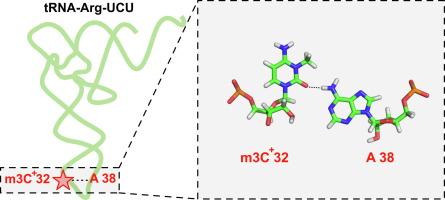
All tRNAs undergo a series of chemical modifications to fold and function correctly. In mammals, the C32 nucleotide in the anticodon loop of tRNA-Arg-CCU and UCU is methylated to form 3-methylcytosine (m3C). Deficiency of m3C in arginine tRNAs has been linked to human neurodevelopmental disorders, indicating a critical biological role for m3C modification. However, the structural repercussions of m3C modification are not well understood. Here, we examine the structural effects of m3C32 modification on the anticodon stem loop (ASL) of human tRNA-Arg-UCU-4-1, a unique tRNA with enriched expression in the central nervous system. Optical melting experiments demonstrate that m3C modification can locally disrupt nearby base pairing within the ASL while simultaneously stabilizing the ASL electrostatically, resulting in little net change thermodynamically. The isoenergetic nature of the C32–A38 pair versus the m3C32–A38 pair may help discriminate against structures not adopting canonical C32–A38 pairings, as most other m3C pairings are unfavorable. Furthermore, multidimensional NMR reveals that after m3C modification there are changes in hairpin loop structure and dynamics, the structure of A37, and the neighboring A31–U39 base pair. However, these structural changes after modification are made while maintaining the shape of the C32–A38 pairing, which is essential for efficient tRNA function in translation. These findings suggest that m3C32 modification could alter interactions of tRNA-Arg isodecoders with one or more binding partners while simultaneously maintaining the tRNA’s ability to function in translation.
期刊介绍:
Journal of Molecular Biology (JMB) provides high quality, comprehensive and broad coverage in all areas of molecular biology. The journal publishes original scientific research papers that provide mechanistic and functional insights and report a significant advance to the field. The journal encourages the submission of multidisciplinary studies that use complementary experimental and computational approaches to address challenging biological questions.
Research areas include but are not limited to: Biomolecular interactions, signaling networks, systems biology; Cell cycle, cell growth, cell differentiation; Cell death, autophagy; Cell signaling and regulation; Chemical biology; Computational biology, in combination with experimental studies; DNA replication, repair, and recombination; Development, regenerative biology, mechanistic and functional studies of stem cells; Epigenetics, chromatin structure and function; Gene expression; Membrane processes, cell surface proteins and cell-cell interactions; Methodological advances, both experimental and theoretical, including databases; Microbiology, virology, and interactions with the host or environment; Microbiota mechanistic and functional studies; Nuclear organization; Post-translational modifications, proteomics; Processing and function of biologically important macromolecules and complexes; Molecular basis of disease; RNA processing, structure and functions of non-coding RNAs, transcription; Sorting, spatiotemporal organization, trafficking; Structural biology; Synthetic biology; Translation, protein folding, chaperones, protein degradation and quality control.



 京公网安备 11010802042870号
京ICP备2023020795号-1
京公网安备 11010802042870号
京ICP备2023020795号-1

 分享
分享
 求助内容:
求助内容: 应助结果提醒方式:
 扫码关注我们
