{"title":"Vagal nerve activity and cancer prognosis: a systematic review and meta-analysis.","authors":"Wen-Bo Huang, Heng-Zhou Lai, Jing Long, Qiong Ma, Xi Fu, Feng-Ming You, Chong Xiao","doi":"10.1186/s12885-025-13956-w","DOIUrl":null,"url":null,"abstract":"<p><strong>Background: </strong>The prognostic significance of vagal nerve (VN) activity, as measured by heart rate variability (HRV) in cancer patients remains a subject of debate. The aim of this meta-analysis was to evaluate the association between various HRV parameters and cancer prognosis.</p><p><strong>Methods: </strong>We conducted an extensive search of the PubMed, Embase, Cochrane, and Web of Science databases and compared the overall survival (OS) of cancer patients with high and low HRV. The data type was unadjusted hazard ratio (HR). Random or fixed-effects models were used to calculate the pooled HR along with the 95% Confidence Interval (CI). We used funnel plot analysis to evaluate potential publication bias.</p><p><strong>Results: </strong>A total of 11 cohort studies were included with 2539 participants. The methodological quality of the included studies is generally high. Compared with low standard deviation of normal-to-normal intervals (SDNN) group, higher SDNN was a protective factor for OS in patients with cancer (I<sup>2</sup> = 66%, HR = 0.59, 95% CI: 0.46-0.75, P < 0.0001). Compared with low root mean square of successive differences (RMSSD) group. The prognostic value of RMSSD did not reach statistical significance (I<sup>2</sup> = 0%, HR = 0.85, 95% CI: 0.70-1.03, P = 0.11). Among the frequency domain indicators, higher high-frequency power HRV (HF-HRV) and low-frequency power HRV (LF-HRV) were associated with significantly longer overall survival compared to the low HF-HRV and LF-HRV groups (I<sup>2</sup> = 6%, HR = 0.59, 95% CI: 0.43-0.80, P = 0.006 and I<sup>2</sup> = 74%, HR = 0.45, 95% CI: 0.22-0.93, P = 0.03). In the nonlinear indicators, higher maximal diagonal line length (Lmax), mean diagonal line length (Lmean), percent of recurrence (REC), and determinism (DET) were associated with poorer tumor OS. The funnel plot shows that there is no publication bias in the study.</p><p><strong>Conclusions: </strong>The findings of this study demonstrate that HRV parameters, particularly SDNN, HF-HRV, and nonlinear indices, exhibit predictive value for prognosis in cancer. Furthermore, it can be inferred that elevated VN activity may predict prolonged survival outcomes. However, these findings should be interpreted with caution due to the heterogeneity observed across included studies. Future research should prioritize prospective studies with standardized measurement protocols to validate these associations.</p>","PeriodicalId":9131,"journal":{"name":"BMC Cancer","volume":"25 1","pages":"579"},"PeriodicalIF":3.4000,"publicationDate":"2025-03-31","publicationTypes":"Journal Article","fieldsOfStudy":null,"isOpenAccess":false,"openAccessPdf":"https://www.ncbi.nlm.nih.gov/pmc/articles/PMC11960028/pdf/","citationCount":"0","resultStr":null,"platform":"Semanticscholar","paperid":null,"PeriodicalName":"BMC Cancer","FirstCategoryId":"3","ListUrlMain":"https://doi.org/10.1186/s12885-025-13956-w","RegionNum":2,"RegionCategory":"医学","ArticlePicture":[],"TitleCN":null,"AbstractTextCN":null,"PMCID":null,"EPubDate":"","PubModel":"","JCR":"Q2","JCRName":"ONCOLOGY","Score":null,"Total":0}
引用次数: 0
Abstract
Background: The prognostic significance of vagal nerve (VN) activity, as measured by heart rate variability (HRV) in cancer patients remains a subject of debate. The aim of this meta-analysis was to evaluate the association between various HRV parameters and cancer prognosis.
Methods: We conducted an extensive search of the PubMed, Embase, Cochrane, and Web of Science databases and compared the overall survival (OS) of cancer patients with high and low HRV. The data type was unadjusted hazard ratio (HR). Random or fixed-effects models were used to calculate the pooled HR along with the 95% Confidence Interval (CI). We used funnel plot analysis to evaluate potential publication bias.
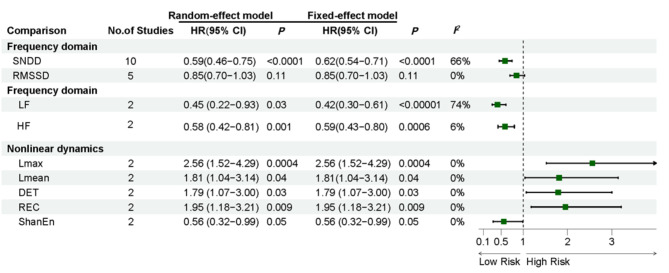
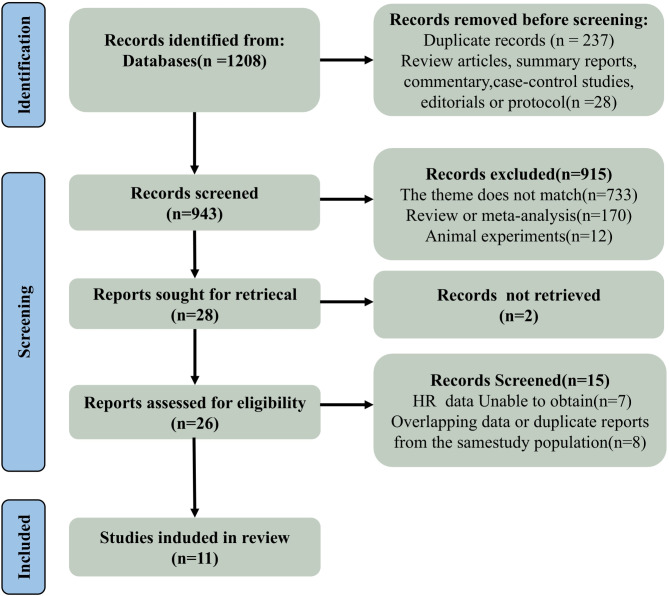
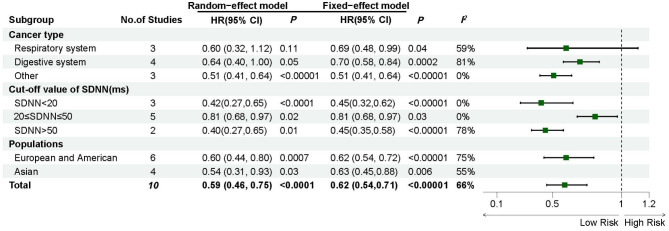
Results: A total of 11 cohort studies were included with 2539 participants. The methodological quality of the included studies is generally high. Compared with low standard deviation of normal-to-normal intervals (SDNN) group, higher SDNN was a protective factor for OS in patients with cancer (I2 = 66%, HR = 0.59, 95% CI: 0.46-0.75, P < 0.0001). Compared with low root mean square of successive differences (RMSSD) group. The prognostic value of RMSSD did not reach statistical significance (I2 = 0%, HR = 0.85, 95% CI: 0.70-1.03, P = 0.11). Among the frequency domain indicators, higher high-frequency power HRV (HF-HRV) and low-frequency power HRV (LF-HRV) were associated with significantly longer overall survival compared to the low HF-HRV and LF-HRV groups (I2 = 6%, HR = 0.59, 95% CI: 0.43-0.80, P = 0.006 and I2 = 74%, HR = 0.45, 95% CI: 0.22-0.93, P = 0.03). In the nonlinear indicators, higher maximal diagonal line length (Lmax), mean diagonal line length (Lmean), percent of recurrence (REC), and determinism (DET) were associated with poorer tumor OS. The funnel plot shows that there is no publication bias in the study.
Conclusions: The findings of this study demonstrate that HRV parameters, particularly SDNN, HF-HRV, and nonlinear indices, exhibit predictive value for prognosis in cancer. Furthermore, it can be inferred that elevated VN activity may predict prolonged survival outcomes. However, these findings should be interpreted with caution due to the heterogeneity observed across included studies. Future research should prioritize prospective studies with standardized measurement protocols to validate these associations.
期刊介绍:
BMC Cancer is an open access, peer-reviewed journal that considers articles on all aspects of cancer research, including the pathophysiology, prevention, diagnosis and treatment of cancers. The journal welcomes submissions concerning molecular and cellular biology, genetics, epidemiology, and clinical trials.





 京公网安备 11010802042870号
京ICP备2023020795号-1
京公网安备 11010802042870号
京ICP备2023020795号-1

 分享
分享
 求助内容:
求助内容: 应助结果提醒方式:
 扫码关注我们
