"Sepsis brought him to his knees": exploring the lived experiences and perspectives of sepsis survivors and family members to inform a sepsis public education campaign in Canada.
Jeanna Parsons Leigh, Rebecca Brundin-Mather, Deirdre Walsh, Sara J Mizen, Cynthia Sriskandarajah, Marie-Maxime Bergeron, Denise E Werner, Kirsten M Fiest
{"title":"\"Sepsis brought him to his knees\": exploring the lived experiences and perspectives of sepsis survivors and family members to inform a sepsis public education campaign in Canada.","authors":"Jeanna Parsons Leigh, Rebecca Brundin-Mather, Deirdre Walsh, Sara J Mizen, Cynthia Sriskandarajah, Marie-Maxime Bergeron, Denise E Werner, Kirsten M Fiest","doi":"10.1186/s12889-025-22344-9","DOIUrl":null,"url":null,"abstract":"<p><strong>Background: </strong>Sepsis is a life-threatening complication of the body's response to fighting an infection. The global burden of sepsis is incredibly high, accounting for an estimated 20% percent of all global deaths as well as high hospitalization costs and long-term multifaceted sequelae. As most sepsis starts in the community, public knowledge of sepsis is essential to rapid identification and medical intervention. The current study is part of multi-study collaborative research program. Following a scoping review and national survey to assess public knowledge of sepsis, we conducted focus groups to explore the lived experiences and perspectives of sepsis survivors and family members with the goal to inform development of a sepsis public education campaign.</p><p><strong>Methods: </strong>We co-designed a focus group guide covering three broad discussion topics: circumstances leading to sepsis, impacts of sepsis, and interactions with healthcare providers. Participants were purposively recruited through the previous national survey and through Sepsis Canada communications. We used a hybrid deductive-inductive approach to code transcripts and generate themes related to developing a sepsis public education campaign.</p><p><strong>Results: </strong>We conducted 11 focus groups with 32 participants. Participants' median age was 53 years (Interquartile Range = 48, 64). Three-quarters (n = 23/32; 72%) self-identified as women, and all participants reported having some post-secondary education. All but one sepsis survivor were adults at the time of their diagnosis. We synthesized three overarching campaign messages from participant's accounts of profound physical and mental impacts of sepsis and perceptions of health system failures: (1) sepsis is serious and common, (2) know the signs of sepsis, and (3) be health attentive and advocate health needs. Potential barriers to message uptake were: (1) sepsis is not well-known or easily understood, (2) perceptions that sepsis is not personally relevant, and (3) health messaging fatigue. Suggestions to effectively hook and draw public attention to sepsis centered on using personal stories and partnering with other health campaigns.</p><p><strong>Conclusions: </strong>Our analysis of participant's lived experiences with sepsis suggest that public communications should aim to (1) improve sepsis symptom recognition, (2) foster perceptions that sepsis is personally relevant, and (3) cultivate and support health advocacy.</p>","PeriodicalId":9039,"journal":{"name":"BMC Public Health","volume":"25 1","pages":"1211"},"PeriodicalIF":3.6000,"publicationDate":"2025-03-31","publicationTypes":"Journal Article","fieldsOfStudy":null,"isOpenAccess":false,"openAccessPdf":"https://www.ncbi.nlm.nih.gov/pmc/articles/PMC11956199/pdf/","citationCount":"0","resultStr":null,"platform":"Semanticscholar","paperid":null,"PeriodicalName":"BMC Public Health","FirstCategoryId":"3","ListUrlMain":"https://doi.org/10.1186/s12889-025-22344-9","RegionNum":2,"RegionCategory":"医学","ArticlePicture":[],"TitleCN":null,"AbstractTextCN":null,"PMCID":null,"EPubDate":"","PubModel":"","JCR":"Q1","JCRName":"PUBLIC, ENVIRONMENTAL & OCCUPATIONAL HEALTH","Score":null,"Total":0}
引用次数: 0
Abstract
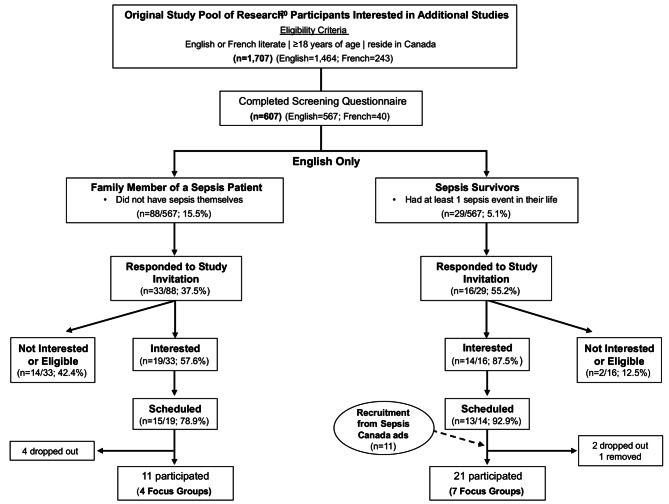
Background: Sepsis is a life-threatening complication of the body's response to fighting an infection. The global burden of sepsis is incredibly high, accounting for an estimated 20% percent of all global deaths as well as high hospitalization costs and long-term multifaceted sequelae. As most sepsis starts in the community, public knowledge of sepsis is essential to rapid identification and medical intervention. The current study is part of multi-study collaborative research program. Following a scoping review and national survey to assess public knowledge of sepsis, we conducted focus groups to explore the lived experiences and perspectives of sepsis survivors and family members with the goal to inform development of a sepsis public education campaign.
Methods: We co-designed a focus group guide covering three broad discussion topics: circumstances leading to sepsis, impacts of sepsis, and interactions with healthcare providers. Participants were purposively recruited through the previous national survey and through Sepsis Canada communications. We used a hybrid deductive-inductive approach to code transcripts and generate themes related to developing a sepsis public education campaign.
Results: We conducted 11 focus groups with 32 participants. Participants' median age was 53 years (Interquartile Range = 48, 64). Three-quarters (n = 23/32; 72%) self-identified as women, and all participants reported having some post-secondary education. All but one sepsis survivor were adults at the time of their diagnosis. We synthesized three overarching campaign messages from participant's accounts of profound physical and mental impacts of sepsis and perceptions of health system failures: (1) sepsis is serious and common, (2) know the signs of sepsis, and (3) be health attentive and advocate health needs. Potential barriers to message uptake were: (1) sepsis is not well-known or easily understood, (2) perceptions that sepsis is not personally relevant, and (3) health messaging fatigue. Suggestions to effectively hook and draw public attention to sepsis centered on using personal stories and partnering with other health campaigns.
Conclusions: Our analysis of participant's lived experiences with sepsis suggest that public communications should aim to (1) improve sepsis symptom recognition, (2) foster perceptions that sepsis is personally relevant, and (3) cultivate and support health advocacy.
期刊介绍:
BMC Public Health is an open access, peer-reviewed journal that considers articles on the epidemiology of disease and the understanding of all aspects of public health. The journal has a special focus on the social determinants of health, the environmental, behavioral, and occupational correlates of health and disease, and the impact of health policies, practices and interventions on the community.



 京公网安备 11010802042870号
京ICP备2023020795号-1
京公网安备 11010802042870号
京ICP备2023020795号-1

 分享
分享
 求助内容:
求助内容: 应助结果提醒方式:
 扫码关注我们
