Paul P Dobesh, Albert A Volkl, Ákos Ferenc Pap, C V Damaraju, Bennett Levitan, Zhong Yuan, Alpesh N Amin
{"title":"Benefit-Risk Assessment of Rivaroxaban in Older Patients With Nonvalvular Atrial Fibrillation or Venous Thromboembolism.","authors":"Paul P Dobesh, Albert A Volkl, Ákos Ferenc Pap, C V Damaraju, Bennett Levitan, Zhong Yuan, Alpesh N Amin","doi":"10.1007/s40266-025-01192-7","DOIUrl":null,"url":null,"abstract":"<p><strong>Background: </strong>Both bleeding and adverse ischemic events increase with age, compounding the benefit-risk balance of anticoagulants in older patients. We present analyses using benefit-risk methods to better understand the age-dependence of the benefit-risk profile of rivaroxaban in patients with nonvalvular atrial fibrillation (NVAF) or venous thromboembolism (VTE).</p><p><strong>Methods: </strong>Randomized controlled trial data from the ROCKET-AF (NVAF) and EINSTEIN DVT, EINSTEIN PE, EINSTEIN-Extension, and EINSTEIN CHOICE in (VTE) were used. For ROCKET-AF, benefits and risks were assessed with incidence rates for key thrombotic and bleeding endpoints and a net clinical benefit (NCB) measure. Cumulative incidences (estimated by the Kaplan-Meier method) were estimated at day 185 for EINSTEIN and EINSTEIN Extension and 1 year for EINSTEIN CHOICE. Incidence differences were calculated for the overall population and age subgroups of < 65, 65-75, and > 75 years.</p><p><strong>Results: </strong>In ROCKET-AF, rate differences in the composite NCB outcome (vascular death, stroke, myocardial infarction, fatal bleeding, critical organ bleeding, and non-CNS systemic embolism) favored rivaroxaban overall and by age < 65, 65-75, and > 75 years (-84, -25, -61, and -150 cases per 10,000 patient-years, respectively). In the pooled EINSTEIN DVT and EINSTEIN PE studies, cumulative incidence differences for the composite NCB outcome (recurrent VTE and major bleeding) were -103, 3, -105, and -544 per 10,000 patients, respectively. For extended VTE treatment with rivaroxaban versus placebo in EINSTEIN-Extension, NCB results were -536, -492, -556, and -601 per 10,000 patients, respectively. In the EINSTEIN CHOICE analysis, NCB favored rivaroxaban 20 mg versus aspirin (-284, -255, -339, and -338, respectively) and rivaroxaban 10 mg versus aspirin (-339, -328, -485, and -80, respectively).</p><p><strong>Conclusions: </strong>This analysis demonstrated a positive benefit-risk profile with rivaroxaban versus trial comparators in older patients with NVAF or VTE, with benefit-risk increasingly favoring rivaroxaban with increasing age.</p><p><strong>Clinical trial registration: </strong>http://ClinicalTrials.gov , identifiers: NCT00403767 (ROCKET-AF), NCT00440193 (EINSTEIN DVT), NCT00439777 (EINSTEIN PE), NCT00439725 (EINSTEIN Extension), and NCT02064439 (EINSTEIN CHOICE).</p>","PeriodicalId":11489,"journal":{"name":"Drugs & Aging","volume":" ","pages":"469-484"},"PeriodicalIF":3.8000,"publicationDate":"2025-05-01","publicationTypes":"Journal Article","fieldsOfStudy":null,"isOpenAccess":false,"openAccessPdf":"https://www.ncbi.nlm.nih.gov/pmc/articles/PMC12053352/pdf/","citationCount":"0","resultStr":null,"platform":"Semanticscholar","paperid":null,"PeriodicalName":"Drugs & Aging","FirstCategoryId":"3","ListUrlMain":"https://doi.org/10.1007/s40266-025-01192-7","RegionNum":3,"RegionCategory":"医学","ArticlePicture":[],"TitleCN":null,"AbstractTextCN":null,"PMCID":null,"EPubDate":"2025/3/31 0:00:00","PubModel":"Epub","JCR":"Q2","JCRName":"GERIATRICS & GERONTOLOGY","Score":null,"Total":0}
引用次数: 0
Abstract
Background: Both bleeding and adverse ischemic events increase with age, compounding the benefit-risk balance of anticoagulants in older patients. We present analyses using benefit-risk methods to better understand the age-dependence of the benefit-risk profile of rivaroxaban in patients with nonvalvular atrial fibrillation (NVAF) or venous thromboembolism (VTE).
Methods: Randomized controlled trial data from the ROCKET-AF (NVAF) and EINSTEIN DVT, EINSTEIN PE, EINSTEIN-Extension, and EINSTEIN CHOICE in (VTE) were used. For ROCKET-AF, benefits and risks were assessed with incidence rates for key thrombotic and bleeding endpoints and a net clinical benefit (NCB) measure. Cumulative incidences (estimated by the Kaplan-Meier method) were estimated at day 185 for EINSTEIN and EINSTEIN Extension and 1 year for EINSTEIN CHOICE. Incidence differences were calculated for the overall population and age subgroups of < 65, 65-75, and > 75 years.
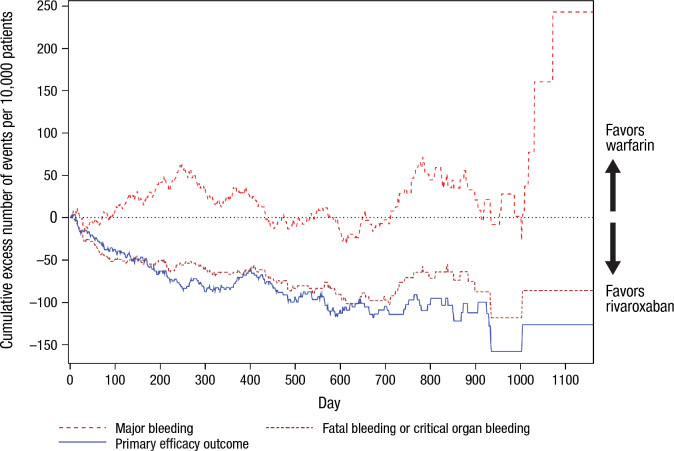
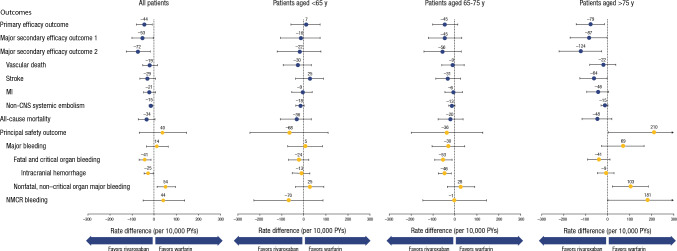
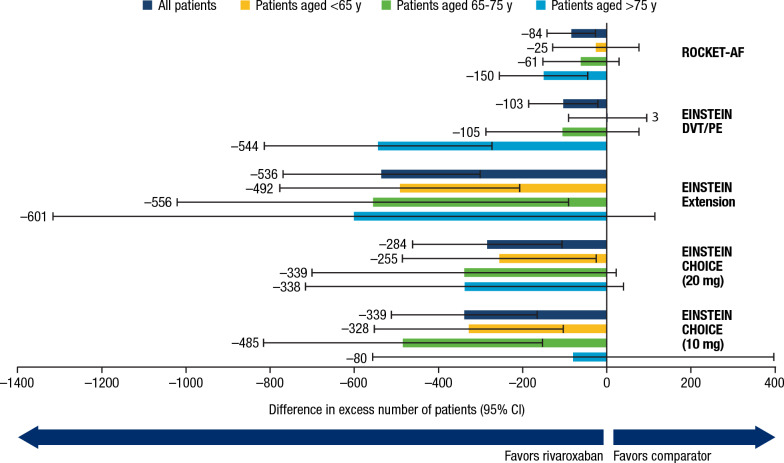
Results: In ROCKET-AF, rate differences in the composite NCB outcome (vascular death, stroke, myocardial infarction, fatal bleeding, critical organ bleeding, and non-CNS systemic embolism) favored rivaroxaban overall and by age < 65, 65-75, and > 75 years (-84, -25, -61, and -150 cases per 10,000 patient-years, respectively). In the pooled EINSTEIN DVT and EINSTEIN PE studies, cumulative incidence differences for the composite NCB outcome (recurrent VTE and major bleeding) were -103, 3, -105, and -544 per 10,000 patients, respectively. For extended VTE treatment with rivaroxaban versus placebo in EINSTEIN-Extension, NCB results were -536, -492, -556, and -601 per 10,000 patients, respectively. In the EINSTEIN CHOICE analysis, NCB favored rivaroxaban 20 mg versus aspirin (-284, -255, -339, and -338, respectively) and rivaroxaban 10 mg versus aspirin (-339, -328, -485, and -80, respectively).
Conclusions: This analysis demonstrated a positive benefit-risk profile with rivaroxaban versus trial comparators in older patients with NVAF or VTE, with benefit-risk increasingly favoring rivaroxaban with increasing age.
期刊介绍:
Drugs & Aging delivers essential information on the most important aspects of drug therapy to professionals involved in the care of the elderly.
The journal addresses in a timely way the major issues relating to drug therapy in older adults including: the management of specific diseases, particularly those associated with aging, age-related physiological changes impacting drug therapy, drug utilization and prescribing in the elderly, polypharmacy and drug interactions.




 京公网安备 11010802042870号
京ICP备2023020795号-1
京公网安备 11010802042870号
京ICP备2023020795号-1

 分享
分享
 求助内容:
求助内容: 应助结果提醒方式:
 扫码关注我们
