Luke Zerwic, Ashray Mohan, Emily Riley, Connor Byeman, Ravi Ashwath
{"title":"The impact of 3D printed vs. 3D virtual congenital heart models on patient and family knowledge.","authors":"Luke Zerwic, Ashray Mohan, Emily Riley, Connor Byeman, Ravi Ashwath","doi":"10.3389/fped.2025.1525549","DOIUrl":null,"url":null,"abstract":"<p><strong>Introduction: </strong>Congenital heart defects (CHDs) often involve complex anatomical structures that can be challenging for patients and their families to understand. While physicians utilize various imaging techniques such as cardiac echocardiograms, CT scans, and MRIs to comprehend these complexities, the information is typically conveyed to patients and families through two-dimensional (2D) images and drawings. Traditional methods often fail to fully capture the intricate nature of CHDs. This study compared the effectiveness of 2D imaging with three-dimensional (3D) virtual and 3D printed models in enhancing the understanding of CHDs among patients and their families.</p><p><strong>Methods: </strong>Family members of patients with congenital heart disease, as well as patients aged 15 years or older, were recruited for the study. Participants were presented with an echocardiogram of their specific cardiac defect alongside an echocardiogram of a structurally normal heart for comparison. They were then randomly assigned to receive education using a 3D printed model or a 3D virtual model of their heart defect. Participants' knowledge of normal cardiac anatomy and the anatomy of their specific cardiac defect was assessed after viewing the echocardiogram (2D image) and again after reviewing the 3D models.</p><p><strong>Results: </strong>One-hundred-nine subjects participated in the study, comprising 79 family members (72.5%) and 30 patients (27.5%). Subjects showed significant improvement in their understanding of normal cardiac anatomy with both 3D printed and 3D virtual models compared to the 2D image (<i>p</i> = 0.022 and <i>p</i> = 0.012, respectively). Among the subjects, 70% in the 3D printed group and 84% in the 3D virtual group indicated a preference for the 3D models over the 2D image. Both the 3D printed, and 3D virtual model groups rated themselves as having an increased understanding of normal cardiac anatomy compared to the 2D images (<i>p</i> = 0.009 and <i>p</i> < 0.001, respectively).</p><p><strong>Discussion: </strong>These findings suggest that incorporating 3D models into the educational process for patients with congenital heart disease can lead to improved comprehension and greater satisfaction.</p>","PeriodicalId":12637,"journal":{"name":"Frontiers in Pediatrics","volume":"13 ","pages":"1525549"},"PeriodicalIF":2.0000,"publicationDate":"2025-03-14","publicationTypes":"Journal Article","fieldsOfStudy":null,"isOpenAccess":false,"openAccessPdf":"https://www.ncbi.nlm.nih.gov/pmc/articles/PMC11949787/pdf/","citationCount":"0","resultStr":null,"platform":"Semanticscholar","paperid":null,"PeriodicalName":"Frontiers in Pediatrics","FirstCategoryId":"3","ListUrlMain":"https://doi.org/10.3389/fped.2025.1525549","RegionNum":3,"RegionCategory":"医学","ArticlePicture":[],"TitleCN":null,"AbstractTextCN":null,"PMCID":null,"EPubDate":"2025/1/1 0:00:00","PubModel":"eCollection","JCR":"Q2","JCRName":"PEDIATRICS","Score":null,"Total":0}
引用次数: 0
Abstract
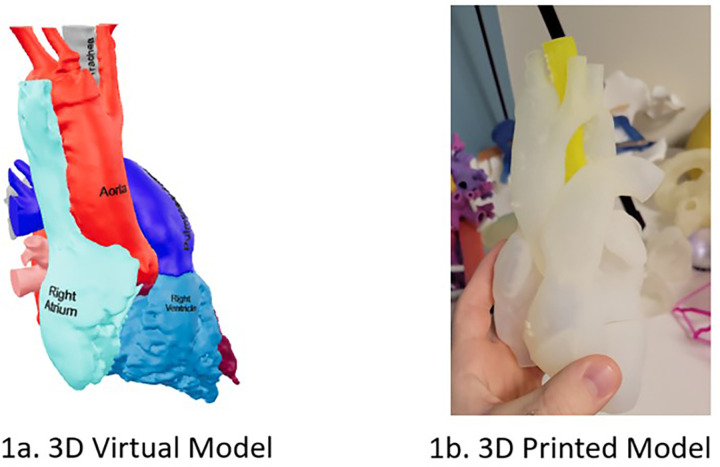
Introduction: Congenital heart defects (CHDs) often involve complex anatomical structures that can be challenging for patients and their families to understand. While physicians utilize various imaging techniques such as cardiac echocardiograms, CT scans, and MRIs to comprehend these complexities, the information is typically conveyed to patients and families through two-dimensional (2D) images and drawings. Traditional methods often fail to fully capture the intricate nature of CHDs. This study compared the effectiveness of 2D imaging with three-dimensional (3D) virtual and 3D printed models in enhancing the understanding of CHDs among patients and their families.
Methods: Family members of patients with congenital heart disease, as well as patients aged 15 years or older, were recruited for the study. Participants were presented with an echocardiogram of their specific cardiac defect alongside an echocardiogram of a structurally normal heart for comparison. They were then randomly assigned to receive education using a 3D printed model or a 3D virtual model of their heart defect. Participants' knowledge of normal cardiac anatomy and the anatomy of their specific cardiac defect was assessed after viewing the echocardiogram (2D image) and again after reviewing the 3D models.
Results: One-hundred-nine subjects participated in the study, comprising 79 family members (72.5%) and 30 patients (27.5%). Subjects showed significant improvement in their understanding of normal cardiac anatomy with both 3D printed and 3D virtual models compared to the 2D image (p = 0.022 and p = 0.012, respectively). Among the subjects, 70% in the 3D printed group and 84% in the 3D virtual group indicated a preference for the 3D models over the 2D image. Both the 3D printed, and 3D virtual model groups rated themselves as having an increased understanding of normal cardiac anatomy compared to the 2D images (p = 0.009 and p < 0.001, respectively).
Discussion: These findings suggest that incorporating 3D models into the educational process for patients with congenital heart disease can lead to improved comprehension and greater satisfaction.
期刊介绍:
Frontiers in Pediatrics (Impact Factor 2.33) publishes rigorously peer-reviewed research broadly across the field, from basic to clinical research that meets ongoing challenges in pediatric patient care and child health. Field Chief Editors Arjan Te Pas at Leiden University and Michael L. Moritz at the Children''s Hospital of Pittsburgh are supported by an outstanding Editorial Board of international experts. This multidisciplinary open-access journal is at the forefront of disseminating and communicating scientific knowledge and impactful discoveries to researchers, academics, clinicians and the public worldwide.
Frontiers in Pediatrics also features Research Topics, Frontiers special theme-focused issues managed by Guest Associate Editors, addressing important areas in pediatrics. In this fashion, Frontiers serves as an outlet to publish the broadest aspects of pediatrics in both basic and clinical research, including high-quality reviews, case reports, editorials and commentaries related to all aspects of pediatrics.



 京公网安备 11010802042870号
京ICP备2023020795号-1
京公网安备 11010802042870号
京ICP备2023020795号-1

 分享
分享
 求助内容:
求助内容: 应助结果提醒方式:
 扫码关注我们
